Op-Ed:Should US Attorney Laura Duffy Resign over Conflict?
By Steve Peace | 10/19/2012 | California, Elections 2012, Local Office | 16 Comments
Photo: Stephanie Woodrow
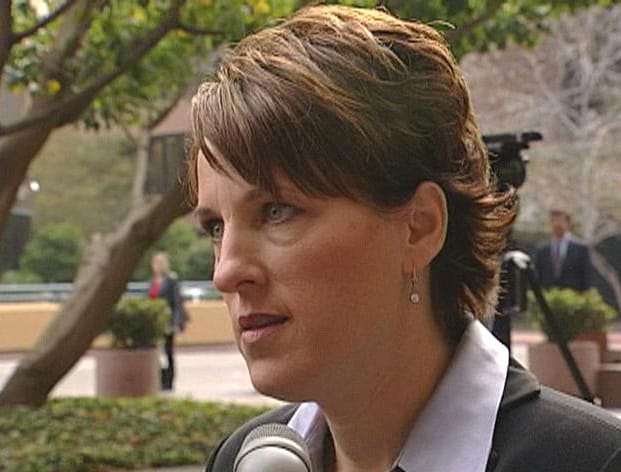
US Attorney Laura Duffy heads the Southern California Office of the Justice Department. The San Diego U-T reported that she has involved herself in the local San Diego mayoral election. In the article she described her involvement as organizing and moderating a campaign forum for the local Jewish community.
Apparently, the event got a bit testy when candidate Bob Filner strenuously objected to his opponent, Carl DeMaio’s aggressive questioning. Duffy followed up the event with an email to the DeMaio campaign “apologizing” for Filner’s conduct and characterizing the audience reaction as positive for DeMaio.
The DeMaio campaign made this email public. Duffy was quick to characterize the email as “private,” but then weighed in with additional on-the-record comments for the U-T article. Duffy’s urgency about characterizing the email as “private” is clearly borne out of her knowledge of the Hatch Act.
The Hatch Act is the Federal law prohibiting Federal employees from participating in elections. The “release” of the “private” email is a pretty transparent tactic to protect Duffy from charges that she has violated at least the spirit, if not the letter, of the Act.
But, the revelation that she also gave money to DeMaio is a smoking cannon. Laura Duffy is not just a federal employee; she is the U.S. Attorney. The issue isn’t that she violated the Hatch Act. The mayor’s race is technically nonpartisan and therefore exempt from the Hatch Act, but California now has nonpartisan Open Primaries. Meaning that, technically, the Hatch Act no longer applies to any California elections except that for President.
Yet, the U.S. Attorney’s office has, as recently as this summer, enforced the Hatch Act against an Orange County Social Services Agency employee who administered federal funds and had sought to run for office in Southern California. He was forced to withdraw, even after his name was placed on the ballot.
There is room for argument concerning rank and file federal employees and the question about how far away from the “electioneering” line they should stay. But, the U.S. Attorney has to enforce these laws. In this case, Duffy has not only crossed the line of appropriate behavior by participating in the election. She has added an element of sleaze to the story by participating in what appears to be an orchestrated leak of a “private” email clearly designed to benefit the candidate she has supported financially.
At a minimum she put herself in a position that a U.S. Attorney should know better than to be in. But, the more believable interpretation of events is even more troubling. She gave money to a candidate. She organized an event. She invited both candidates. She established the rules of the event. She moderated the event. Filner clearly began to smell a rat as the event unfolded. After the event, she initiated an email to the candidate she supports articulating a partisan view of what occurred. She participated in an interview with the local newspaper to insist that the “leaked” email was “private”, never intended for publication. But, then she kept talking.
This isn’t about who people support in a Mayor’s race. It’s not even about San Diego. I do not live in the City of San Diego. The DeMaio campaign tactic is shady, but I’m sure the Filner campaign has its share of similar efforts. That’s politics. That’s why, of all institutions, the Department of Justice simply has to keep itself miles and miles away from politics. For the U.S. Attorney to involve herself, or even get close enough to let others get her involved, is inexcusable.
In the words of the Vice President, “This is a big … uh … deal.” She should resign.


Leave Your Comment →
16 Comments
Blaz Gutierrez
10.19.2012
@blazgutierrez
This seems to be a legal grey area where the Hatch Act hasn’t caught up to the state of the law. The Act applies only to partisan elections, but the 2010 Open Primary made all CA elections (except President) non-partisan.
My understanding is that the DOJ’s interpretation leaves significant room for Duffy to face more severe consequences . That’s only based off of a DOJ advisory opinion though. Still need to have the Court’s decide this one.
Ian Dawes
10.19.2012
@iandawes
She publicly endorsed a candidate and organized an event, it sounds like a violation of the Hatch Act that you briefly describe here. Maybe some more information would be helpful to following up on this story.
Michael Higham
10.19.2012
@michaelhigham
Laura Duffy got too involved in the mayoral race, but like it was said at the conclusion, “That’s politics.” I’m sure things like this happen more often than one might think.
Alex Gauthier
10.19.2012
@alexg
Regardless of who you believe, this whole situation is sticky. Duffy really should have known better than to inject herself into the limelight here.
steve peace
10.19.2012
This from our friend Dave Maass at City Beat:
“You’re totally wrong about the Hatch Act. California’s “non-partisan” races are subject to it. Look:
Can a nonpartisan election turn into a partisan election?
Answer: State and local laws create only a rebuttable presumption that an election is nonpartisan. See Special Counsel v. Yoho, 15 M.S.P.R. 409, 413 (1983), overruled on other grounds, Special Counsel v. Purnell, 37 M.S.P.R. 184 (1988). Evidence showing that partisan politics actually enter the campaigns of the candidates may rebut this presumption. See McEntee v. Merit Sys. Prot. Bd., 404 F.3d 1320 (Fed. Cir. 2005); In re Broering, 1 P.A.R. 778, 779 (1955). For example, if a candidate solicits or advertises the endorsement of a partisan political party or uses a political party’s resources to further his or her campaign, these actions may rebut the presumption that an election is nonpartisan, and thus, indicate that the election is a partisan one. While each case is fact specific, the Board has consistently held that it is less about the title used, and more about the actions of the candidate. The general analysis is whether the candidate acted in concert with a partisan political party. See Special Counsel v. Campbell, 58 M.S.P.R. 170 (1993), aff’d, 27 F.3d 1560 (Fed. Cir. 1994); McEntee v. Merit Sys. Prot. Bd.,, 404 F.3d 1320 (Fed. Cir. 2005). “
sc_eb7ad7107f65cdbc2da9379518ad0e71
10.20.2012
@sc_eb7ad7107f65cdbc2da9379518ad0e71
Steve, you couldn’t be more right. Laura Duffy has been an embarassment to the department of justice and her role in the mayoral campaign greatly questions her ethics and ability to impartially enforce the law. While somewhat unrelated but relevant to her lack of ethics, her crusade against medical marijuana in San Diego has given the marijuana trade back to the cartels. Even the only collective permitted by all local municapilites and sanctioned by the 5-Republican board of supervisors was threatened with an asset forfeiture letter and forced to shut down. As your headline suggests, yes, Duffy needs to resign.
LaPlayaHeritage
10.20.2012
@laplayaheritage
http://www.voiceofsandiego.org/government/article_dafa4e7e-1a14-11e2-8806-001a4bcf887a.html
“Update: This came up at a mayoral debate Thursday night in Kensington. Carl DeMaio said this, trying to show the bipartisan support he’s generated (my emphasis):
“I’m supported by Mayor Jerry Sanders. I’m supported by the leading Democrat donor, Qualcomm founder Irwin Jacobs. Laura Duffy, the U.S. Attorney, donated to my campaign and today commented about her displeasure with the congressman’s temperament,” DeMaio said.”
steve peace
10.21.2012
Well, Carl told the truth. She did give him money and when she did so she was required under state law to disclose her employment. Neither the Hatch Act nor the Justice Department Policy apply to the DeMaio campaign. The DeMaio campaign had television spots already in the can attacking Filner for being erratic. They obviously set out to bait him in the debates. But, Bob took the bait. I can’t criticize the DeMaio strategy. Was Duffy in on developing the strategy? Or, did the campaign just take advantage of her involvement without her knowledge? Not sure which explanation would trouble me more. It doesn’t matter. That is the point. This not about the campaign for Mayor. It is more important than that. That is the reason for the Justice Department Policy which basically says “don’t even go close to the line” and when in doubt get an opinion from your ethics officer first. She has certainly come close to the line. Probably violated Department policy. May have actually violated the Act. Even if she did, it makes no sense to prosecute her. There are more important things for the Justice Department to focus on. But, when a leader makes a mistake of this magnitude, real leaders step down. I do not know Ms. Duffy. She probably is a talented lawyer and capable of providing great value as a public servant. But, the position she currently holds requires an extraordinary level of absolute public confidence that she can keep her office out of politics. I don’t see how she can possibly do that now going forward.
KeninSD
10.24.2012
So, she gets a pass on a very serious violation of Justice Dep’t policy? What could be more important than an honest US Attorney? Or, after eight years of the W war criminal presidency we are inured to criminals in high places? It’s no wonder our lack of respect for government is at an all time low.
Richard Gorin
10.21.2012
@jaguar943
In the wake of the Citizens United, I’m not sure that the Hatch Act has any further validity. Duffy’s prosecution of medical marijuana is an affront to California’s rights under the Tenth Amendment and I want her gone. But that’s probably a political rather than a legal decision.
Paying Attention
10.23.2012
She should have been fired. But not for her political support. Laura Duffy allowed sex trafficked children to remain sex slaves for two years while she built a case against their pimps.
http://www.nctimes.com/news/local/sdcounty/article_78336de5-09ad-570b-be27-996174a009da.html?mode=story
while Steve Peace was behind the de-regulation of California’s electricity markets.
So either way, San Diego loses.
steve peace
10.23.2012
Paying Attention,
Below is a recent piece I wrote that tells the true story of the state “energy” crisis. I told the truth. Folks chose to believe Enron instead of me. It was my failure to communicate. But, if folks had paid more attention, Enron could never have pulled the wool over their eyes.
Steve
Myth, Corruption, Cap And Trade: The Next Big Derivative Disaster
“The great enemy of the truth is very often not the lie — deliberate, contrived and dishonest, but the myth, persistent, persuasive, and unrealistic. Belief in myths allows the comfort of opinion without the discomfort of thought.” – John F. Kennedy
Steve Peace (the author is a former State Senator. He chaired the Conference Committee that produced AB1890 in 1996)
Sacramento Bee columnist, Dan Walters, mounted an interesting dismissal of the significance of political corruption in California’s Capitol on Sunday, arguing that the real problem in state government is hastiness. Those darn legislators just take on problems too quickly, embracing poorly vetted solutions of “convenience” that later backfire on the public, he suggested.
It is an important observation because it comes from the Capitol’s seminal journalist. What Mr. Walters writes has a tendency to leak into the work of his colleagues and ultimately imbed itself into Capitol lore.
The ultimate example of such hastiness, says Mr. Walters, was the unanimous passage of the Electric Deregulation Bill (AB1890) in 1996. Sometimes these myths become a barrier to “the discomfort of thought”. But this colossal myth continues to have colossal consequence.
Here are the facts:
The PUC passed a binding deregulation order (more accurately “restructuring order”) in December of 1995 after more than four years of hearings and workshops. Before adopting their final rulemaking the PUC published massive documents the proposed changes –the final two known as the “Yellow Book” and the “Blue Book”.
The Wilson administration and deregulation advocates sponsored more than a dozen electric deregulation bills in the Legislature beginning in 1992. The bills were subjected to hundreds of hours of hearings between 1992 and 1995. None of them passed.
During this period the Federal Energy Regulatory Commission (FERC) continued to pressure for deregulation and promote the notion of a transition that would include “non recovery of stranded assets” This, of course, meant that no regulated utility would build a power plant for fear that they would ultimately not be allowed to recover their investment out of “unregulated” rates.
AFTER the PUC takes its action in December of 1995 and after the legislature is advised by the Attorney General and the Legislative Counsel that the PUC did in fact have the authority to unilaterally restructure without Legislative approval. Democrats, who overwhelmingly oppose the entire concept of deregulation simply do not have the two-thirds vote necessary to override the Governor. AB1890, along with other bills, is moved to a two-house conference committee in 1996.
The Conference Committee meets for almost 200 hours over a period of six months in televised public hearings held in the Capitol’s largest hearing rooms. All six members of the Conference Committee attend all meetings and the audience averages over 100 people in attendance throughout the process.
These hearings include many days in which meetings are held twice a day. Once in the morning, and again in the evening with staff working with language in between (in the hearing room open to the public). All language is vetted in detail in publicly televised hearings, including a final word-for-word public reading of the entire document in two successive televised hearings with the entire committee and a packed room in attendance.
Only a couple of weeks into the process, Mr. Walters complains privately about these evening hearings. He is told that because the committee members also serve on other committees, and because the Chair insists that committee members actually be present at the hearings, evening hearings are necessary (in fact preferable) to assure proper attention to a complex subject. These evening hearings also bring the added benefit of attracting significantly greater “general public” participation. The Committee encourages this by allowing testimony from numerous so-called “unrepresented” members of the public. Mr. Walters generally does not attend, but presumably monitors the proceedings on television.
The final product makes no changes in the PUC’s market design, despite heavy lobbying by Enron and its allies to eliminate the proposed Power Exchange (PX) in favor of a direct “bilateral market” in which energy traders would sell directly to retail consumers. AB1890 does however make two substantive changes to the PUC order that the Governor agrees to. First, it puts in place a statutory mechanism to preserve historical programs targeted at alternative energy and poor consumers. Second, it puts in place a temporary retail rate freeze and cap on the three utility companies’ ability to recover “stranded costs” (the purpose is to protect residential and small commercial ratepayers in the transition from potential volatility created by marketers). The balance of the bill essentially mirrors the December PUC order.
The process is praised by all of the participants, and by numerous editorials throughout the state, including the San Jose Mercury, which calls the process “thorough and exhaustive.”
The package of bills passes unanimously after a lengthy floor presentation. Many legislators who had firmly established records opposing deregulation vote yes and even co-author the bill. Why? Because not passing the bill would have meant the market would still open as directed by the PUC, but without the environmental protections and without the ratepayer protections included in AB1890.
The first evidence of market manipulation efforts is reported to FERC in the fall of 1998. FERC refuses to even open an investigation. Despite these early gaming efforts — much to the chagrin of energy traders –volatility in the transparent Power Exchange remains low, and rates to consumers are running well below expectations. This holds until the summer of 2000 when energy traders and natural gas suppliers, led by Enron and Sempra Trading, execute a coordinated attack on the California Power Exchange.
FERC hears evidence that energy traders are manipulating Western Energy markets. The testimony demonstrates that California is particularly vulnerable to such activity because of its growing dependence on imported power (ironically this dependence is largely the result of FERC’s own policies discouraging both new power plant construction and long-term energy contracts in favor of heavy reliance upon spot market (short-term) trades. FERC refuses to act.
Enron follows its market attack with a sophisticated and comprehensive PR strategy designed to keep the press and a term limited legislature focused on the entirely false contention that California’s problems are rooted in “failed market design”.
Enron and their allies use their clout at FERC to win in Washington what they could not win in Sacramento: FERC shuts down California’s transparent PX to lay the groundwork for the bilateral (dark) market Enron had always sought.
Led by the Enron Myth and by “free advice” from traders from Credit Suisse First Boston camped out in the Speaker’s office, the Capitol flails through a series of worthless exercises for a year until Enron’s corporate collapse reveals to the press the dimension of illegal activities that were actually behind the “California” Energy Crisis. (Interestingly, the corporate collapse is directly related to Enron’s California strategy, but no one ever makes the connection publicly).
In the meantime, because of AB1890’s rate freeze, PG&E and Edison are not allowed to pass the bloated wholesale energy costs on to residential and small business customers. This threatens both companies’ solvency but protects their millions of small customers. But for the AB1890 rate freeze, the entire state would have been hit with the devastating retail level impact that was experienced in San Diego where the Sempra owned SDG&E had already exited the rate freeze.
Throughout this period, the media repeats the Enron Myth as to the cause of the crisis and literally invents the idea that the Legislature had acted precipitously and in the dead of night on AB1890 to open electricity markets.
It takes more than five years for the Federal Courts to eventually rule that FERC had acted illegally in failing to stop the illegal trading activity. The evidence provided in court is the same evidence that had been provided to FERC in the beginning.
Turns out that the “crisis” wasn’t about energy at all. It was about derivatives and a trading ethic that depends upon the ability to create market volatility to make massive profits. Most of the court-ordered “recovered” ill-gotten gains come in the form of cancelled obligations from Edison and PG&E who, out of cash, had stopped paying wholesale suppliers. But for the AB1890 Rate Freeze, these costs would have long ago been passed on to consumers and never recovered.
By now, the Enron California narrative is inextricably woven into the AB1890 Myth. The PUC removes all documents related to the December 1995 Order from its website. The Power Exchange is never revived and the spin’s residual is the Capitols most demonstrably inaccurate Myth: “the problem with the legislature is Conference Committees, just look at AB1890.”
Folks in the Legislature who never put much stock in “process” recognize the opportunity to essentially abolish it. They simply stop having conference committees – the only official and transparent way to resolve differences between the two houses — in favor of backroom meetings between leadership staffs. Unvetted language is routinely dropped into “hijacked” bills — totally bypassing the entire hearing process and rendering all but a few legislators irrelevant. Thanks to term limits, most do not even know what they miss.
So, in the end, the 1890 Myth results in the elimination of transparency in both the California energy market and in the California legislative process.
Enron’s Ken Lay dies under somewhat suspicious circumstances. Jeff Skilling goes to prison. Enron’s traders move on to new companies and new markets. Dan Walters keeps his day job.
As is often the case, there is a kernel of truth in Mr. Walters piece. There may be a bigger problem than corruption in the Capitol but it’s certainly not that things do not move fast enough. In fact, in general important things don’t move at all.
The problem is not “hastiness.” It’s “laziness.”
Important issues require a lot of work. Discussing them in public is hard and sometimes dangerous work when every word said in public is subjected to a cynical and presumptively negative spin by observers who have neither the time or the temperament to learn, let alone meet the challenge of distilling and sharing the complexities actually at the root of big problems.
So, we should not be surprised when legislators simply retreat to darkness when there is no reward for staying in the light of day.
The folks that cause problems like this simply move on. Like those traders at Enron; they had cut their teeth years before, profiting despite spectacular market collapses (see “When Genius Fails: The Story of Long Term Capitol Management”). Where did they go? They went to the housing market; destroyed it, moved on — profits in their pocket. And, now they are licking their chops over California’s new “Cap and Trade” market. Same people; just working for different companies; spinning the same old tale; still working in the dark of night.
It’s a pretty transparent trail, despite the night travel. A “new ethic” FERC is actually threatening to take action against JP Morgan energy traders allegedly caught scamming the California market earlier in the year. But, these guys keep moving, trolling for the next big score.
The Capitol media could do some much deserved public service time by simply drawing the obvious connections between the companies and the traders before they produce the next great “Derivative Disaster”. Long Term Capital Management. Enron, Credit Suisse, JP Morgan: different companies, same people, same ethic. These are not folks looking to make a living. They are folks looking to make a killing.
Great story. But, it requires some “discomfort of thought” and some night work.
Cat
10.23.2012
First off, a previous U.S. Attorney lost her job here for no apparent reason. Then, Duffy arrives and sets to protect us all by shutting down medical marijuana shops. I kept waiting to see big bad guys be brought to justice, silly me. Understand, I am a senior ciitizen who has never done drugs, but I never felt threatened by these shops. Duffy reminds too much of too many other media whore public servants in this city I love. Time for her to move on.. and yesterday!
Tracy Jones
10.26.2012
@tracy_jones
I agree with you…well written.
Jeanne Brown
10.24.2012
If the Hatch Act is an act that prohibits Federal Employees from participating in elections, whether an office is partisan or not should not matter. If it says elections, not political parties or partisan elections, then Ms Duffy is participating in elections and should be punished according to the rules of the Act.
Tracy Jones
10.26.2012
@tracy_jones
I think she is a narrow minded woman that should have never had the job to start with.