
Photo: Michael Reynolds
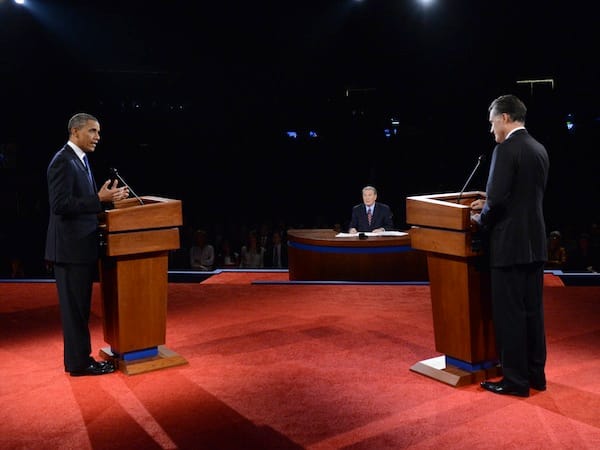
Debates have always been an important platform for candidates to articulate and narrate their stances on the issues of the era. Like any art, particular moments in the past have defined and redirected its present form. Here are a few of these defining, great debate moments that, despite their brevity in broadcast, have not been fleeting in political memory.
The 1858 Lincoln-Douglas Debate
No one alive today was present to experience it, but the 1858 senatorial debate between Illinois Senator Stephen Douglas and Mr. Abraham Lincoln is a significant piece of debate history. Each candidate spoke at great length with subsequent, substantial rebuttals after the initial speeches. Not only has it served as a template for traditional debating since then, the format has been hailed as optimal for truly reaching the core of the issues. Some lament that today’s 90-minute format is nothing more than a superficial sparring match made for pure entertainment.
The 1960 Kennedy-Nixon Debate
Being the first televised debate, this match redefined the way new media would and could, from that point forward, influence democracy and politics. According to the Museum of Broadcast Communications, 6% of voters reported “that their vote was the result of the debates alone.” Today, the televised debates do not necessarily have the same awe-inspired influence, but the Internet will serve as the newest media medium to change democracy and politics.
The 1976 Ford-Carter Debate
After a hiatus, the debate returned to TV in 1976 and was the first in which an incumbent president participated and in which the debate series featured a vice presidential contest. Ford shocked the nation when he stated that “There is no Soviet domination of Eastern Europe, and there never will be under a Ford administration.” Unfortunately, the live fact checking now available on Twitter and other media platforms didn’t exist, although it was hardly necessary for this claim. The Cold War ensued (officially) for the next 13 years.
The 1980 Carter-Reagan Debate
Ronald Reagan famously said,
"Next Tuesday all of you will go to the polls, will stand there in the polling place and make a decision. I think when you make that decision, it might be well if you would ask yourself, are you better off than you were four years ago? Is it easier for you to go and buy things in the stores than it was four years ago? Is there more or less unemployment in the country than there was four years ago? Is America as respected throughout the world as it was? Do you feel that our security is as safe, that we're as strong as we were four years ago?"
This should sound eerily familiar, aside from the economic and foreign affairs parallels, because it has become an inseparable part of the modern election rhetoric paradigm.
The 1988 Bentsen-Quayle Debate that his young career was a non-issue when he said that he “ as much experience in the Congress as Jack Kennedy did when he sought the Presidency.''
Vice presidential candidates Lloyd Bentsen and Dan Quayle, senators from Texas and Indiana, engaged in heated attacks in this particular debate. Quayle, who was significantly younger than the 67-year-old Bentsen, asserted
Senator Bentsen, heavily offended, retorted “''Senator, I served with Jack Kennedy. I knew Jack Kennedy. Jack Kennedy was a friend of mine. Senator, you're no Jack Kennedy,” in what would become one of the most famous debate quotes of all time.
Interestingly, in the last week’s debate between Vice President Biden, 69, and Congressman Paul Ryan, 42, Biden haughtily replied to Ryan’s Kennedy tax cut comments with, “So, now you’re Jack Kennedy?”
The Future
On Thursday at IVN.us, the first ever online presidential debate between Dr. Jill Stein and Governor Gary Johnson was featured over Google Hangout. As politics move further into the digital realm, the debate might see yet another era in the age of this new media. As information is becoming more accessible, discourse and debates can only become more inclusive.