Judge Halts Controversial Pennsylvania Voter ID Law
By Timothy Troutner | 10/05/2012 | Elections 2012, Electoral Reform, Headline, Pennsylvania | 47 Comments
Michael Bryant / The Philadelphia Inquirer
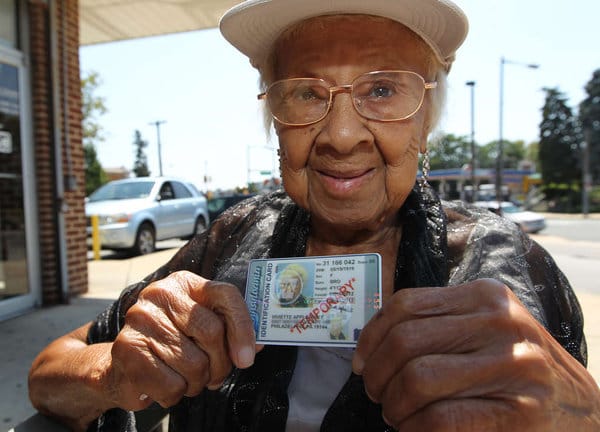
For months, a battle has been raging in Pennsylvania parallel to the presidential race. It is a battle over the rules governing the election itself. With so much at stake this election cycle, party leaders are taking advantage of every opportunity to gain votes. The battle over requirements for photo identification is just another way for the parties to influence the election. The controversial Pennsylvania voter ID law is revolving around two competing claims of election fraud and voter disenfranchisement.
Republicans warn of possible voting fraud, while Democrats dismiss these fears as unfounded and raise the specter of voter disenfranchisement. On Tuesday, Commonwealth Court Judge Robert Simpson ruled that the controversial legislation could not be enforced this election cycle. The latest skirmish in court resulted in a preliminary injunction blocking much of the law. The judge’s ruling indicated that the state has yet to resolve the conflict:
“Consequently, I am not still convinced in my predictive judgment that there will be no voter disenfranchisement arising out of the Commonwealth’s implementation of a voter identification requirement for purposes of the upcoming election. Under these circumstances, I am obliged to enter a preliminary injunction.”
The ruling specifically halts the requirement for voters to present photo identification at polling places. It does not strike down the law, but simply postpones it.
The enforcement of the requirement could go into effect for the next election cycle, when further activist efforts may quell fears surrounding voter disenfranchisement. Voters may still be asked to show ID, but they are allowed to vote without the requirement of a provisional ballot. Predictably, the decision has been met with both praise and disappointment. Jim Burn, the chairman of the Pennsylvania Democratic Party welcomed the decision in a press release:
“Today is a significant victory in the fight to make sure everyone has the right to vote in November, but the Pennsylvania Democratic Party is remaining vigilant to ensure that voters are educated about the voting process and they are protected when they cast their vote.”
Horace Cooper, director of the National Center for Public Policy Research’s Voter Identification Task Force, was disappointed, but clarified that the ruling simply reset the timeline on Pennsylvania voter ID reform, ”Today’s ruling is a temporary setback. Notably, the court’s ruling accepts the principle that the voter ID rules are legal. Unfortunately, the timing of the change meant that Pennsylvanians will have to wait one more election cycle before they can be sure their elections are fraud-free.”
The effect of the ruling remains somewhat unclear. On the practical side, the state must change its voter education campaign to reflect the ruling. While the judge’s ruling was meant to prevent voter disenfranchisement, it may result in some confusion as officials scramble to rewrite their message to voters. The Philadelphia Inquirer reports that Department of State spokesman Ron Ruman said, ”With ads to air on roughly 20 network TV affiliates statewide, along with dozens of radio stations, billboards, buses, and websites, it’s an uphill battle to pull the plug quickly.”
Republicans were hoping the law would help secure the swing state for the presidential election, as the demographic without photo ID is perceived as unfavorable to the Republican cause. Although supporters of the law focus on the threat of election fraud, House Majority Leader Mike Turzai infamously said:
“Voter ID — which is going to allow Governor Romney to win the state of Pennsylvania — done.”
Voters without photo ID will now be allowed to vote, and it appears that the change in the law could only increase voter turnout.
Neil Samuels, executive director of the Bucks Democratic Party, claims that the controversy will create significant backlash, “This voter ID boondoggle was incredibly motivating for some. I know of people who had to go through hurdles and they’re furious about this, and that’s going to drive them to vote.”
On the national stage, Pennsylvania’s decision may influence other states that are going through a similar legal challenge. Although the law was blocked temporarily in Pennsylvania, the principle behind it remained unscathed. Some argue this is a victory for the Pennsylvania voter ID requirement. The Heritage Foundation’s Hans von Spakovsky gave this analysis:
“While this may seem to be a win for opponents of common-sense election reform efforts like voter ID, it is actually a loss. Pennsylvania was handicapped in implementing its new law by the shortness of time remaining before the election. The court simply found that the state could not effectively implement the ID requirement in only a month. The law is still in place and remains valid.”
Whether this result will outweigh the public setback from the temporary injunction is difficult to tell. The conclusion of this case remains to be seen. Next election, the state is likely to face further legal battles as it tries to enforce the ID requirement. For now, however, Pennsylvanians must turn their attention to the issues and the candidates, and decide who will hold the reins of power. The Pennsylvania voter ID controversy is a reminder that voters are not simply choosing between ideas, they are choosing the politicians who have the power to change the rules of the game itself.


Leave Your Comment →
47 Comments
William Boardman
10.05.2012
@williamboardman
There is no public setback from the current injunction.
Even the state stipulated that it had no cases of voter fraud before the first trial. NO cases. None. Zero. Zip. Nada. The problem in Pennsylvania was imaginary.
William Boardman
10.05.2012
@williamboardman
The judge who issued the injunction is the same judge who, in August, thought the law was just fine and dandy. The facts haven’t changed. He’s a Republican.
Lucas Eaves
10.05.2012
@lucaseaves
I think it is great that such law is postponed. I have nothing against voter ID if you give reasonable for people to it and I dont feel that was the case here.
William Boardman
10.05.2012
@williamboardman
What changed between the judge’s first ruling (law’s just fone) and his second ruling (oops, too complicated to implement this fast)?
Plaintiffs appealed to the Supreme Court, which held an expedited hearing, and remanded the case with instructions to make a reasonable ruling.
William Boardman
10.05.2012
@williamboardman
The Supreme Court comprises three Democrats and three Republicans.
The law is still open to constitutional challenge — both federal and state.
There are at least two other, unresolved lawsuits challenging the law.
Jane Susskind
10.05.2012
@jsusskind
It think this was a good ruling — the judge didn’t completely rule out the principle behind the law, but put it on hold because we are one month away from an election. I think the legislation is partisan, and had the intent to disenfranchise voters, but the fact that it will be decided post election means that questions of whether or not this is an election year stunt to help the GOP block voters is out of the debate. The law can be looked at on its merits, not on it’s implications on the upcoming election.
William Boardman
10.05.2012
@williamboardman
Insofar as it is legislation that is intended to solve a problem for which no evidence exists — the law has no merit.
William Boardman
10.05.2012
@williamboardman
From Mike Joba:
There’s a ton of confusion out there among college students about whether they can vote using their school ID’s. There seems to be only one place on the Web that breaks that info down—a state-by-state chart of where college ID’s are accepted, with a link to each state’s ID rules:
Here’s the link.
http://www.headcount.org/student-voter-id-requirements/?ref=rpemail&site=markcrispinmiller.com&email=[email protected]
I was hoping you wouldn’t mind sharing it with your readers.
Janet Lynn
10.05.2012
If they needed them to get free stuff they would have gotten them
Theresa Radford
10.05.2012
so out of touch woth the reality I know
Jerry Crowe
10.05.2012
If the people fighting against the law would exert as much effort in obtaining IDs for those that needed them, then this wouldn’t be an issue. You need an ID to obtain federal benefits so why not have to provide one for state elections?
William Boardman
10.05.2012
@williamboardman
Because you have to have an ID to register.
People don’t seem to understand the process.
The state of Pennsylvania stipulated to the court that there was no evidence of a problem.
Carol Reshenk Minor
10.05.2012
Some form of photo identification should be in everyone’s possession but these projects should be started and ended within plenty of time before voting begins……it was a scam.
Brittany Prichard
10.05.2012
I’m just curious how people survived without IDs for so long. I mean, you gotta have one for just about everything these days lol.
Hyperbole, of course…but you still have to use one quite a bit.
Dan Wheary
10.05.2012
No, I think that since the government doesn’t care to remove people who aren’t citizens you might as well let them vote since they’re going to be living here. So people should just be allowed to walk in and vote.
William Boardman
10.05.2012
@williamboardman
Because you have to have an ID to register.
People don’t seem to understand the process.
The state of Pennsylvania stipulated to the court that there was no evidence of a problem.
William Boardman
10.05.2012
@williamboardman
Also an urban legend, non-citizens voting.
No evidence.
Florida’s recent voter purge, for example.
Donald Wescott
10.05.2012
No
Robert Joseph Lake III
10.05.2012
Completely acceptable, maybe just do DNA tests like from Gattaca, that way we wouldn’t have to worry about photo id’s.
David Wynn Smith
10.05.2012
We need ID for everything else, … Why not to vote!!!
William Boardman
10.05.2012
@williamboardman
You need an ID to register.
Michael Snider
10.05.2012
All voting should be by mail, as is done in Oregon and Washington
Allan Carroll
10.05.2012
they have PLENTY of time to go obtain their FREE i.d. …. ready, set, GO
Stormy Leigh
10.05.2012
Most polling places already required ID to vote it just standardized it. I wasn’t allowed to show my college ID or military ID last election but this law would have allowed me to. My polling place requires a photo ID with the correct address. People are so uninformed its ridiculous.
William Boardman
10.05.2012
@williamboardman
Where was that?
Vermont is totally different. No ID required.
But you’re right, people who think there’s a real problem ARE uninformed.
And how did they get that way?
The answer is partisan propaganda from….
David P. Garcia
10.05.2012
If these people are so disconnected from the reality we all live in to the point; they don’t have proper ID, then they should not vote! The problems facing this Country are complex and need to be addressed by well informed individuals not individuals who are so lazy they will not go and pick up their own identification. These are the type of people who should not vote because they don’t care enough about themselves to care about the country and or the rest of us!
William Boardman
10.05.2012
@williamboardman
Uh, do you really want to say, “these people”?
And do ou really want to impose your own conditions on the Constitution?
Sounding a lot like the Romney 47% rap.
Kimba Spencer
10.05.2012
Only if they are free – homeless people who have NO money should be allowed to vote too. How are they supposed to get IDs?
Bill Sicola
10.05.2012
YES……PERIOD
Douglas Neslund
10.05.2012
oh, you mean the ID law was “rammed down the throats” of PA citizens like Obamacare was? Seems like that one somehow passed the Supreme Court test …
Brittany Jean Prichard
10.05.2012
Why don’t people ever complain about having ID to work and drive a car? You need it then, so I don’t see having an ID to vote to be such a problem.
William Boardman
10.05.2012
@williamboardman
You need to review the amicus briefs for the plaintiffs in the Pennsylvania case.
Should give you more answers than you need.
Bill Hart
10.05.2012
That must be another Democrap judge.
William Boardman
10.05.2012
@williamboardman
Wrong. Elected Republican.
JoAnne French
10.05.2012
I believe we must have photo ID and a voter registration card. I do and I don’t think it is too much to ask. Fraud is rampant without these.
William Boardman
10.05.2012
@williamboardman
Fraud is NOT rampant.
“Voter fraud” is an urban legend supporting a partisan agenda.
Even Pensylvania admitted it had NO cases of voter fraud with which to justify the voter ID law.
Carol Kretchmer Gil
10.05.2012
I think it would be a fair thing…not to try to make it more difficult for certain people to vote.
Dan Friebis
10.05.2012
Nothing wrong with being required to present a photo ID….Identity Theft is a big issue and it keeps everything and everyone honest and straightforward. If you are concerned that your party won’t be properly represented or may face a hardship, organize volunteers to pick them up and take them to get the id’s. It truly is reasonable to expect people to prove who they are so that everything is on the up and up. The only people that should have a problem with this is the one’s who want to be dishonest.
William Boardman
10.05.2012
@williamboardman
Identity theft is a problem, but not with regard to voting.
To understand why Republicans thought this was a good way to suppress voter cohorts that tend tio vote Democratic, read the Pennsylvania case amicus briefs.
Peter Swayze
10.05.2012
Your papers please.
Mike Hicks
10.05.2012
No such thing as a “reasonable time period” to unreasonable progressives.
William Boardman
10.05.2012
@williamboardman
That’s the Pennsylvania Supreme Court you’re talking about — three Republicans and three Democrats.
JoAnne French
10.05.2012
Voters have had time have had time to meet the requirements to legally vote……………………………………………………..
William Boardman
10.05.2012
@williamboardman
And you know this because you’ve checked out the circumstances of every U.S. voting jurisdiction?
Jill Greene
10.05.2012
Im sorry, where in the Constitution does it say that lazy people aren’t allowed to vote?
Alex Gauthier
10.06.2012
@alexg
Funny how these laws become of such importance weeks before an election, disregard the years in between elections when it would be much easier to do.
William Boardman
10.08.2012
@williamboardman
Actually, in the wake of the 2010 election,
Republican state legislatures went right to work
passing voter suppression laws in early 2011,
and kept right at it through 2012.
What’s “funny” is how long it took people who care about election integrity
to start reating to these shamelessly partisan efforts to rig the system.