
Credit: voterocky.org
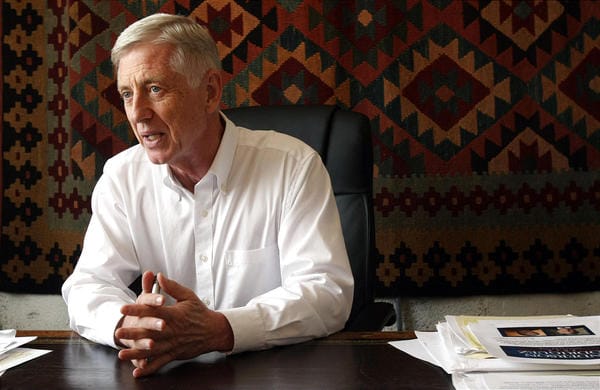
As Romney and Obama march toward November, all eyes are focused on the two parties and their battle for the White House. Many Americans are unaware of the struggle of third-party candidates such as Justice Party candidate Rocky Anderson to gain media attention and ballot access.
Rocky Anderson's fight for ballot access depends on a web of laws governing elections. Although ballot access laws vary from state-to-state, naturally most of them favor candidates who can obtain a large number of signatures. Candidates from minor parties are caught in a vicious cycle of media attention and ballot access. Without media attention and popular support, it is difficult to reach the threshold of signatures. Without ballot access, it is hard to gain media coverage.
Rocky Anderson's campaign is trying to carve out a niche among voters dissatisfied with the current system, especially those concerned with issues of justice. As the Justice Party website proclaims:
"The two-party system has failed us. The moment has come for American citizens to come together for our mutual benefit to solve the problems that lie before us. The Justice Party issues a clarion call to join our community of concerned Americans demanding social, economic, and environmental justice for all, not just for the wealthiest Americans and their corporations."
Rocky Anderson's campaign encountered opposition, both from those who fear his effect on the election and from ballot access laws across the nation. Some fear that Anderson and the Justice Party may take votes away from Democrats. Last year, The Salt Lake City Tribune recorded the words of Thad Hall, a political science professor at the University of Utah:
"Basically what Rocky is saying is he wants a bunch of Republicans to get elected, because what's going to happen in these situations - he's going to peel votes away from Democrats and end up electing a bunch of ultra-pro-life, ultra-gun, don't-tax-the-rich, cut-benefits-to-the-poor people."
Anderson and his supporters insist that his campaign exists to give Americans another option, which will help shift the political dialogue. According to a recent article in The Salt Lake City Tribune Anderson said:
"We’re in this more than to simply make a statement. We can, with very significant support in the election, make an enormous difference in altering the disastrous direction this country is headed."
Yet, his influence depends on giving voters a chance to see his name on the ballot. Ballot access laws are a frequent point of complaint for third-party candidates trying to break into the public spotlight. The campaign has faced an uphill battle.
Rocky Anderson has taken an unusual approach, seeking the nomination of a variety of parties from state-to-state. He has achieved ballot access success on the ticket of the Justice Party in several states, the Natural Law Party in Michigan, the Oregon Progressive Party, as well as gaining the nomination of independent parties across the country. The fight to get on the ballot continues.
In a telephone interview, Rocky Anderson said, "We have paperwork turned in in two states, and we're waiting on those."
He went on to mention that in a third state, the campaign's signatures were in legal limbo. The effort has not been without setbacks. Anderson failed to meet signature requirements in Ohio, Arkansas, and several other states. He said that even the threat of a legal challenge can shut down a signature campaign in a state, as the fines associated with the legal challenge are enough to make responding economically impossible. Anderson pointed out that the current system favors the establishment.
"The two parties gather all the spoils... [Our current system] disregards any integrity and sense of democracy."
The Rocky Anderson campaign is aware of the tremendous challenges facing a third-party campaign. That being said, Anderson sees his campaign as part of a larger movement to restore power to the people, a movement that will take more than just one political candidacy.
"It's going to take a tremendous people's movement... and that's why I founded the Justice Party."
American political discourse often seems to be caught in a rut. Washington, D.C. seems to be caught in partisan gridlock, and yet many voters don't find their views represented by either party. The third-party candidacy of Rocky Anderson illustrates the difficulties candidates face in placing their names on the ballot. Still, it is refreshing to see a candidate take a stand on issues often ignored by the two-party system.
Rocky Anderson's fight for ballot access is the latest in a series of efforts to give Americans another choice.With a fiscal crises and high unemployment, issues of justice often are left behind for "pragmatic" reasons. America, and hopefully the American ballot, will always have a place for candidates who are passionate about the forgotten issues facing this generation.