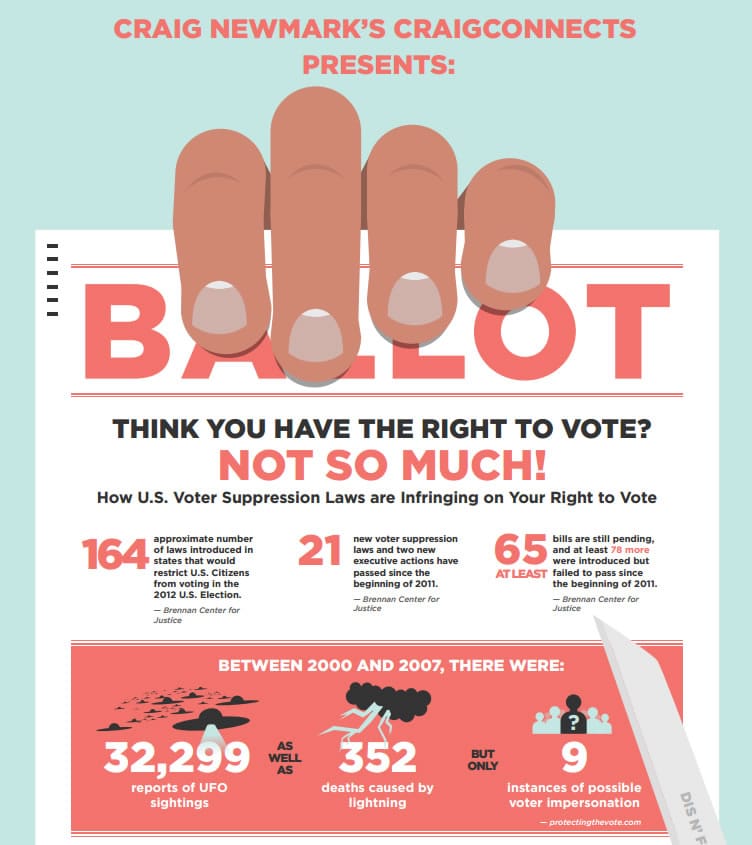
Voter Suppression, By the Numbers
By Jane Susskind | 07/12/2012 | Elections 2012, Headline | 6 CommentsThe Brennan Center for Justice released a study in which they outlined the changes in voting laws we face in the 2012 election and the adverse affect on voter participation.
Here’s how the Brennan Center for Justice arrived at the number 5 million:
5: The number of states where new photo ID laws will be in effect (Kansas, South Carolina, Tennessee, Texas, Wisconsin)
3: The number of states where new proof of citizenship laws will be in effect (Alabama, Kansas, Tennessee)
240,000: The number of potential voters in Alabama that do not have documentary proof of citizenship
2: The number of states that passed laws restricting voter registration drives, causing all or most of those drives to stop (Florida and Texas)
176,000: The number of people who registered to vote via drives
5.13: The percent of voters in Texas that registered via drives
60,000: The number of Maine citizens who registered and voted on Election Day in 2008. Since Maine abolished Election Day registration, the number of potential voters adversely affected in 2012
3: The number of states where the early voting period was cut by half or more (Florida, Georgia, and Ohio)
8,000,000: The number of Americans who voted early in the above states
2: The number of states that made it substantially more difficult or impossible for people with past felony convictions to get their voting rights restored (Florida and Iowa)
1,000,000: The number of people in Florida who could have benefited from the prior practice
5: The number of battleground states that have already cut back on voting rights (and may pass additional restrictive legislation)
171: The number of electoral votes belonging to the state that have already cut back on voting rights
270: The number of electoral votes needed to win the presidency
63: The percent of the total number of electoral votes affected by restrictive voter laws


Leave Your Comment →
6 Comments
Matt Metzner
07.12.2012
@mmetzner
The Brennan Center report on voter fraud practically debunks any voter fraud argument used to justify any restrictions. Good background to go along with understanding the laws as they stand today.
Anne
07.12.2012
I need a drivers license to drive. By not having a drivers license, am I being suppressed from driving? To buy a home or rent an apartment, I need some form of ID. Is my ability to secure shelter suppressed because I don’t have an ID? If I want to use a credit card, I am frequently asked to show my ID to prove I am not fraudulently using someone else’s card, is my ability to purchase suppressed? When I go to the airport to travel, I am required to show ID, is my ability to travel suppressed? If it is suppression to require an ID to vote to reduce voter fraud, then why isn’t it called suppression when I am forced to have a drivers license to drive, or have an ID to prevent fraud when I rent or buy a home, use a credit card or travel?
Craig D. Schlesinger
07.12.2012
@craigschlesinger
You’d think that with so few people voting relative to the number of eligible voters that the scenario would be the opposite. But alas, no. The establishment thrives off of keeping people disenfranchised from the process, whether its suppressig minority turn out or excluding candidates from parties like Green and Libertarian from polls/debates. End the duopoly!
Chad Peace
07.12.2012
@Chad_Peace
Personally, I think absentee voting is no good for the political process. It creates a self-perpetuating problem where the politicians only talk to (and mail to) the people that vote, and in turn, they vote in much higher volume, but are only informed by the most partisan one-sided messages ….
Peter Susskind
07.12.2012
Let’s not forget that the vast majority of those thus disenfranchised will be potential democratic voters. Add the ludicrous Supreme Court decision which turned the likes of Exxon and GE into “people,” so the republican party can collect huge extra amount of donations, and our system is well and truly skewed, (and screwed!). So much for the separation of powers. I feel even more strongly that the recent surprising decision from Roberts on The Patient Protection and Affordable Care Act was just to give the court some political capital so that they could help out the republicans again and much more in the future.
Bob Morris
07.12.2012
@Bob_Morris
Democrats should launch major initiatives to help everyone get the proper documentation. Problem solved.