U.S. Behind in Requiring the Labeling of GMOs
By Heather Rogers | 07/05/2012 | Activism, Ballot Initiatives | 32 CommentsA recent IVN article, by contributor Ryan McLain, explains the current FDA guidelines on labeling the genetically modified foods (GMOs) that make it into our grocery stores. The senate failed to pass a bill last month that would have required the labeling of all GMOs by vote of 26 to 73. Unsurprisingly Monsanto, the world’s largest producer of genetically engineered seed, has in the past contributed to the campaigns of many of the Senators opposed to the bill through the company’s political action fund.
List of Monsanto’s political contributions January 2012 through June 2012.
Currently there are more than 40 industrialized countries which require the labeling of GMOs. Starting in January 2013, India will join the ranks of Australia, Japan, and the European Union in requiring GMO labeling. The United States is far behind the status quo even though multiple polls have shown that the majority of Americans are in favor of labeling.
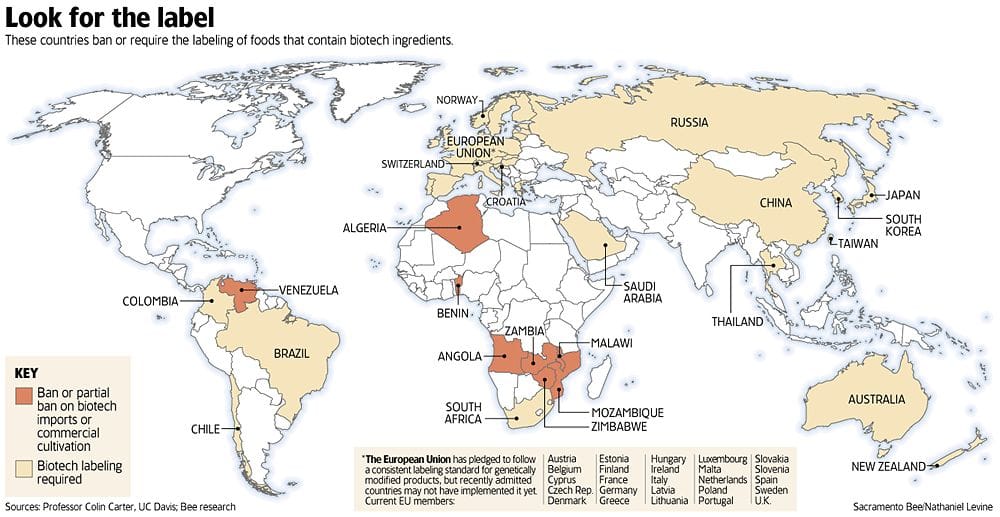
In addition to enacting labeling laws, certain countries have placed outright bans on the planting of GMO crops. Ireland, Switzerland, New Zealand, Austria, Sri Lanka, Greece, Hungary and Bulgaria are among the countries where no GMO is permitted to take root. As of mid-2011 only three counties in the United States had successfully banned the planting of GMO crops. The counties are Mendocino, Trinity, and Marin, all in California. Other counties in the United States have attempted to sanction similar bans, but all have failed.
In November, Californians will be able to vote on the Right to Know initiative, which if it passes, will be the country’s first law requiring the labeling of a wide range of genetically modified food. The law would allow consumers the knowledge of which of their foods have had their DNA artificially altered.
Certain companies currently make it a point to label their products Non-GMO, in a self-initiated attempt to inform their consumers. The unregulated labeling practices have received some backlash however. A class action lawsuit filed against Pepsico owned Naked Juice accused the company of using GMOs in their Non-GMO labeled products.
Whether or not GMOs are a threat to public health or blight to the environment is still a point of heated debate between scientists, activists, and politicians. The fact is however, that consumers have the right to full disclosure about what they are buying and eating so they are able to make informed decisions.


Leave Your Comment →
32 Comments
Matt Metzner
07.05.2012
@mmetzner
have you seen a correlation between GMO labels and decreased sales?
Heather Rogers
07.05.2012
@heatherrogers
New York University Environmental Law Journal published a piece about the benefits and risks of labeling GMOs. In the article it states, “Certain business interests, particularly those in the agriculture and processed food industries, fear that labeling will increase consumer suspicion, thereby making GMO products less attractive, or even stigmatizing them. How well founded are these fears? One speaker at this conference mentioned the sharp decline in the sale of a particular brand of tomato paste in the United Kingdom, when it was revealed that the product was made from GMO tomatoes. Some businessmen fear that GMO labeling could have a similar effect in other product sectors.”
http://www.ecolomics-international.org/biosa_appleton_labeling_gmo_products_nyuelj_2000.pdf
Jane Susskind
07.05.2012
@jsusskind
It would be interesting to see how many politicians are involved in Monsanto…maybe an article topic for next week Heather?
Heather Rogers
07.05.2012
@heatherrogers
Look for it on Tuesday!
Lauren Moore
07.05.2012
@laurendimitra
I realize this article is about labeling and not GMOs in general, but I think its interesting that so many are against GMOs without thinking of positives they can bring. I for one am admittedly against GMOs, when used for useless ridiculous means, such as making an apple greener and bigger. But a couple years ago the UN talked of using GMOs to fix hunger problems in africa. If we could modify wheat and other crops to be able to thrive in drought conditions, we could help prevent starvation. That’s something I could get behind.
Amos Cooper
07.05.2012
@adcooper12
I think it’s also possible to make square tomatoes so it’s possible to fit more for shipping.
Manny
07.09.2012
Hunger problems in Africa are human caused ones. GMOs to solve this problem is an ‘easy’ fix that has not been thoroughly tested. There are so many ways and technologies that have existed for thousands of years to cure famine. The main cultprits of famine in Africa is extremely corrupt governments led by tyrants and lack of planning or knowledge of agriculture techniques like crop rotation and proper irrigation. These are the real problems, not drought. So, introducing GMOs only perpetuates and legitimizes the corrupt officials.
We already have the technology to feed the world in a sustainable, organic way, but until we take corruption, greed, and money out of the equation, this will never materialize.
Lauren Moore
07.10.2012
@laurendimitra
Yes we do have the means, but through shipment food can spoil or be taken by the government. Electricity is scarce so green houses are problematic. There is barely enough enough water, 15 miles away from most villages for a family, so how would irrigation work? By altering the genetics of food to be able to grow in the rough terrains of africa, we can provide jobs, food and self pride to african citizens who will then be able to take the power in government they deserve instead of relying solely on the tyrants.
Aaron Mathis
07.05.2012
Instead of requiring companies to label GMO’s (IE, Government intervention in the free market), why don’t we let companies choose to advertise that their product contains NO GMO’s… A label that read ‘contains no GMO’s’ was the deciding factor a couple days ago when I chose which health smoothy I chose to by at the grocery.
While we’re at it – stop the FDA from prosecuting organic farmers and raw milk suppliers.
Aaron Mathis
07.05.2012
Disregard that I didn’t proofread. :)
Gifford Alexander
07.06.2012
You must label the contents of food. Labeling GMOs is no different. Softball question.
Francis J Wilhelm
07.06.2012
Strong lobbying efforts by the food industry is preventing the labeling of GMO’s.
Andrew Vickers
07.06.2012
Most of the food we eat already *is* genetically modified, by mutation and artificial selection. Should we label that as “GMO” as well?
Redd Greene Blu
07.06.2012
There is a huge difference between selective cultivation and genetic modification.
Pam Mercier
07.06.2012
As a libertarian, I am against banning things, but I do think that people have the right to make their own INFORMED choices about what they put in their bodies, be it food or anything else. The bio-tech food industry is afraid of letting the American public know what many other countries already know…GMOs are bad for your health, bad for animals, bad for the environment. Our so-called representatives in Congress are allowing the American citizens to be used as guinea pigs. We are paying the price for their greed…higher rates of food allergies, obesity, and other health problems. Animals have died or have gotten sick from GMO feed. Once the public is made aware, then the market forces should be allowed to decide if GMOs should continue to be offered in any form.
James William Struckle
07.06.2012
Much more worried about pesticides (like the one causing the bee die off) then I am about genetically modified foods. But I don’t mind the labeling, people should be able to make informed choices.
Bonnie Myers
07.07.2012
James Struckle, GMO crops have increased the use of pesticides tremendously.
Jodi Ehrlich
07.06.2012
I am also against banning things BUT 100% believe in LABELING- ABSOLUTELY label GMO’s give us a chance to choose
Jodi Ehrlich
07.06.2012
GMO means altering the DNA- it is 100% different than selection or gradffting
Grady Bautista
07.06.2012
Abso-frickin-lutely. A labeling law lets the consumer decide. This should satisfy everyone from libertarians to left liberals.
Bruce Stevens
07.06.2012
We should have required labeling. GMO food will be another humanity nightmare. Senators are corrupt and take money from the GMO makers like the Monsanto Corp. which gave us DDT and Agent Orange.
Portier Gary
07.06.2012
Yes! And all the crap they are putting in the foods should be taken out. I don’t want Bread that takes a month to go bad. They are killing us one by one in many ways. Nothing is pure anymore not even water, bottle or tap.
Jim Simons
07.06.2012
I would indeed! I really would like to know what I’m putting in my mouth. I’m afraid I’d be shocked by what is found.
Craig D. Schlesinger
07.06.2012
@craigschlesinger
Consumers have a right to know what is in their food, and the right to NOT purchase from a company that doesnt make it transparent. The governemtn doesn’t need to play a role. The market sorts this all about. Consumer demand will lead to food companies delivering labeling and nutrition info to customers in a more innovative, efficient manner than the FDA could ever dream up. Besides, the FDA is too busy raiding Amish dairy farms with assault weapons.
Anita
07.06.2012
I definitely want to be informed if I am purchasing genetically altered foods. I personally want more info on GMOs before I will be willing to consume them.
Heather Rogers
07.08.2012
@heatherrogers
Odds are you already consume them on a daily basis.
Debbie Henry Lucas
07.06.2012
Absolutelt.
Greg Kiff
07.06.2012
yes I support it.
Judy Ferro
07.06.2012
Knowing is our right…
Shaari Rogacs
07.06.2012
There was only one study done before the Food and Drug Adminstration approved GMO’s. That study was done by the manufacturer. Independent studies done on baby chicks fed GMO corn have resulted in the chicks being born without some of their skulls. We don’t know what this stuff will do to humans.
Tylor Reinhardt
07.07.2012
I don’t think all GMOs are bad for people, but they should be able to know what is modified, or that it was modified. I’d rather know what was modified.
The visitor
07.11.2012
Is it not yet blatantly obvious that Monsanto is in collaboration with the US government to make big money for the $elite$.. and at the same time control all food supplies & systematically depopulate the planet? Why should we let the greedy 1% get away with spreading poison & lies? Stop fiddling with your bloody I-phones & wake up!!