Is It Time to Reform the Electoral College?
By Damon Eris | 06/25/2012 | Electoral Reform | 71 CommentsFollowing the controversies surrounding the presidential election of 2000, in which George W. Bush lost the popular vote but won the presidency, there was renewed interest in reforming the Electoral College system. That interest has held steady over the course of the last decade. In a Gallup survey from late last year, 62% of those polled said they would prefer that the president be elected by a direct popular vote rather than via the indirect system characteristic of the Electoral College. The poll found broad agreement across the political spectrum in favor of such a change. Those who said they support the direct election of the president included 71% of Democrats, 61% of Independents and 53% of Republicans.
One potential avenue of reform would be to abolish the Electoral College altogether by means of a constitutional amendment establishing the direct popular election of the nation’s highest executive officer. Such a strategy would not be entirely unprecedented. In 1913, the states ratified the seventeenth amendment to the Constitution, which provided for the direct election of US Senators by the people of the several states, taking that power out of the hands of state legislatures.
However, given the difficulty of amending the federal constitution, in recent years reformers have opted to take a different tack. The National Popular Vote Compact seeks to establish the direct election of the president not by abolishing the Electoral College but rather by changing the way in which states award their electoral votes. The Constitution empowers the legislature of each state to determine how it chooses its electors and apportions its electoral votes. Currently, all but two states award all of their electoral votes to the presidential candidate who wins the state’s popular vote. The remaining two, Nebraska and Maine, utilize a mixed allocation system that takes into account proportional differences in the popular vote between Congressional districts.
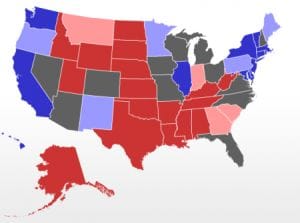
Under the National Popular Vote Compact, states would agree to award their electoral college votes to the winner of the national popular election. Eight states and the District of Columbia have already signed on to the program: Vermont, Maryland, Washington, Illinois, New Jersey, Massachusetts, California and Hawaii. Together, these states control 139 electoral votes, just under half of the 270 necessary to elect the president. According to the agreement, the National Popular Vote Compact will not come into effect until at least 270 electoral votes have been pledged to the process.
Supporters of the compact argue that establishing a popular vote rule is simply common sense and point out that the current system alienates large swaths of the nation from the presidential election process because it privileges a small number of so-called swing states. Opponents worry about the possibility of protracted court cases and the potential unintended consequences that may result of enough states sign on.
Over the weekend, the New York Times hosted a debate on the proposal in its Opinion Pages. Steven J. Brams, a professor of politics at NYU, started off the discussion by making the case in favor of the Compact. Brams noted that in this year’s presidential election voters in the nation’s three largest states “will largely be ignored in the 2012 campaign,” and argued that the Compact will prevent divergences between the national popular vote and the Electoral College outcome. “The 2012 presidential election will probably be decided by 8 to 12 battleground states . . . The cleanest way to prevent divided verdicts is to abolish the Electoral College and substitute direct popular vote for the president. . . . An ingenious alternative solution is the national popular vote plan.”
In response, readers questioned the legal issues a state compact would raise, and brought up problems that might result from the proposed process.
Martin G. Evans, a professor in the School of Management at the University of Toronto, pointed out that the nature of interstate compacts has not yet been worked out by the courts: “whether interstate compacts have to be approved by Congress is an issue that has not been settled by the courts. When the political power of a state that does not sign the compact is encroached on, the courts may rule that Congressional approval of the compact is required.”
Jay Reinlein worried that the national compact would marginalize smaller states: “Mr. Brams’s solution to the problem of battleground states is no solution at all since it marginalizes smaller states and smaller media markets in favor of larger states and larger media markets.” Mr. Reinlein proposed instead that states should award their electoral votes on a proportional basis.


Leave Your Comment →
71 Comments
Faith Eischen
06.25.2012
@faitheischen
Having a voting system that better reflects the population of large states seems more democratic/participatory in regard to electing our nation’s president. I think it would take years before any amendment of the federal constitution would happen (if at all).
Matt Metzner
06.25.2012
@mmetzner
I wonder what this reform would do to campaign spending. Would this mean that it would take more money to win an election because candidates need to cover more states? Or would it decrease necessary spending as candidate focus on high population states?
oldgulph
06.25.2012
@oldgulph
Presidential candidates currently do everything within their power to raise as much money as they possibly can from donors throughout the country. They then allocate the money that they raise nationally to places where it will do the most good toward their goal of winning the election.
Money doesn’t grow on trees. The fact that candidates would spend their money more broadly (that is, in all 50 states and DC) would not, in itself, loosen up the wallet of a single donor anywhere in the country. Candidates will continue to try to raise as much money as economic considerations permit. Economic considerations by donors determines how much money will be available, not the existence of an increases number of places where the money might be spent.
With the current system, they spend more than two-thirds of their time and money in just six closely divided battleground states; 80% in just nine states; and 99% in just 16 states. That’s precisely what they should do in order to get elected with the current system, because the voters of two-thirds of the states simply don’t matter. Candidates have no reason to poll, visit, advertise, organize, campaign, or care about the concerns of voters in states where they are safely ahead or hopelessly behind. Over 85 million voters are ignored.
If every vote mattered throughout the United States, as it would under a national popular vote, candidates would reallocate the money they raise.
A nationwide presidential campaign, with every vote equal, would be run the way presidential candidates campaign to win the electoral votes of closely divided battleground states, such as Ohio and Florida, under the state-by-state winner-take-all methods. The big cities in those battleground states do not receive all the attention, much less control the outcome. Cleveland and Miami do not receive all the attention or control the outcome in Ohio and Florida.
The itineraries of presidential candidates in battleground states (and their allocation of other campaign resources in battleground states) reflect the political reality that every gubernatorial or senatorial candidate knows. When and where every vote is equal, a campaign must be run everywhere.
With National Popular Vote, when every vote is equal, everywhere, it makes sense for presidential candidates to try and elevate their votes where they are and aren’t so well liked. But, under the state-by-state winner-take-all laws, it makes no sense for a Democrat to try and do that in Vermont or Wyoming, or for a Republican to try it in Wyoming or Vermont.
Candidates would need to build a winning coalition across demographics. Candidates would have to appeal to a broad range of demographics, and perhaps even more so, because the election wouldn’t be capable of coming down to just one demographic, such as soccer mom voters in Ohio.
In terms of recent presidential elections, the 11 largest states include five “red states (Texas, Florida, Ohio, North Carolina, and Georgia) and six “blue” states (California, New York, Illinois, Pennsylvania, Michigan, and New Jersey). The fact is that the big states are just about as closely divided as the rest of the country. For example, among the four largest states, the two largest Republican states (Texas and Florida) generated a total margin of 2.1 million votes for Bush, while the two largest Democratic states generated a total margin of 2.1 million votes for Kerry.
Among the 11 most populous states in 2004, the highest levels of popular support, hardly overwhelming, were found in the following seven non-battleground states:
* Texas (62% Republican),
* New York (59% Democratic),
* Georgia (58% Republican),
* North Carolina (56% Republican),
* Illinois (55% Democratic),
* California (55% Democratic), and
* New Jersey (53% Democratic).
In addition, the margins generated by the nation’s largest states are hardly overwhelming in relation to the 122,000,000 votes cast nationally. Among the 11 most populous states, the highest margins were the following seven non-battleground states:
* Texas — 1,691,267 Republican
* New York — 1,192,436 Democratic
* Georgia — 544,634 Republican
* North Carolina — 426,778 Republican
* Illinois — 513,342 Democratic
* California — 1,023,560 Democratic
* New Jersey — 211,826 Democratic
To put these numbers in perspective, Oklahoma (7 electoral votes) alone generated a margin of 455,000 “wasted” votes for Bush in 2004 — larger than the margin generated by the 9th and 10th largest states, namely New Jersey and North Carolina (each with 15 electoral votes). Utah (5 electoral votes) alone generated a margin of 385,000 “wasted” votes for Bush in 2004. 8 small western states, with less than a third of California’s population, provided Bush with a bigger margin (1,283,076) than California provided Kerry (1,235,659).
oldgulph
06.25.2012
@oldgulph
Congressional consent is not required for the National Popular Vote compact under prevailing U.S. Supreme Court rulings. However, because there would undoubtedly be time-consuming litigation about this aspect of the compact, National Popular Vote is working to introduce a bill in Congress for congressional consent.
The U.S. Constitution provides:
“No state shall, without the consent of Congress,… enter into any agreement or compact with another state….”
Although this language may seem straight forward, the U.S. Supreme Court has ruled, in 1893 and again in 1978, that the Compacts Clause can “not be read literally.” In deciding the 1978 case of U.S. Steel Corporation v. Multistate Tax Commission, the Court wrote:
“Read literally, the Compact Clause would require the States to obtain congressional approval before entering into any agreement among themselves, irrespective of form, subject, duration, or interest to the United States.
“The difficulties with such an interpretation were identified by Mr. Justice Field in his opinion for the Court in [the 1893 case] Virginia v. Tennessee. His conclusion [was] that the Clause could not be read literally [and this 1893 conclusion has been] approved in subsequent dicta.”
Specifically, the Court’s 1893 ruling in Virginia v. Tennessee stated:
“Looking at the clause in which the terms ‘compact’ or ‘agreement’ appear, it is evident that the prohibition is directed to the formation of any combination tending to the increase of political power in the states, which may encroach upon or interfere with the just supremacy of the United States.”
The state power involved in the National Popular Vote compact is specified in Article II, Section 1, Clause 2 the U.S. Constitution:
“Each State shall appoint, in such Manner as the Legislature thereof may direct, a Number of Electors….”
In the 1892 case of McPherson v. Blacker (146 U.S. 1), the Court wrote:
“The appointment and mode of appointment of electors belong exclusively to the states under the constitution of the United States”
The National Popular Vote compact would not “encroach upon or interfere with the just supremacy of the United States” because there is simply no federal power — much less federal supremacy — in the area of awarding of electoral votes in the first place.
In the 1978 case of U.S. Steel Corporation v. Multistate Tax Commission, the compact at issue specified that it would come into force when seven or more states enacted it. The compact was silent as to the role of Congress. The compact was submitted to Congress for its consent. After encountering fierce political opposition from various business interests concerned about the more stringent tax audits anticipated under the compact, the compacting states proceeded with the implementation of the compact without congressional consent. U.S. Steel challenged the states’ action. In upholding the constitutionality of the implementation of the compact by the states without congressional consent, the U.S. Supreme Court applied the interpretation of the Compacts Clause from its 1893 holding in Virginia v. Tennessee, writing that:
“the test is whether the Compact enhances state power quaod [with regard to] the National Government.”
The Court also noted that the compact did not
“authorize the member states to exercise any powers they could not exercise in its absence.”
oldgulph
06.25.2012
@oldgulph
Of course, there is always the possibility that the U.S. Supreme Court might change the legal standards concerning congressional consent contained in its 1893 and 1978 rulings. Some have argued, for example, that congressional intervention in what would otherwise be an exclusively state matter might be required if the compacting states exerted some kind of adverse “political” effect on non-compacting states. In a dissenting opinion, U.S. Supreme Court Justice White suggested, in U.S. Steel v. Multi-State Tax Commission, that courts could consider the possible adverse effects of a compact on non-compacting states in deciding whether congressional consent is required.
Because each state has independent power to award its electoral votes in the manner it sees fit, it is difficult to see what “adverse effect” might be claimed by one state from the decision of another state to award its electoral votes in a particular way. It is especially unclear what adverse “political” effect might be claimed, given that the National Popular Vote compact would treat votes cast in all 50 states and the District of Columbia equally. A vote cast in a compacting state is, in every way, equal to a vote cast in a non-compacting state. The National Popular Vote compact does not confer any advantage on states belonging to the compact as compared to non-compacting states. A vote cast in a compacting state would be, in every way, equal to a vote cast in a non-compacting state. The National Popular Vote compact certainly would not reduce the voice of voters in non-compacting states relative to the voice of voters in member states.
oldgulph
06.25.2012
@oldgulph
Anyone concerned about the relative power of big states and small states should realize that the current system shifts power from voters in the small and medium-small states to voters in the current handful of big states.
With National Popular Vote, when every vote counts equally, successful candidates will find a middle ground of policies appealing to the wide mainstream of America. Instead of playing mostly to local concerns in Ohio and Florida, candidates finally would have to form broader platforms for broad national support. Elections wouldn’t be about winning a handful of battleground states.
Now political clout comes from being among the handful of battleground states. More than 2/3rds of states and voters are ignored.
Now with state-by-state winner-take-all laws (not mentioned in the U.S. Constitution, but since enacted by 48 states), presidential elections ignore 12 of the 13 lowest population states (3-4 electoral votes), that are non-competitive in presidential elections. 6 regularly vote Republican (AK, ID, MT, WY, ND, and SD), and 6 regularly vote Democratic (RI, DE, HI, VT, ME, and DC) in presidential elections. Voters in states that are reliably red or blue don’t matter. Candidates ignore those states and the issues they care about most.
Support for a national popular vote is strong in every smallest state surveyed in recent polls among Republicans, Democrats, and Independent voters, as well as every demographic group. Support in smaller states (3 to 5 electoral votes): AK -70%, DC -76%, DE –75%, ID -77%, ME – 77%, MT- 72%, NE – 74%, NH–69%, NE – 72%, NM – 76%, RI – 74%, SD- 71%, UT- 70%, VT – 75%, WV- 81%, and WY- 69%.
In the lowest population states, the National Popular Vote bill has passed in nine state legislative chambers, and been enacted by 3 jurisdictions.
Of the 25 smallest states (with a total of 155 electoral votes) 18 received no attention at all from presidential campaigns after the conventions. Of the seven smallest states with any post-convention visits, Only 4 of the smallest states – NH (12 events), NM (8), NV (12), and IA (7) – got the outsized attention of 39 of the 43 total events in the 25 smallest states. In contrast, Ohio (with only 20 electoral votes) was lavishly wooed with 62 of the total 300 post-convention campaign events in the whole country.
oldgulph
06.25.2012
@oldgulph
The main media at the moment, TV, costs much more per impression in big cities than in smaller towns and rural area. Candidates get more bang for the buck in smaller towns and rural areas.
In the 2012 campaign, so far, “Much of the heaviest spending has not been in big cities with large and expensive media markets, but in small and medium-size metropolitan areas in states with little individual weight in the Electoral College: Cedar Rapids and Des Moines in Iowa (6 votes); Colorado Springs and Grand Junction in Colorado (9 votes); Norfolk and Richmond in Virginia (13 votes). Since the beginning of April, four-fifths of the ads that favored or opposed a presidential candidate have been in television markets of modest size.”
http://www.nytimes.com/2012/06/08/us/politics/9-swing-states-are-main-focus-of-ad-blitz.html?_r=1&pagewanted=all
oldgulph
06.25.2012
@oldgulph
Any state that enacts the proportional approach on its own would reduce its own influence. This was the most telling argument that caused Colorado voters to agree with Republican Governor Owens and to reject this proposal in November 2004 by a two-to-one margin.
If the proportional approach were implemented by a state, on its own, it would have to allocate its electoral votes in whole numbers. If a current battleground state were to change its winner-take-all statute to a proportional method for awarding electoral votes, presidential candidates would pay less attention to that state because only one electoral vote would probably be at stake in the state.
The proportional method also could result in third party candidates winning electoral votes that would deny either major party candidate the necessary majority vote of electors and throw the process into Congress to decide.
If the whole-number proportional approach had been in use throughout the country in the nation’s closest recent presidential election (2000), it would not have awarded the most electoral votes to the candidate receiving the most popular votes nationwide. Instead, the result would have been a tie of 269–269 in the electoral vote, even though Al Gore led by 537,179 popular votes across the nation. The presidential election would have been thrown into Congress to decide and resulted in the election of the second-place candidate in terms of the national popular vote.
A system in which electoral votes are divided proportionally by state would not accurately reflect the nationwide popular vote and would not make every vote equal.
It would penalize states, such as Montana, that have only one U.S. Representative even though it has almost three times more population than other small states with one congressman. It would penalize fast-growing states that do not receive any increase in their number of electoral votes until after the next federal census. It would penalize states with high voter turnout (e.g., Utah, Oregon).
Moreover, the fractional proportional allocation approach does not assure election of the winner of the nationwide popular vote. In 2000, for example, it would have resulted in the election of the second-place candidate.
A national popular vote is the way to make every person’s vote equal and matter to their candidate because it guarantees that the candidate who gets the most votes in all 50 states and DC becomes President.
Ryan McLain
06.25.2012
@vote3rdparty
The problem is that then the small states wouldn’t matter to any of the candidates and would be neglected. It’s the same reason we have the Senate not based upon population.
oldgulph
06.26.2012
@oldgulph
Now with state-by-state winner-take-all laws (not mentioned in the U.S. Constitution, but since enacted by 48 states), presidential elections ignore 12 of the 13 lowest population states (3-4 electoral votes), that are non-competitive in presidential elections. 6 regularly vote Republican (AK, ID, MT, WY, ND, and SD), and 6 regularly vote Democratic (RI, DE, HI, VT, ME, and DC) in presidential elections. Voters in states that are reliably red or blue don’t matter. Candidates ignore those states and the issues they care about most.
* * *
Support for a national popular vote is strong in every smallest state surveyed in recent polls among Republicans, Democrats, and Independent voters, as well as every demographic group. Support in smaller states (3 to 5 electoral votes): AK -70%, DC -76%, DE –75%, ID -77%, ME – 77%, MT- 72%, NE – 74%, NH–69%, NE – 72%, NM – 76%, RI – 74%, SD- 71%, UT- 70%, VT – 75%, WV- 81%, and WY- 69%.
In the lowest population states, the National Popular Vote bill has passed in nine state legislative chambers, and been enacted by 3 jurisdictions.
* * *
Of the 25 smallest states (with a total of 155 electoral votes) 18 received no attention at all from presidential campaigns after the conventions. Of the seven smallest states with any post-convention visits, Only 4 of the smallest states – NH (12 events), NM (8), NV (12), and IA (7) – got the outsized attention of 39 of the 43 total events in the 25 smallest states. In contrast, Ohio (with only 20 electoral votes) was lavishly wooed with 62 of the total 300 post-convention campaign events in the whole country.
Wesley Adams
06.26.2012
I like the Electoral College. I just wish their football program was better.
Steve Arnold
06.26.2012
Electoral college is a joke; California has 52 votes and is NEVER a “Swing” state, for example. Democrats count on the votes, Republicans don’t sweat em, and it’s such a huge amount of the necessary votes. Seems a real vote would make much more sense to me anyway.
Al Alborn
06.26.2012
I’m guessing closer to 80% have no idea how the Electoral College works…
Russell Miller
06.26.2012
It’s a slippery slope…without the Electoral College, we are one step closer to a Democracy.
“Democracy is nothing more than mob rule, where 51% of the people may take away the rights of the other 49%.” Quote Attributed to Thomas Jefferson, but not comfirmed
oldgulph
06.26.2012
@oldgulph
The National Popular Vote bill would change existing state winner-take-all laws that award all of a state’s electoral votes to the candidate who get the most popular votes in each separate state (not mentioned in the U.S. Constitution, but since enacted by 48 states), to a system guaranteeing the majority of Electoral College votes for, and the Presidency to, the candidate getting the most popular votes in the entire United States.
* * *
The National Popular Vote bill preserves the constitutionally mandated Electoral College and state control of elections. It ensures that every vote is equal, every voter will matter, in every state, in every presidential election, and the candidate with the most votes wins, as in virtually every other election in the country.
* * *
The National Popular Vote bill would end the disproportionate attention and influence of the “mob” in the current handful of closely divided battleground states, such as Florida, while the “mobs” of the vast majority of states are ignored. 98% of the 2008 campaign events involving a presidential or vice-presidential candidate occurred in just 15 closely divided “battleground” states. 12 of the 13 lowest population states (3-4 electoral votes), that are non-competitive are ignored, in presidential elections. 9 of the original 13 states are considered “fly-over” now. Over half (57%) of the events were in just four states (Ohio, Florida, Pennsylvania and Virginia). Similarly, 98% of ad spending took place in these 15 “battleground” states. At most, 12 states will determine the election.
The current system does not provide some kind of check on the “mobs.” There have been 22,000 electoral votes cast since presidential elections became competitive (in 1796), and only 17 have been cast for someone other than the candidate nominated by the elector’s own political party. 1796 remains the only instance when the elector might have thought, at the time he voted, that his vote might affect the national outcome. Since 1796, the Electoral College has had the form, but not the substance, of the deliberative body envisioned by the Founders. The electors now are dedicated party activists of the winning party who meet briefly in mid-December to cast their totally predictable rubberstamped votes in accordance with their pre-announced pledges.
If a Democratic presidential candidate receives the most votes, the state’s dedicated Democratic party activists who have been chosen as its slate of electors become the Electoral College voting bloc. If a Republican presidential candidate receives the most votes, the state’s dedicated Republican party activists who have been chosen as its slate of electors become the Electoral College voting bloc. The winner of the presidential election is the candidate who collects 270 votes from Electoral College voters from among the winning party’s dedicated activists.
* * *
The Republic is not in any danger from National Popular Vote.
National Popular Vote has NOTHING TO DO with pure democracy. Pure democracy is a form of government in which people vote on policy initiatives directly. With National Popular Vote, the United States would still be a representative democracy, in which citizens continue to elect the President by a majority of Electoral College votes by states, to represent us and conduct the business of government in the periods between elections.
Jason Ryan
06.26.2012
I think it’s time to do away with it, its just as corrupt as the rest of government™
Trudy Snyder
06.26.2012
Reform it. Then I don’t have to hear about Obama and Romney being the ONLY candidates in the race to pick from. I’m writing in my vote this year…electoral college or not.
Manuel Cosme Jr.
06.26.2012
I like Wesley’s response. lol
Warren Trammell
06.26.2012
I keep hearing that the NWO is gona “rig” the Nov election for odummer… how can they “rig” and cheat the Electoral College ?????
Joseph Hagerty
06.26.2012
So do people realize that small states and states with lower #’s will never get represented fairly if they choose the popular vote. The most populous state rules…..
oldgulph
06.26.2012
@oldgulph
Now with state-by-state winner-take-all laws (not mentioned in the U.S. Constitution, but since enacted by 48 states), presidential elections ignore 12 of the 13 lowest population states (3-4 electoral votes), that are non-competitive in presidential elections. 6 regularly vote Republican (AK, ID, MT, WY, ND, and SD), and 6 regularly vote Democratic (RI, DE, HI, VT, ME, and DC) in presidential elections. Voters in states that are reliably red or blue don’t matter. Candidates ignore those states and the issues they care about most.
* * *
Support for a national popular vote is strong in every smallest state surveyed in recent polls among Republicans, Democrats, and Independent voters, as well as every demographic group. Support in smaller states (3 to 5 electoral votes): AK -70%, DC -76%, DE –75%, ID -77%, ME – 77%, MT- 72%, NE – 74%, NH–69%, NE – 72%, NM – 76%, RI – 74%, SD- 71%, UT- 70%, VT – 75%, WV- 81%, and WY- 69%.
In the lowest population states, the National Popular Vote bill has passed in nine state legislative chambers, and been enacted by 3 jurisdictions.
* * *
Of the 25 smallest states (with a total of 155 electoral votes) 18 received no attention at all from presidential campaigns after the conventions. Of the seven smallest states with any post-convention visits, Only 4 of the smallest states – NH (12 events), NM (8), NV (12), and IA (7) – got the outsized attention of 39 of the 43 total events in the 25 smallest states. In contrast, Ohio (with only 20 electoral votes) was lavishly wooed with 62 of the total 300 post-convention campaign events in the whole country.
* * *
With the current state-by-state winner-take-all system of awarding electoral votes, it could only take winning a bare plurality of popular votes in the 11 most populous states, containing 56% of the population of the United States, for a candidate to win the Presidency with a mere 26% of the nation’s votes!
Justin Paulsen
06.26.2012
I favor direct popular vote.
Warren Trammell
06.26.2012
65% to 75% of Americans are Conservative and if allowed to rule….our Constitutional Republic would be put back on the right path, so the Libtards are fighting this hard !!!!!
John Idstrom
06.26.2012
Electoral.
Joe Gilmore
06.26.2012
Reading all the rants that people on both sides of the isle are spewing these days, I give props to the framers for keeping the actual decision out of the hands of the rabble! It’s all about stability.
oldgulph
06.26.2012
@oldgulph
The precariousness of the current state-by-state winner-take-all system of awarding electoral votes is highlighted by the fact that a shift of a few thousand voters in one or two states would have elected the second-place candidate in 4 of the 13 presidential elections since World War II. Near misses are now frequently common. There have been 6 consecutive non-landslide presidential elections (1988, 1992, 1996, 2000, 2004, and 2008). 537 popular votes won Florida and the White House for Bush in 2000 despite Gore’s lead of 537,179 (1,000 times more) popular votes nationwide. A shift of 60,000 voters in Ohio in 2004 would have defeated President Bush despite his nationwide lead of over 3 million votes.
* * *
In 1789, in the nation’s first election, the people had no vote for President in most states. Only men who owned a substantial amount of property could vote. Since then, state laws gave the people the right to vote for President in all 50 states and DC.
* * *
The Electoral College is now the set of dedicated party activists who vote as rubberstamps for presidential candidates. In the current presidential election system, 48 states award all of their electors to the winners of their state.
* * *
The National Popular Vote bill would end the disproportionate attention and influence of the “mob” in the current handful of closely divided battleground states, such as Florida, while the “mobs” of the vast majority of states are ignored. 98% of the 2008 campaign events involving a presidential or vice-presidential candidate occurred in just 15 closely divided “battleground” states. 12 of the 13 lowest population states (3-4 electoral votes), that are non-competitive are ignored, in presidential elections. 9 of the original 13 states are considered “fly-over” now. Over half (57%) of the events were in just four states (Ohio, Florida, Pennsylvania and Virginia). Similarly, 98% of ad spending took place in these 15 “battleground” states. At most, 12 states will determine the election.
* * *
The current system does not provide some kind of check on the “mobs.” There have been 22,000 electoral votes cast since presidential elections became competitive (in 1796), and only 17 have been cast for someone other than the candidate nominated by the elector’s own political party. 1796 remains the only instance when the elector might have thought, at the time he voted, that his vote might affect the national outcome. Since 1796, the Electoral College has had the form, but not the substance, of the deliberative body envisioned by the Founders. The electors now are dedicated party activists of the winning party who meet briefly in mid-December to cast their totally predictable rubberstamped votes in accordance with their pre-announced pledges.
* * *
If a Democratic presidential candidate receives the most votes, the state’s dedicated Democratic party activists who have been chosen as its slate of electors become the Electoral College voting bloc. If a Republican presidential candidate receives the most votes, the state’s dedicated Republican party activists who have been chosen as its slate of electors become the Electoral College voting bloc.
oldgulph
06.26.2012
@oldgulph
The precariousness of the current state-by-state winner-take-all system of awarding electoral votes is highlighted by the fact that a shift of a few thousand voters in one or two states would have elected the second-place candidate in 4 of the 13 presidential elections since World War II. Near misses are now frequently common. There have been 6 consecutive non-landslide presidential elections (1988, 1992, 1996, 2000, 2004, and 2008). 537 popular votes won Florida and the White House for Bush in 2000 despite Gore’s lead of 537,179 (1,000 times more) popular votes nationwide. A shift of 60,000 voters in Ohio in 2004 would have defeated President Bush despite his nationwide lead of over 3 million votes.
Jim Carlton
06.26.2012
@ Warren – electors are not technically required to vote as they promised. @ Joseph – you are correct sir
Lance Harvell
06.26.2012
the size of the state is what matters most.
Kenny Cook
06.26.2012
Give to much power to populatedv areas. Bias to rural areas.
Lance Harvell
06.26.2012
small states hould favor the electoral college. After all their are 34 population centers in the US with over 500,000 population. In a close race why would anyone go to Wy, ND, SD, or Maine.
oldgulph
06.26.2012
@oldgulph
Now with state-by-state winner-take-all laws (not mentioned in the U.S. Constitution, but since enacted by 48 states), presidential elections ignore 12 of the 13 lowest population states (3-4 electoral votes), that are non-competitive in presidential elections. 6 regularly vote Republican (AK, ID, MT, WY, ND, and SD), and 6 regularly vote Democratic (RI, DE, HI, VT, ME, and DC) in presidential elections. Voters in states that are reliably red or blue don’t matter. Candidates ignore those states and the issues they care about most.
* * *
Support for a national popular vote is strong in every smallest state surveyed in recent polls among Republicans, Democrats, and Independent voters, as well as every demographic group. Support in smaller states (3 to 5 electoral votes): AK -70%, DC -76%, DE –75%, ID -77%, ME – 77%, MT- 72%, NE – 74%, NH–69%, NE – 72%, NM – 76%, RI – 74%, SD- 71%, UT- 70%, VT – 75%, WV- 81%, and WY- 69%.
In the lowest population states, the National Popular Vote bill has passed in nine state legislative chambers, and been enacted by 3 jurisdictions.
* * *
Of the 25 smallest states (with a total of 155 electoral votes) 18 received no attention at all from presidential campaigns after the conventions. Of the seven smallest states with any post-convention visits, Only 4 of the smallest states – NH (12 events), NM (8), NV (12), and IA (7) – got the outsized attention of 39 of the 43 total events in the 25 smallest states. In contrast, Ohio (with only 20 electoral votes) was lavishly wooed with 62 of the total 300 post-convention campaign events in the whole country.
oldgulph
06.26.2012
@oldgulph
With National Popular Vote, big cities would not get all of candidates’ attention, much less control the outcome.
The population of the top five cities (New York, Los Angeles, Chicago, Houston and Philadelphia) is only 6% of the population of the United States and the population of the top 50 cities (going as far down as Arlington, TX) is only 19% of the population of the United States.
Suburbs and exurbs often vote Republican.
* * *
Any candidate who ignored, for example, the 16% of Americans who live in rural areas in favor of a “big city” approach would not likely win the national popular vote.
* * *
If big cities controlled the outcome of elections, the governors and U.S. Senators would be Democratic in virtually every state with a significant city.
* * *
A nationwide presidential campaign, with every vote equal, would be run the way presidential candidates campaign to win the electoral votes of closely divided battleground states, such as Ohio and Florida, under the state-by-state winner-take-all methods. The big cities in those battleground states do not receive all the attention, much less control the outcome. Cleveland and Miami do not receive all the attention or control the outcome in Ohio and Florida.
* * *
The itineraries of presidential candidates in battleground states (and their allocation of other campaign resources in battleground states) reflect the political reality that every gubernatorial or senatorial candidate knows. When and where every vote is equal, a campaign must be run everywhere.
* * *
With National Popular Vote, when every vote is equal, everywhere, it makes sense for presidential candidates to try and elevate their votes where they are and aren’t so well liked. But, under the state-by-state winner-take-all laws, it makes no sense for a Democrat to try and do that in Vermont or Wyoming, or for a Republican to try it in Wyoming or Vermont.
* * *
Even in California state-wide elections, candidates for governor or U.S. Senate don’t campaign just in Los Angeles and San Francisco, and those places don’t control the outcome (otherwise California wouldn’t have recently had Republican governors Reagan, Dukemejian, Wilson, and Schwarzenegger). A vote in rural Alpine county is just an important as a vote in Los Angeles. If Los Angeles cannot control statewide elections in California, it can hardly control a nationwide election.
In fact, Los Angeles, San Francisco, San Jose, and Oakland together cannot control a statewide election in California.
* * *
Similarly, Republicans dominate Texas politics without carrying big cities such as Dallas and Houston.
There are numerous other examples of Republicans who won races for governor and U.S. Senator in other states that have big cities (e.g., New York, Illinois, Michigan, Pennsylvania, and Massachusetts) without ever carrying the big cities of their respective states.
* * *
Candidates would need to build a winning coalition across demographics. Any candidate who ignored, for example, the 16% of Americans who live in rural areas in favor of a “big city” approach would not likely win the national popular vote. Candidates would have to appeal to a broad range of demographics, and perhaps even more so, because the election wouldn’t be capable of coming down to just one demographic, such as soccer mom voters in Ohio.
Niki Cvitkovich
06.26.2012
If the electoral college was removed, the candidates would only campaign in new York, Texas and California, ignoring less populated states entirely. That’s bad.
oldgulph
06.26.2012
@oldgulph
With the current state winner-take-all system of awarding electoral votes, winning a bare plurality of the popular vote in the 11 most populous states, containing 56% of the population, could win the Presidency with a mere 26% of the nation’s votes!
* * *
But the political reality is that the 11 largest states rarely agree on any political question. In terms of recent presidential elections, the 11 largest states include five “red states (Texas, Florida, Ohio, North Carolina, and Georgia) and six “blue” states (California, New York, Illinois, Pennsylvania, Michigan, and New Jersey). The fact is that the big states are just about as closely divided as the rest of the country. For example, among the four largest states, the two largest Republican states (Texas and Florida) generated a total margin of 2.1 million votes for Bush, while the two largest Democratic states generated a total margin of 2.1 million votes for Kerry.
* * *
Among the 11 most populous states in 2004, the highest levels of popular support, hardly overwhelming, were found in the following seven non-battleground states:
* Texas (62% Republican),
* New York (59% Democratic),
* Georgia (58% Republican),
* North Carolina (56% Republican),
* Illinois (55% Democratic),
* California (55% Democratic), and
* New Jersey (53% Democratic).
* * *
In addition, the margins generated by the nation’s largest states are hardly overwhelming in relation to the 122,000,000 votes cast nationally. Among the 11 most populous states, the highest margins were the following seven non-battleground states:
* Texas — 1,691,267 Republican
* New York — 1,192,436 Democratic
* Georgia — 544,634 Republican
* North Carolina — 426,778 Republican
* Illinois — 513,342 Democratic
* California — 1,023,560 Democratic
* New Jersey — 211,826 Democratic
* * *
To put these numbers in perspective, Oklahoma (7 electoral votes) alone generated a margin of 455,000 “wasted” votes for Bush in 2004 — larger than the margin generated by the 9th and 10th largest states, namely New Jersey and North Carolina (each with 15 electoral votes). Utah (5 electoral votes) alone generated a margin of 385,000 “wasted” votes for Bush in 2004. 8 small western states, with less than a third of California’s population, provided Bush with a bigger margin (1,283,076) than California provided Kerry (1,235,659).
Greg Bard
06.26.2012
Representation is for people. States aren’t people. THEY DON’T DESERVE representation. It has to be 50%+1, because that “+1″ is a human. Small states especially don’t deserve additional representation because there are NO PEOPLE THERE!
Steven Ritter
06.26.2012
popular vote would force the candidates to campaign in all states and make all votes count. That said I like the idea of the electoral college.
oldgulph
06.26.2012
@oldgulph
The National Popular Vote bill preserves the constitutionally mandated Electoral College and state control of elections. It ensures that every vote is equal, every voter will matter, in every state, in every presidential election, and the candidate with the most votes wins, as in virtually every other election in the country.
Ernie Fuhr
06.26.2012
The Founding Fathers wanted a “check” on the will of the masses of people – The inference is that people are too stupid to choose the best leader. 2008 proved this to be true!
Paul Purdue
06.26.2012
NO,NO,NO……
Paul Purdue
06.26.2012
to reforming the Electoral College
Gable Bates
06.26.2012
Popular vote only would have six states calling the shots, and since dense urban areas have more liberal Democrats, such a change would permanently hand every presidency over to them. I wouldn’t mind the proposition of CA splitting its electoral votes, because it’s currently a state version of the same problem. Most CA counties are conservative to one degree or another, but most of the population is in liberal coastal cities. This brings us Democratic politicians but also conservative initiatives. In other words, the conservatives in the eastern half of the state are continually fighting to have a voice in state government. We don’t want this problem on a national scale.
oldgulph
06.26.2012
@oldgulph
With the current state winner-take-all system of awarding electoral votes, winning a bare plurality of the popular vote in the 11 most populous states, containing 56% of the population, could win the Presidency with a mere 26% of the nation’s votes!
* * *
But the political reality is that the 11 largest states rarely agree on any political question. In terms of recent presidential elections, the 11 largest states include five “red states (Texas, Florida, Ohio, North Carolina, and Georgia) and six “blue” states (California, New York, Illinois, Pennsylvania, Michigan, and New Jersey). The fact is that the big states are just about as closely divided as the rest of the country. For example, among the four largest states, the two largest Republican states (Texas and Florida) generated a total margin of 2.1 million votes for Bush, while the two largest Democratic states generated a total margin of 2.1 million votes for Kerry.
* * *
Among the 11 most populous states in 2004, the highest levels of popular support, hardly overwhelming, were found in the following seven non-battleground states:
* Texas (62% Republican),
* New York (59% Democratic),
* Georgia (58% Republican),
* North Carolina (56% Republican),
* Illinois (55% Democratic),
* California (55% Democratic), and
* New Jersey (53% Democratic).
* * *
In addition, the margins generated by the nation’s largest states are hardly overwhelming in relation to the 122,000,000 votes cast nationally. Among the 11 most populous states, the highest margins were the following seven non-battleground states:
* Texas — 1,691,267 Republican
* New York — 1,192,436 Democratic
* Georgia — 544,634 Republican
* North Carolina — 426,778 Republican
* Illinois — 513,342 Democratic
* California — 1,023,560 Democratic
* New Jersey — 211,826 Democratic
* * *
To put these numbers in perspective, Oklahoma (7 electoral votes) alone generated a margin of 455,000 “wasted” votes for Bush in 2004 — larger than the margin generated by the 9th and 10th largest states, namely New Jersey and North Carolina (each with 15 electoral votes). Utah (5 electoral votes) alone generated a margin of 385,000 “wasted” votes for Bush in 2004. 8 small western states, with less than a third of California’s population, provided Bush with a bigger margin (1,283,076) than California provided Kerry (1,235,659).
Jaime Frausto Avila
06.26.2012
@ Warren, LMFAO! Really? 65-75% conservative? The only odummer about your statements and statistical acumen is the 1 fool who believes your statistic! LOL
Will Agee
06.26.2012
Reform time within each of us. The system has been bought out and serves only a chosen few.
Aaron LaFollette
06.26.2012
oh, there’s alot of work to do, alright. I just hope the next generations are into it as well – it’s going to take that long to fix.
Jaime Frausto Avila
06.26.2012
Seems to me that we have a lot of fake right-wing republicans posing as Independents, based on the comments I see here. This isn’t Comedy Central, leave the jokes at the door!
Adrienne Rhew
06.26.2012
yes
Che Harness
06.26.2012
A direct democracy would be better!!
It’s MOST CERTAINLY time to change the way we elect or president but I don’t know if reformation ,or even destruction, of the electoral college would scratch the surface of the changes that need to happen.
Wouldn’t getting rid of the electoral college give more power to densely populated cities and states? As a single step it sounds like it would favor democrats.
oldgulph
06.26.2012
@oldgulph
The National Popular Vote bill would change existing state winner-take-all laws that award all of a state’s electoral votes to the candidate who get the most popular votes in each separate state (not mentioned in the U.S. Constitution, but since enacted by 48 states), to a system guaranteeing the majority of Electoral College votes for, and the Presidency to, the candidate getting the most popular votes in the entire United States.
* * *
The National Popular Vote bill preserves the constitutionally mandated Electoral College and state control of elections. It ensures that every vote is equal, every voter will matter, in every state, in every presidential election, and the candidate with the most votes wins, as in virtually every other election in the country.
* * *
Since 1932 the combined popular vote for Presidential candidates adds up to Democrats: 745,407,082 and Republican: 745,297,123 — a virtual tie. During my lifetime, Republicans have done very well in the national popular vote.
Dan McDonough
06.26.2012
Leave the Electoral College alone. It was set up as a way to keep the states more equal in the voting process. States like California could dictate to the rest of our states who the president was going to be. With the Electoral College, at least it levels the playing field a little. Some don’t care about states rights, but, I for one do. It is the basic foundation of our country.
oldgulph
06.26.2012
@oldgulph
The current state-by-state winner-take-all method of awarding electoral votes (not mentioned in the U.S. Constitution, but since enacted by 48 states), ensures that the candidates, after the primaries, will not reach out to about 76% of the states and their voters. Candidates have no reason to poll, visit, advertise, organize, campaign, or care about the voter concerns in the dozens of states where they are safely ahead or hopelessly behind.
* * *
Presidential candidates concentrate their attention on only a handful of closely divided “battleground” states and their voters. There is no incentive for them to bother to care about the majority of states where they are hopelessly behind or safely ahead to win. 9 of the original 13 states are considered “fly-over” now. In the 2012 election, pundits and campaign operatives agree, that, at most, only 12 states and their voters will matter. They will decide the election. None of the 10 most rural states will matter, as usual. About 76% of the country will be ignored –including 19 of the 22 lowest population and medium-small states, and 17 medium and big states like CA, GA, NY, and TX. This will be more obscene than the 2008 campaign, when candidates concentrated over 2/3rds of their campaign events and ad money in just 6 states, and 98% in just 15 states (CO, FL, IN, IA, MI, MN, MO, NV, NH, NM, NC, OH, PA, VA, and WI). Over half (57%) of the events were in just 4 states (OH, FL, PA, and VA). In 2004, candidates concentrated over 2/3rds of their money and campaign visits in 5 states; over 80% in 9 states; and over 99% of their money in 16 states.
* * *
More than 2/3rds of the states and people have been merely spectators to presidential elections. They have no influence. That’s more than 85 million voters, 200 million Americans, ignored. When and where voters are ignored, then so are the issues they care about most.
* * *
The number and population of battleground states is shrinking as the U.S. population grows.
As of March 10th, some pundits think there will be only Six States That Will Likely Decide The 2012 Election
http://www.outsidethebeltway.com/the-six-states-that-will-likely-decide-the-2012-election/
* * *
“The presidential campaigns and their allies are zeroing in mainly on nine swing states, bombarding them with commercials in the earliest concentration of advertising in modern politics. “
“no recent general election advertising strategy has covered so little ground so early. In the spring of 2000, George W. Bush and Al Gore fought an air war in close to 20 states. In early 2004, there were the “Swing Seventeen.” And in 2008, the Obama campaign included 18 states in its June advertising offensive, its first of the general election.”
“The fall promises to bring wall-to-wall advertising” in the handful of swing states remaining.
“With so many resources focused on persuading an ever-shrinking pool of swing voters . . the 2012 election is likely to go down in history as the one in which the most money was spent reaching the fewest people.”
http://www.nytimes.com/2012/06/08/us/politics/9-swing-states-are-main-focus-of-ad-blitz.html?_r=1&pagewanted=all
* * *
Policies important to the citizens of ‘flyover’ states are not as highly prioritized as policies important to ‘battleground’ states when it comes to governing.
Charlene Marcus
06.26.2012
I would prefer a popular vote to the Electoral College.
Ray Smith
06.26.2012
First of all, most folks need to know what the Electoral College is and why it was instituted….
Nanson Hwa
06.26.2012
The electoral college is antiquated. Direct popular vote with computerized systems directly linked to social security numbers, citizenship status, and criminal records should be used to verify voters eligibility. At the present time the electoral is too easily influence with corporate money and special interests groups.
John K. Fitzgerald
06.26.2012
Scrap the electoral college in favor of the popular vote. The electoral was created in a time when it took months (if not years) to count the ballots and transmit the results to Washington. It should have been scrapped a century ago. Besides, by it’s very nature, the electorate is too easy to manipulate through padding and bribery.
Debra Soldi
06.26.2012
The Electoral College should be abolished. Everyone’s vote should count the same in a true democracy, therefore the president should be elected by popular vote.
MrSpartan
06.26.2012
The NPV scheme actually seeks to change America by destroying the American federation of states and inventing a whole new nation, a full-on democracy that was wisely and fiercely opposed by the founders. (Ben Franklin wrote for example that “a democracy is two wolves and a lamb voting on what to have for lunch”.) The founders knew that full-on democracies do not last the test of time.
The President is the President of the Federation of 50 American states and is elected by the 50 states in a federal election with 50 separate processes to decide how those votes are cast. It’s a FEDERAL election, not a national one.
The President is president of the United STATES of America, not the United Population of America – nor is he/she president of your local PTA! The President is elected by the States, not the population, by design, always has been and for good reason.
The NPV hucksters, in reality, want the President to stop being elected by a MAJORITY of the states as required today. They want to have the President elected by a PLURALITY of the population (“the candidate with the MOST votes wins!”), a system where easily 65% of the American population could vote AGAINST a candidate who could win in a contrived electoral landslide!
The NPV does not “preserve” the Electoral College as they claim. (The EC has operated successfully without change for over 224 years – why does it need “preserving”?) The NPV DESTROYS the EC in function. This nutty idea specifically states that “the NPV compact stays in force forever OR until the Electoral College is abolished”. (Now THAT sounds like they are trying to “preserve” the EC, now, doesn’t it/!)
Ironically, the EC is NEEDED by the NPV plotters because it provides them with the loophole they need: This clever scheme is simply an end run around the Constitution by CHANGING the Constitutional way the President is elected with only a simple Majority vote rather than the Super Majority of states (38 of 50 states) PLUS a majority vote of both chambers of Congress that is required to AMEND the Constitution!
The NPV is bad public policy for dozens more reasons and it must be opposed everywhere.it is discussed.
oldgulph
06.27.2012
@oldgulph
A MAJORITY of the states is NOT required today to elect a President .
With the current state-by-state winner-take-all system of awarding electoral votes, it could only take winning a bare plurality of popular votes in the 11 most populous states, containing 56% of the population of the United States, for a candidate to win the Presidency with a mere 26% of the nation’s votes!
With the current system of electing the President, no state requires that a presidential candidate receive anything more than the most popular votes in order to receive all of the state’s electoral votes.
Not a single legislative bill has been introduced in any state legislature in recent decades (among the more than 100,000 bills that are introduced in every two-year period by the nation’s 7,300 state legislators) proposing to change the existing universal practice of the states to award electoral votes to the candidate who receives a plurality (as opposed to absolute majority) of the votes (statewide or
district-wide). There is no evidence of any public sentiment in favor of imposing such a requirement.
If an Electoral College type of arrangement were essential for avoiding a proliferation of candidates and people being elected with low percentages of the vote, we should see evidence of these conjectured apocalyptic outcomes in elections that do not employ such an arrangement. In elections in which the winner is the candidate receiving the most votes throughout the entire jurisdiction served by
that office, historical evidence shows that there is no massive proliferation of third-party candidates and candidates do not win with small percentages. For example, in 905 elections for governor in the last 60 years, the winning candidate received more than 50% of the vote in over 91% of the elections. The winning candidate received more than 45% of the vote in 98% of the elections. The winning candidate received more than 40% of the vote in 99% of the elections. No winning candidate received less than 35% of the popular vote.
Since 1824 there have been 16 presidential elections in which a candidate was elected or reelected without gaining a majority of the popular vote.– including Lincoln (1860), Wilson (1912, and 1916), Truman (1948), Kennedy (1960), Nixon (1968), and Clinton (1992 and 1996).
oldgulph
06.27.2012
@oldgulph
Under National Popular Vote, the candidate with the most popular votes in all 50 states and DC would get the 270+ ELECTORAL COLLEGE votes from the enacting states. That majority of ELECTORAL COLLEGE votes guarantees the candidate with the most popular votes in all 50 states and DC wins the presidency.
***
The National Popular Vote bill would change existing state winner-take-all laws that award all of a state’s electoral votes to the candidate who get the most popular votes in each separate state (not mentioned in the U.S. Constitution, but since enacted by 48 states), to a system guaranteeing the majority of Electoral College votes for, and the Presidency to, the candidate getting the most popular votes in the entire United States.
***
The Electoral College is 538 electors who are dedicated party activists of the
winning party who meet briefly in mid-December to cast their totally predictable rubberstamped votes in accordance with their pre-announced pledges.
***
National Popular Vote has NOTHING TO DO with “full-o”n democracy. “Full-on” democracy is a form of government in which people vote on policy initiatives directly.
With National Popular Vote, the president would still be elected by 50 American states in a federal election with 50 separate processes to decide how those votes are cast. The United States would still be a republic, in which citizens continue to elect the President by a majority of Electoral College votes by states, to represent us and conduct the business of government in the periods between elections.
***
The bill logically says:
“This agreement shall terminate if the electoral college is abolished.”
The bill could not function without the Electoral College.
oldgulph
06.27.2012
@oldgulph
The Founding Fathers in the Constitution did not require states to allow their citizens to vote for president, much less award all their electoral votes based upon the vote of their citizens.
***
The presidential election system we have today is not in the Constitution, and enacting National Popular Vote would not need an amendment. State-by-state winner-take-all laws to award Electoral College votes, were eventually enacted by states, using their exclusive power to do so, AFTER the Founding Fathers wrote the
Constitution. Now our current system can be changed by state laws again.
***
Unable to agree on any particular method for selecting presidential electors, the Founding Fathers left the choice of method exclusively to the states in section 1 of Article II of the U.S. Constitution– “Each State shall appoint, in such Manner as the Legislature thereof may direct, a Number of Electors . . .” The U.S. Supreme Court has repeatedly characterized the authority of the state legislatures over the manner of awarding their electoral votes as “plenary” and “exclusive.”
***
The constitution does not prohibit any of the methods that were debated and rejected. Indeed, a majority of the states appointed their presidential electors using two of the rejected methods in the nation’s first presidential election in 1789 (i.e., appointment by the legislature and by the governor and his cabinet). Presidential
electors were appointed by state legislatures for almost a century.
***
Neither of the two most important features of the current system of electing the President (namely, universal suffrage, and the 48 state-by-state winner-take-all method) are in the U.S. Constitution. Neither was the choice of the Founders when they went back to their states to organize the nation’s first presidential election.
***
In 1789, in the nation’s first election, the people had no vote for President in most states, only men who owned a substantial amount of property could vote, and only three states used the state-by-state winner-take-all method to award electoral votes.
***
The current 48 state-by-state winner-take-all method (i.e., awarding all of a state’s electoral votes to the candidate who receives the most popular votes in a particular state) is not entitled to any special deference based on history or the historical meaning of the words in the U.S. Constitution. It is not mentioned in the U.S.
Constitution, the debates of the Constitutional Convention, or the Federalist Papers. The actions taken by the Founding Fathers make it clear that they never gave their imprimatur to the winner-take-all method.
***
The constitutional wording does not encourage, discourage, require, or prohibit the use of any particular method for awarding the state’s electoral votes.
***
As a result of changes in state laws enacted since 1789, the people have the right to vote for presidential electors in 100% of the states, there are no property requirements for voting in any state, and the state-by-state winner-take-all method is used by 48 of the 50 states. States can, and frequently have, changed their method of awarding electoral votes over the years. Maine and Nebraska do not use the winner-take-all method– a reminder that an amendment to the U.S. Constitution is not required to change the way the President is elected.
***
The normal process of effecting change in the method of electing the President is specified in the U.S. Constitution, namely action by the state legislatures. This is how the current system was created, and this is the built-in method that the Constitution provides for making changes. The abnormal process is to go outside the Constitution, and amend it.
oldgulph
06.27.2012
@oldgulph
With the Electoral College and federalism, the Founding Fathers meant to empower the states to pursue their own interests within the confines of the Constitution. The National Popular Vote is an exercise of that power, not an attack upon it.
***
The current state-by-state winner-take-all method of awarding electoral votes (not mentioned in the U.S. Constitution, but enacted by 48 states), under which all of a state’s electoral are awarded to the candidate who gets the most votes in each state, ensures that the candidates, after the primaries, in 2012 do not reach out to about 76% of the states and their voters. 9 of the original 13 states are ignored. Candidates have no reason to poll, visit, advertise, organize, campaign, or care
about the voter concerns in the dozens of states where they are safely ahead or hopelessly behind. The Founders did not intend this.
***
Federalism concerns the allocation of power between state governments and the national government. The National Popular Vote bill concerns how votes are tallied, not how much power state governments possess relative to the national government. The powers of state governments are neither increased nor decreased based on whether presidential electors are selected along the state boundary lines, or national lines (as with the National Popular Vote).
ZZMike
06.27.2012
It’s still a bad idea. There are very good reasons why the Founding Fathers set us up as a republic rather than a direct democracy. Democracy does not scale up very well. It got us people like Huey Long of Louisiana. It gets us Congressmen who spend decades in office – long past their “best-by” dates. The masses are too easily swayed by golden-throated orators, men with good hair, and people who consider themselves superior to everyone else – like Sen. Kerry, like John Edwards.
One problem is that the convention system has been changed from what it was some decades ago. In those days, nobody knew who the candidate would be until it was over. Conventions occasionally went on for days, with vote after vote. Nowadays, conventions are little more than victory parties for candidates who have been chosen along the way.
Look at other Presidents to lost the popular vote:
John Quincy Adams, 1824
Rutherford B Hayes, 1876
Benjamin Harrison, 1888
Where was the outrage then?
oldgulph
06.28.2012
@oldgulph
As I’ve explained before:
***
The Republic is not in any danger from National Popular Vote.
National Popular Vote has NOTHING TO DO with pure democracy. Pure democracy is a form of government in which people vote on policy initiatives directly. With National Popular Vote, the United States would still be a representative democracy, in which citizens continue to elect the President by a majority of Electoral College votes by states, to represent us and conduct the business of government in the periods between elections.
***
The National Popular Vote bill would end the disproportionate attention and influence of the “mob” in the current handful of closely divided battleground states, such as Florida, while the “mobs” of the vast majority of states are ignored. 98% of the 2008 campaign events involving a presidential or vice-presidential candidate occurred in just 15 closely divided “battleground” states. 12 of the 13 lowest population states (3-4 electoral votes), that are non-competitive are ignored, in presidential elections. 9 of the original 13 states are considered “fly-over” now. Over half (57%) of the events were in just four states (Ohio, Florida, Pennsylvania and Virginia). Similarly, 98% of ad spending took place in these 15 “battleground” states. At most, 12 states will determine the election.
***
The current system does not provide some kind of check on the “mobs.” There have been 22,000 electoral votes cast since presidential elections became competitive (in 1796), and only 17 have been cast for someone other than the candidate nominated by the elector’s own political party. 1796 remains the only instance when the elector might have thought, at the time he voted, that his vote might affect the national outcome. Since 1796, the Electoral College has had the form, but not the substance, of the deliberative body envisioned by the Founders. The electors now are dedicated party activists of the winning party who meet briefly in mid-December to cast their totally predictable rubberstamped votes in accordance with their pre-announced pledges.
***
If a Democratic presidential candidate receives the most votes, the state’s dedicated Democratic party activists who have been chosen as its slate of electors become the Electoral College voting bloc. If a Republican presidential candidate receives the most votes, the state’s dedicated Republican party activists who have been chosen as its slate of electors become the Electoral College voting bloc. The winner of the presidential election is the candidate who collects 270 votes from Electoral College voters from among the winning party’s dedicated activists.
***
In Gallup polls since 1944, only about 20% of the public has supported the current system of awarding all of a state’s electoral votes to the presidential candidate who receives the most votes in each separate state (with about 70% opposed and about 10% undecided). Support for a national popular vote is strong among Republicans, Democrats, and Independent voters, as well as every demographic group in virtually every state surveyed in recent polls in closely divided Battleground states: CO – 68%, FL – 78%, IA 75%, MI – 73%, MO – 70%, NH – 69%, NV – 72%, NM– 76%, NC – 74%, OH – 70%, PA – 78%, VA – 74%, and WI – 71%; in Small states (3 to 5 electoral votes): AK – 70%, DC – 76%, DE – 75%, ID – 77%, ME – 77%, MT – 72%, NE 74%, NH – 69%, NV – 72%, NM – 76%, OK – 81%, RI – 74%, SD – 71%, UT – 70%, VT – 75%, WV – 81%, and WY – 69%; in Southern and Border states: AR – 80%,, KY- 80%, MS – 77%, MO – 70%, NC – 74%, OK – 81%, SC – 71%, TN – 83%, VA – 74%, and WV – 81%; and in other states polled: AZ – 67%, CA – 70%, CT – 74%, MA – 73%, MN – 75%, NY – 79%, OR – 76%, and WA – 77%.
***
Most Americans don’t care whether their presidential candidate wins or loses in their state. . . they care whether he/she wins the White House. Voters want to know, that even if they were on the losing side, their vote actually was directly and equally counted and mattered to their candidate. Most Americans think it’s wrong for the candidate with the most popular votes to lose. We don’t allow this in any other election in our representative republic.
Eric Coger
06.29.2012
Changing or eliminating the Electoral College would be the single biggest mistake since the 17th Amendment. Senators used to represent the state and exercised the will of the respective state governments. Now they work for the corporations and cannot be recalled by the governors or state legislatures. Even splitting the votes of a single state is a terrible idea.
Example, Colorado has 9 electoral votes. Most years it would go 5-4 or 4-5 one way or the other. No serious presidential candidate will care about the state’s issues for one vote, but for nine, they will visit and listen. Rural areas and states would be subject to the whims of the urbanites in the 7-9 largest cities and the votes of everyone else would be greatly diminished.
The Founding Fathers knew what they were doing, many amendments are good and keep the living Constitution relevant, but changes to the basic system are shortsighted or onesided and almost never good.
oldgulph
06.29.2012
@oldgulph
As I’ve explained before:
The Founding Fathers in the Constitution did not require states to allow their citizens to vote for president, much less award all their electoral votes based upon the vote of their citizens.
***
The presidential election system we have today is not in the Constitution. State-by-state winner-take-all laws to award Electoral College votes, were eventually enacted by states, using their exclusive power to do so, AFTER the Founding Fathers wrote the Constitution. Now our current system can be changed by state laws again.
***
Unable to agree on any particular method for selecting presidential electors, the Founding Fathers left the choice of method exclusively to the states in section 1 of Article II of the U.S. Constitution– “Each State shall appoint, in such Manner as the Legislature thereof may direct, a Number of Electors . . .” The U.S. Supreme Court has repeatedly characterized the authority of the state legislatures over the manner of awarding their electoral votes as “plenary” and “exclusive.”
***
The constitution does not prohibit any of the methods that were debated and rejected. Indeed, a majority of the states appointed their presidential electors using two of the rejected methods in the nation’s first presidential election in 1789 (i.e., appointment by the legislature and by the governor and his cabinet). Presidential
electors were appointed by state legislatures for almost a century.
***
A nationwide presidential campaign, with every vote equal, would be run the way presidential candidates campaign to win the electoral votes of closely divided battleground states, such as Ohio and Florida, under the state-by-state winner-take-all methods. The big cities in those battleground states do not receive all the attention, much less control the outcome. Cleveland and Miami do not receive all the attention or control the outcome in Ohio and Florida.
***
The itineraries of presidential candidates in battleground states (and their allocation of other campaign resources in battleground states) reflect the political reality that every gubernatorial or senatorial candidate knows. When and where every vote is equal, a campaign must be run everywhere.
***
With National Popular Vote, when every vote is equal, everywhere, it makes sense for presidential candidates to try and elevate their votes where they are and aren’t so well liked. But, under the state-by-state winner-take-all laws, it makes no sense for a Democrat to try and do that in Vermont or Wyoming, or for a Republican to try it in Wyoming or Vermont.
***
With National Popular Vote, big cities would not get all of candidates’ attention, much less control the outcome.
The population of the top five cities (New York, Los Angeles, Chicago, Houston and Philadelphia) is only 6% of the population of the United States and the population of the top 50 cities (going as far down as Arlington, TX) is only 19% of the population of the United States.
Suburbs and exurbs often vote Republican.
* * *
Any candidate who ignored, for example, the 16% of Americans who live in rural areas in favor of a “big city” approach would not likely win the national popular vote.
* * *
If big cities controlled the outcome of elections, the governors and U.S. Senators would be Democratic in virtually every state with a significant city.
matthewreece
07.02.2012
@matthewreece
Reforming the Electoral College amounts to patching a broken system. We need to focus on abolishing the government, not trying to fix what cannot be fixed.
Alessandra
07.02.2012
direct election of President by citizens and reform Senate – each State should have a number of Senators in proportion to the size of their population.
ZZMike
07.02.2012
Allesandra: Somebody hasn’t read the Constitution. Congress consists of the House of Representatives, which “represent” their states. The number of representatives (usually called “Congressmen”) depends on the population. This gives states a voice in proportion to their population. Congress also consists of the Senate, in which each state has two Senators. This is to give small states an equal voice with large ones. Balance is what we’re after.
matthewreece: Anarchy wold be a good thing. That way, us guys with power and muscle would be able to get what we want, whenever we wanted it.
oldgulph: A direct democracy will not work here. Your last paragraph says it all. Hitler was elected by a direct democratic vote, not a representative one. Most dictators, like Saddam. are elected by direct democratic votes (if by “democratic” you mean that the people vote, then the dictator’s hand-picked commissioners count the votes).
In this country, there have been only 4 Presidents who were elected but lost the popular vote.
If indeed the Electoral College needs to be reformed, it needs to be reformed back to the way it was in the 20th century.
Daisy
11.06.2012
Now with state-by-state winner-take-all laws (not mentioned in the U.S. Constitution, but since enacted by 48 states), presidential elections ignore 12 of the 13 lowest population states (3-4 electoral votes), that are non-competitive in presidential elections. 6 regularly vote Republican (AK, ID, MT, WY, ND, and SD), and 6 regularly vote Democratic (RI, DE, HI, VT, ME, and DC) in presidential elections. Voters in states that are reliably red or blue don’t matter. Candidates ignore those states and the issues they care about most.
* * *
Support for a national popular vote is strong in every smallest state surveyed in recent polls among Republicans, Democrats, and Independent voters, as well as every demographic group. Support in smaller states (3 to 5 electoral votes): AK -70%, DC -76%, DE –75%, ID -77%, ME – 77%, MT- 72%, NE – 74%, NH–69%, NE – 72%, NM – 76%, RI – 74%, SD- 71%, UT- 70%, VT – 75%, WV- 81%, and WY- 69%.
In the lowest population states, the National Popular Vote bill has passed in nine state legislative chambers, and been enacted by 3 jurisdictions.
* * *
Of the 25 smallest states (with a total of 155 electoral votes) 18 received no attention at all from presidential campaigns after the conventions. Of the seven smallest states with any post-convention visits, Only 4 of the smallest states – NH (12 events), NM (8), NV (12), and IA (7) – got the outsized attention of 39 of the 43 total events in the 25 smallest states. In contrast, Ohio (with only 20 electoral votes) was lavishly wooed with 62 of the total 300 post-convention campaign events in the whole country.
Daisy
11.06.2012
Now with state-by-state winner-take-all laws (not mentioned in the U.S. Constitution, but since enacted by 48 states), presidential elections ignore 12 of the 13 lowest population states (3-4 electoral votes), that are non-competitive in presidential elections. 6 regularly vote Republican (AK, ID, MT, WY, ND, and SD), and 6 regularly vote Democratic (RI, DE, HI, VT, ME, and DC) in presidential elections. Voters in states that are reliably red or blue don’t matter. Candidates ignore those states and the issues they care about most.
* * *
Support for a national popular vote is strong in every smallest state surveyed in recent polls among Republicans, Democrats, and Independent voters, as well as every demographic group. Support in smaller states (3 to 5 electoral votes): AK -70%, DC -76%, DE –75%, ID -77%, ME – 77%, MT- 72%, NE – 74%, NH–69%, NE – 72%, NM – 76%, RI – 74%, SD- 71%, UT- 70%, VT – 75%, WV- 81%, and WY- 69%.
In the lowest population states, the National Popular Vote bill has passed in nine state legislative chambers, and been enacted by 3 jurisdictions.
* * *
Of the 25 smallest states (with a total of 155 electoral votes) 18 received no attention at all from presidential campaigns after the conventions. Of the seven smallest states with any post-convention visits, Only 4 of the smallest states – NH (12 events), NM (8), NV (12), and IA (7) – got the outsized attention of 39 of the 43 total events in the 25 smallest states. In contrast, Ohio (with only 20 electoral votes) was lavishly wooed with 62 of the total 300 post-convention campaign events in the whole country.
So Vote Now!