Skip to content
Subscribe

California Water Wars Spotlight: MWD, The 800 lb Gorilla

Published:

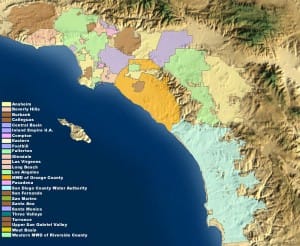
The Metropolitan Water District of Southern California (MWD) is the biggest supplier of treated water in the US. It delivers an average of 1.7 billion gallons of water daily to 17 million people in Los Angeles, Orange, San Diego, Riverside, San Diego, San Bernardino and Ventura counties. MWD is composed of 26 member agencies including the City of Los Angeles Department of Water and Power (DWP) and has quite rightfully been called the 800 lb. gorilla of California water.

When you turn on a faucet in southern California, the water probably originated hundreds of miles away and arrives through a byzantine system of water projects, canals, and tunnels. A major source of MWD water is the Colorado River Aqueduct, which is pumped uphill five times on its 242 mile journey from Lake Havasu. It has 92 miles of tunnels, 9 treatment plants, 9 reservoirs, and many miles of canals.

More water comes from the State Water Project, which originates in the Sacramento Delta. It delivers water to Central Valley farmers as well as to southern California.  It is the largest single user of electricity in California, at about 2-3%. In total, water pumping and treatment uses over 6% of total electricity in California.  Hydroelectric power can bring some power back, but water projects are generally net users of power, not net producers.

The final major source of water for MWD is the Owens Valley. This was a major focus of the movie ‘Chinatown’, which was a fictionalized account about William Mulholland and the water wars of the 1930’s. The Los Angeles Aqueduct moves Owens Valley water to L.A. and is owned and operated by DWP. Loss of water in Owens Valley has been a concern for decades. DWP is now legally mandated to restore water to the area, which means there is less to export.

This convoluted and expensive system, while certainly a marvel of engineering and dedication, is clearly somewhat less than sustainable. Southern California is semi-arid desert made lush by piping water from long distances. But the Sacramento Delta and the Colorado River are having serious problems. Water supplies that used to be reliable are no longer so.

Aquafornia says "In the West, it is said that water flows uphill towards money, and nowhere else could that be truer than here in Southern California." At the center of this is the Metropolitan Water District gorilla, which labors at the Herculean task of supplying clean water to 17 million people.  Even more than Central Valley agriculture, MWD is the primary power in California water politics. The MWD gorilla seeks increasing amounts of water and has the power and clout to get it. This makes everyone else nervous.

Adhere to the IVN etiquette

By posting a comment, you agree to adhere to our etiquette rules: No partisan attacks, no personal attacks, substantiate your sources, no self-promotion.

Contact IVN

Questions about this article or our coverage? Send us a message. A free IVN member account is required.

Message sent

Thanks, we’ll review it and get back to you if needed.

Message not sent

Sorry, something went wrong. Please try again.

Sign in to send a message

Messages are tied to your IVN member account. Signing in is free and takes a few seconds.

Republish this article

Republishing guidelines

Republish IVN articles for free. Independent Voter News articles may be republished online or in print under a Creative Commons BY-NC-ND 4.0 license, on these terms:

  1. Credit the author and IVN. Keep the byline ("By Author Name, Independent Voter News") and the attribution note at the end, which links to the original.
  2. Keep the meaning. You may update time and place references and apply your house style. You may trim for length, as long as the cuts don't change the meaning or misrepresent the author. Keep the headline. Mark any additions as your own (for example "Additional reporting by ...").
  3. Translations are welcome. Translate faithfully, add "Translated from English by [your outlet]", and tell us at editor@ivn.us.
  4. Keep the links, including the link to the original article.
  5. Keep the tracking image. The HTML includes a 1-pixel image that counts readers on your page. It collects no personal information.
  6. Photos and illustrations. Images credited to IVN may be used with this article only. Images credited to others (AP, Getty, Unsplash, Wikimedia and so on) stay under their owners' terms. Secure the rights or switch "Include images" off.
  7. Don't sell it. You can't sell our articles or sell ads specifically against them. Your normal site advertising is fine.
  8. No implied endorsement. Don't suggest that IVN or the author endorses you, your candidates or your causes, or that donations to you support IVN.
  9. Keep labels. Opinion or analysis pieces keep that label.
  10. Point search engines to the original. Where your CMS allows, set the canonical URL to the original IVN article.
  11. No bulk or automated republishing, and don't submit our articles to aggregators (Apple News, Google News, MSN) as your own.
  12. Corrections and removals. Update your copy when we correct it, and remove it promptly if we ask. We'll contact you at the email you give us.
  13. Questions or print republication: editor@ivn.us.

IVN staff: fill in who you're inviting above, then create the invite.

Preparing the article

California Water Wars Spotlight: MWD, The 800 lb Gorilla

Choose a format
  • HTML
  • Email HTML
  • Markdown
  • Formatted (.docx)
  • Plain text
  • WordPress blocks
  • PDF
Choose a platform

Photos credited to others need their owners' permission.

To for

Republishing somewhere else? Questions? editor@ivn.us