Social Media Sparks Democracy, One Click at a Time
 Jane Susskind
One of the core pillars of our political process is the belief that democracy works best when the most people participate. Yet with the election just one week away, we are confronted with a number of challenges to ensuring that our democracy functions to the best of its abilities. With the acceleration of technology and increased access to information, however, it has been found that social media sparks democracy.
Tools made available by social media have encouraged alternative voices to enter the political arena, voices that in previous years have been muted. As a result of technology, participation in the political process is accessible and direct engagement is feasible.
Through social sharing, social media users have the opportunity to broadcast political messages. By sharing a campaign or candidates' message, users are becoming advocates of that message. Passing political messages along to friends can have revolutionary effects in enhancing the democratic process.
On the local level, candidates and politicians are able to engage with residents of their city or town. By using Facebook and Twitter, elected officials have a direct experience with their government, and can represent the many voices in his or her community.
Adam Sharp, head of Government and Politics on Twitter, spoke to the importance of social media in expanding democratic reach at the Republican National Convention earlier this year:
"In a broader sense, what you're seeing is a democratization of access. That you don't need the same establishment infrastructure to get the same message out that you used to. We think back to the 1980 Republican Primary and that moment when Ronald Reagan took the microphone and said 'I paid for that microphone.' Anyone can have a microphone now and that microphone is free."
Without the topdown infrastructure of a major political party, he continues, social media paved the way for the Tea Party Movement to organize across state lines in 2010 and to find like-minded individuals who would not have connected in previous election.
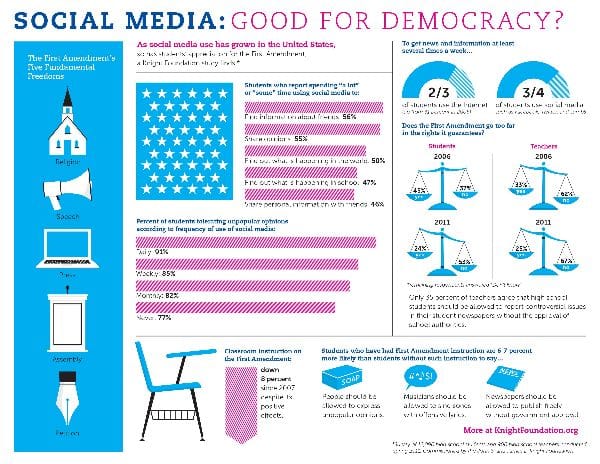
Social media has also been linked to increasing student appreciation for the First Amendment rights inherent in the democratic process. One of the key findings of a study conducted by Knight Foundation was that students who use social media have a higher appreciation of the First Amendment. Ninety-one percent of students actively on social networking sites agreed that "people should be allowed to express unpopular opinions," while students who had never used social media only agreed with that statement 71% of the time. Media Bistro visualized these findings into the below infographic:
Do you think social media sparks democracy? If so, in what ways?
You Might Also Like