
 Cara Brown McCormick
California lawmakers convened a joint legislative oversight hearing on February 17 to examine concerns that unclear cannabis packaging rules are undermining youth protections.
The hearing, held by the Joint Legislative Audit Committee and the Assembly Business and Professions Committee, focused on findings from the audit of the Department of Cannabis Control under the title: “Unclear Rules and Insufficient Enforcement Hamper Its Ability to Identify Packaging That Is Attractive to Children (Report 2024-105).”
“In general, we found that state law and DCC’s regulations about design elements that are attractive to children are unspecific, leading to subjective and sometimes inconsistent determinations of whether cannabis product packaging is compliant,” the audit report states.
The State Auditor further recommended that “the Legislature consider clarifying design elements that are prohibited from cannabis packaging.”
At the hearing, lawmakers discussed the State Auditor’s conclusion that existing rules lack precision.
That debate over clarity versus enforcement comes as a new white paper released on February 18 argues that California’s legal cannabis industry is not facing a youth marketing crisis, but a lack of clear definitions — and that the far more urgent problem lies in the illicit market, where packaging is openly and intentionally designed to attract children.
In The Packaging Problem: The High Cost of an Undefined Standard, author Tiffany Devitt takes on one of the most debated phrases in state cannabis law: the prohibition on products “attractive to children.”
The paper, prepared for the California Cannabis Operators Association, makes a straightforward claim: “California law prohibits cannabis packaging that is ‘attractive to children.’ Everyone agrees with the goal. The problem is that the laws don’t explain how to tell when packaging crosses that line.”
Rather than offering rhetoric, the paper offers definitions, data, and detailed policy recommendations.
A Standard Without Clear Edges
Devitt begins by contrasting the packaging rule with other youth protection measures in California law.
“Unlike other youth-protection rules in cannabis regulation — such as age-gated advertising, child-resistant packaging, or school setbacks — the ‘attractive to children’ standard lacks clear definitions, thresholds, or objective criteria.”
In other areas, the rules are measurable, objective, and enforceable. Setbacks from schools or daycare centers, for example, are measured in feet. Prohibitions on depictions of minors in advertising are unambiguous. But when it comes to packaging, the report says regulators and businesses are left without a consistent test.
“As a result, similar products can receive different treatment depending on who is reviewing them, when, and in what context.”
The paper directly points to the confusion: regulations prohibit the imitation of cartoons and candy. But, it asks, “What, exactly, is the difference between a cartoon, which is prohibited, and a drawing, which is not?”
“Two people can look at the same illustration and reasonably disagree,” it states. “There is nothing in regulation to resolve that disagreement.”
The result, according to the report, is that the standard becomes “elastic — expanding or contracting depending on who is applying it.”
That uncertainty, Devitt argues, is not theoretical. It plays out in routine packaging reviews, inspector conversations, and internal disputes between compliance and marketing teams.
The Compliance Gap
The Department of Cannabis Control has issued guidance on what may qualify as youth-appealing, citing mascots, anthropomorphized characters, and other design features.
But the white paper explains why that has not solved the problem.
“The guidance conveys risk but does not draw a line,” the report states. It relies on adjectives like bright or flashy, without defining what crosses the legal threshold.
Because guidance is not legally binding, legally operating cannabis companies face a dilemma: “Do we treat guidance as if it were law… or do we follow the regulations as written and accept the risk that guidance may be applied retroactively through enforcement?”
In a competitive market with declining sales, the paper notes, these decisions carry real financial consequences.
A Structured Review of 162 Brands
What sets the white paper apart is that it relies on no anecdotes. It conducts a structured review of 162 cannabis brands drawn from the top 150 selling brands in California and 50 Weedmaps award winners.
The goal, the paper explains, was “to ground the debate in evidence rather than assumption.”
Each brand was evaluated against six design features commonly cited in youth-appeal discussions: illustrated characters, anthropomorphic elements, bubble-style fonts, fantasy themes, candy imagery, and references to children’s entertainment.
The results are central to the paper’s credibility.
Out of 162 brands:
- 68 percent were clearly compliant.
- 22 percent fell into a gray area created by undefined terms.
- 10 percent were clearly problematic, arguably prohibited under current regulations.
“Among the most visible cannabis brands in California, youth-appealing packaging is not the norm,” the report concludes.
It adds that “most licensed brands are already operating within the bounds of existing law.”
The data also show that larger brands are more compliant. “None of the top 20 brands reviewed fell into the clearly prohibited category.” In contrast, among the smallest 20 brands, one in four raised serious concerns.
“The takeaway is not widespread noncompliance,” the paper states. “It is a concentration of uncertainty in the middle tier.”
The Real Outliers: The Illicit Market
The strongest section of the white paper may be its focus on the illicit market.
“If you want to see packaging that is genuinely designed to attract kids, look outside the legal market,” it states.
“The worst offenders are not licensed dispensaries or top-selling brands. They are unlicensed dispensaries and delivery services, smoke shops, and online drug sellers operating entirely outside the regulatory system.”
The report describes “direct knockoffs of Skittles, Nerds Rope, and Cheetos, along with cartoon mascots that would not look out of place on a Saturday-morning cereal box.”

“These are not close calls or matters of interpretation,” the paper says. “They are clear violations of California law, and they are putting young people at risk.”
More importantly, the report argues that the packaging is only part of the problem. In illicit markets, broader protections such as testing, labeling, and age verification are often ignored.
The implication is clear: enforcement resources may be better focused where risk is highest.
Precision, Not Prohibition
The paper does not call for sweeping new bans. Instead, it calls for clearer rules.
“California does not lack youth-protection rules. It lacks precision.”
Among its recommendations:
- Codify existing guidance into formal regulation.
- Define “mascot” based on expressive features and implied personality.
- Define “anthropomorphized element” as any non-human item given human traits.
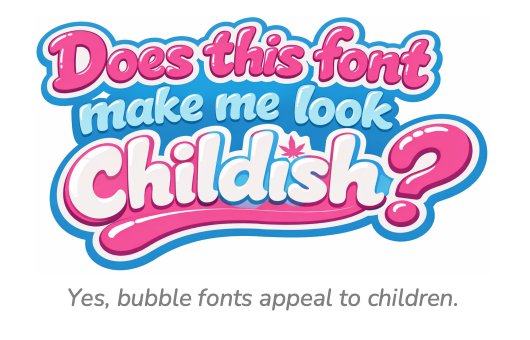
- Define “bubble or volumetric font” as rounded lettering resembling toy or candy branding and include it as a high-risk design element.
- Draw a clear boundary between describing flavor and imitating candy.
- Apply enforcement at the manufacturing level.
- Offer an optional binding pre-market review process.
- Prioritize enforcement toward unlicensed retail and delivery channels.
The conclusion is confident but measured.
“California’s cannabis market does not have a youth-protection problem. It has a definition problem.”
“The solution is straightforward,” the report states. “Say what ‘cartoon’ means. Define which typographic treatments are prohibited. Draw a clear boundary between describing flavor and imitating candy.”
“California does not need to rewrite its cannabis laws. It needs to finish drafting them.”
In a policy debate often driven by headlines and assumptions, the white paper stands out for its reliance on data, its acknowledgment of real violations, and its proposals for clear, enforceable definitions and standards.
Its central argument is simple: when rules are clear, compliance improves. According to the data, nearly 70 percent of the licensed market is already there.