Ideology is the Source of Political Gridlock

 Jacek Popiel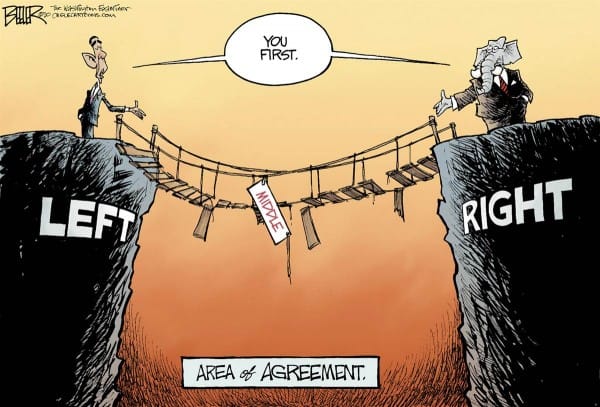
American politics have become alarmingly adversarial. Extreme partisanship has deemed any oppositional view as the dangerous "other," making ideology the source of political gridlock. In politics, identifying colleagues as the enemy is unlikely to produce workable solutions. It is also un-American. Our true enemy is not the “other side,” it is ideology: a man-made worldview reducing life to a simple formula.
Ideology divides humanity into two classes: Us, who know the “truth,” and Them, too dim to understand or too corrupt to agree. We are on a mission to perfect the world and They are the obstacle to progress.
The appeal of ideology is emotional security, born of the certainty of one’s own righteousness and moral superiority. The end goal is power, founded on the blind loyalty of one’s followers and the assumed greatness of the cause.
The United States was born out of the rejection of the reigning 17th and 18th century ideologies: “divine-right” monarchy, enforced religious uniformity, and national superiority. Our foundational documents enshrined individual liberty and pluralism. The First Amendment forbade state imposition of religious conformity. The Second gave the citizens the arms to oppose any such effort, be it religious or political. Many other constitutional clauses hold the similar purpose of ensuring freedom.
In a system designed to prevent enforced uniformity, the only orderly recourse is voluntary consensus between free individuals and the associations they choose to form. This has been “the American way” from the Revolution on, and historical experience supports the validity and strength of this model. But free persons are still imperfect, as the Founders well knew. The temptations of power – and tyranny – are never far from the political discourse.
Our system spectacularly failed in 1860, when radical minorities in North and South drove the nation to secession and war. The resulting conflict saved the Union and freed the slaves, but the price was huge: 600,000 dead (2% of the population), a century of bitter division between victors and vanquished, and three generations passing before ex-slaves obtained full civil rights.
By contrast, the deep and angry political divisions of the Great Depression years were overcome in the common effort to victory in WW II. The “Greatest Generation” did not gain this title through courage, ingenuity and sacrifice alone. They also were willing to recognize that victory against the outside enemies required internal unity.
We are today faced with a like choice. While our economy and national spirit weaken, we engage in ideological warfare against our fellow Americans, demanding obedience to our partisan principles while declaring theirs to be heresy. The sorry state of our federal government is a testament to our divisions.
This is common in times of uncertainty and perceived decline. In Europe and Asia, past ideological rigidities led to civil strife, terrorism, war, and the rise of tyrannical and murderous regimes. America largely escaped this fate through its ability of find the middle ground and focus on practical solutions to real problems.

Today we appear to be slipping in the wrong direction, but in the end none of us will profit from the weakening of our ideals. Our true enemies – be they authoritarian states or terrorists – can only rejoice at our bickering, while reaping the benefits of the resulting weakness and indecision.
We must decide: continued and fruitless civil strife and its consequences, or renewed cooperation and the perpetuation of the American Destiny.
You Might Also Like