Skip to content
Subscribe

Federal Judge Dismisses Lawsuit Challenging Tenn. Law That Suppresses Voters' Rights

A federal judge on Monday dismissed a lawsuit brought by the League of Women Voters (LVW) of Tennessee and a bipartisan group of voters that challenged a 2023 law that some plaintiffs said intimidated them out of voting in the August primaries.

Federal Judge Dismisses Lawsuit Challenging Tenn. Law That Suppresses Voters' Rights
Photo by Yunus Tug on Unsplash. Unsplash+ license obtained by author.
Published:

Photo Credit: Yunus Tug / Unplash+

A federal judge on Monday dismissed a lawsuit brought by the League of Women Voters (LVW) of Tennessee and a bipartisan group of voters that challenged a 2023 law that some plaintiffs said intimidated them out of voting in the August primaries.

In 2023, Tennessee lawmakers passed a law that made it a criminal offense for anyone who is not a "bona fide" member of a political party to vote in that party's taxpayer-funded primary elections.

Plaintiffs in the lawsuit challenging the law assert that it does not create a legal definition of what "bona fide" means or how that can be determined or enforced in the primary process.

Instead, voters were left confused by signs at polling locations during primary voting that looked like this:
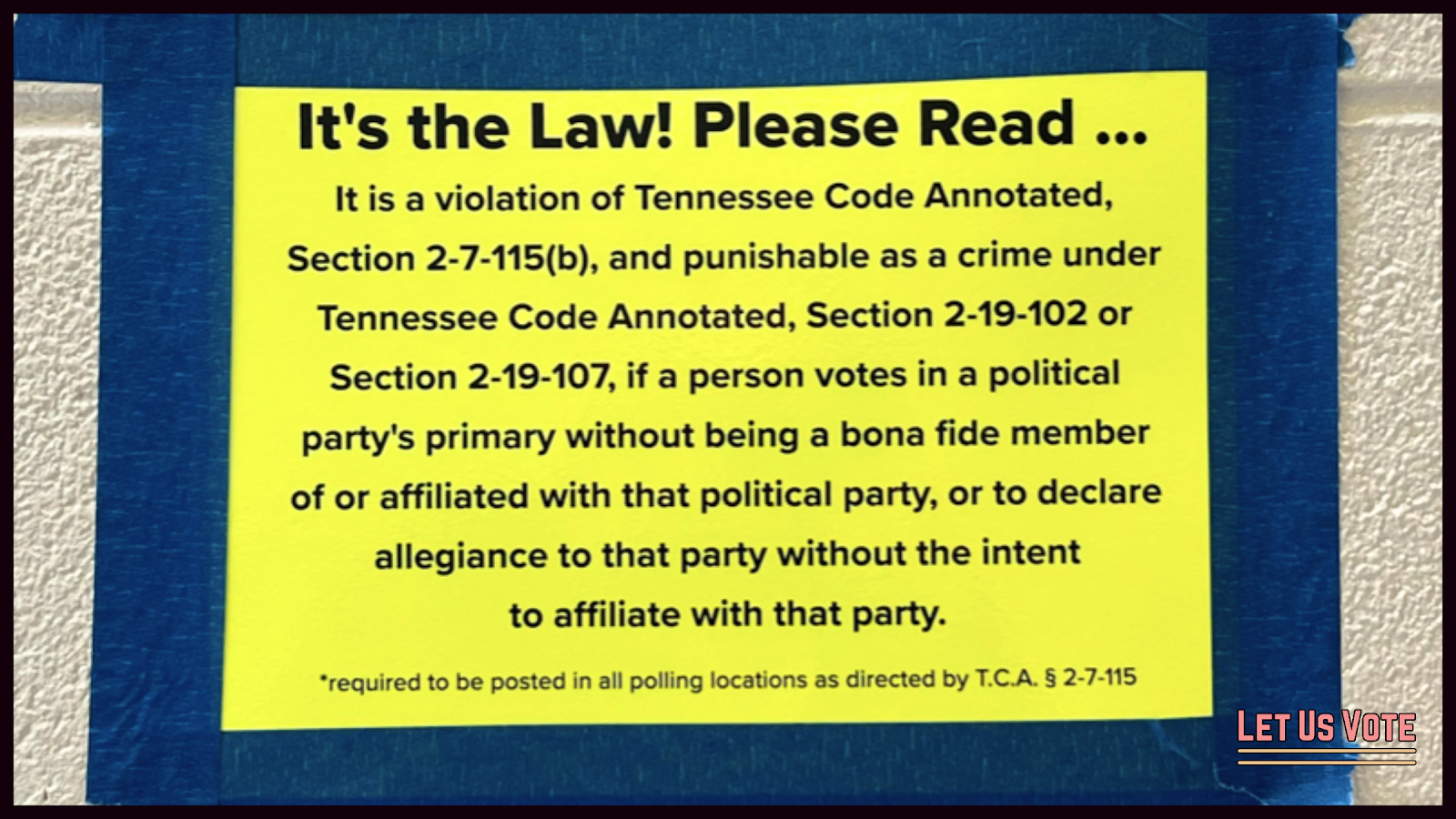
TN

Tennessee is technically an open primary state. Voters are not required to register with a party. However, state law does require voters to have allegiance to a party at the time they vote.

The 2023 law says voters who are not a "bona fide" member of one of two major parties can be prosecuted with a criminal misdemeanor or even a felony depending on the case.

“This law has discouraged Tennesseans from voting and will continue to cause unnecessary confusion for voters who rely on the League's nonpartisan voter information for clear guidance,” LVW of Tennessee President Debby Gould has previously stated.

Plaintiffs maintain that it goes beyond confusion and say the law is an intimidation tactic targeted at independent voters and "swing voters."

"After being targeted for voting in a primary for someone I've known since childhood, I feel strongly that this law is simply meant to intimidate voters and suppress the vote in Tennessee," said Tennessee voter and plaintiff Gabe Hart.

He added:

“I was told directly by my local D.A. that I should be concerned about being prosecuted; I was called a felon by a local elected official; and I was otherwise worried about both voting and speaking my mind because of this law."

Other plaintiffs had similar stories, including James Palmer who is the chair of an Industrial Development Board in Roane County. Palmer wanted to vote in the 2024 GOP primary but has supported Democrats in the past.

According to the lawsuit, he did not want to risk public embarrassment if someone challenged his right to vote.

Judge Eli Richardson ruled Monday that plaintiffs did not have standing in the case, and even if they did, the secretary of state and attorney general are entitled to "sovereign immunity."

Sovereign immunity is a legal doctrine that essentially protects government officials from lawsuits that do not have their consent.

According to inside sources, it is unclear right now what the LVW of Tennessee's next steps will be. There are a number of options to consider, or the group could drop the case entirely.

Stay tuned for further developments in this story. Special thanks to Jeremy Gruber at Open Primaries for providing updates.

Adhere to the IVN etiquette

By posting a comment, you agree to adhere to our etiquette rules: No partisan attacks, no personal attacks, substantiate your sources, no self-promotion.

Contact IVN

Questions about this article or our coverage? Send us a message. A free IVN member account is required.

Message sent

Thanks, we’ll review it and get back to you if needed.

Message not sent

Sorry, something went wrong. Please try again.

Sign in to send a message

Messages are tied to your IVN member account. Signing in is free and takes a few seconds.

Republish this article

Republishing guidelines

Republish IVN articles for free. Independent Voter News articles may be republished online or in print under a Creative Commons BY-NC-ND 4.0 license, on these terms:

  1. Credit the author and IVN. Keep the byline ("By Author Name, Independent Voter News") and the attribution note at the end, which links to the original.
  2. Keep the meaning. You may update time and place references and apply your house style. You may trim for length, as long as the cuts don't change the meaning or misrepresent the author. Keep the headline. Mark any additions as your own (for example "Additional reporting by ...").
  3. Translations are welcome. Translate faithfully, add "Translated from English by [your outlet]", and tell us at editor@ivn.us.
  4. Keep the links, including the link to the original article.
  5. Keep the tracking image. The HTML includes a 1-pixel image that counts readers on your page. It collects no personal information.
  6. Photos and illustrations. Images credited to IVN may be used with this article only. Images credited to others (AP, Getty, Unsplash, Wikimedia and so on) stay under their owners' terms. Secure the rights or switch "Include images" off.
  7. Don't sell it. You can't sell our articles or sell ads specifically against them. Your normal site advertising is fine.
  8. No implied endorsement. Don't suggest that IVN or the author endorses you, your candidates or your causes, or that donations to you support IVN.
  9. Keep labels. Opinion or analysis pieces keep that label.
  10. Point search engines to the original. Where your CMS allows, set the canonical URL to the original IVN article.
  11. No bulk or automated republishing, and don't submit our articles to aggregators (Apple News, Google News, MSN) as your own.
  12. Corrections and removals. Update your copy when we correct it, and remove it promptly if we ask. We'll contact you at the email you give us.
  13. Questions or print republication: editor@ivn.us.

IVN staff: fill in who you're inviting above, then create the invite.

Preparing the article

Federal Judge Dismisses Lawsuit Challenging Tenn. Law That Suppresses Voters' Rights

Choose a format
  • HTML
  • Email HTML
  • Markdown
  • Formatted (.docx)
  • Plain text
  • WordPress blocks
  • PDF
Choose a platform

Photos credited to others need their owners' permission.

To for

Republishing somewhere else? Questions? editor@ivn.us