
 Shawn Griffiths
CARSON CITY, NEV. - Registered unaffiliated voters in Nevada – the state’s largest registered voting bloc – came close to gaining real electoral power with the adoption of semi-open primaries. That is, until Gov. Joe Lombardo decided to keep their voices suppressed.
Not only that, but Lombardo also made the false claim that giving unaffiliated voters access to taxpayer-funded primary elections would go against the will of Nevada voters. Here is the communication between him and Nevada Secretary of State Franciso Aguilar:
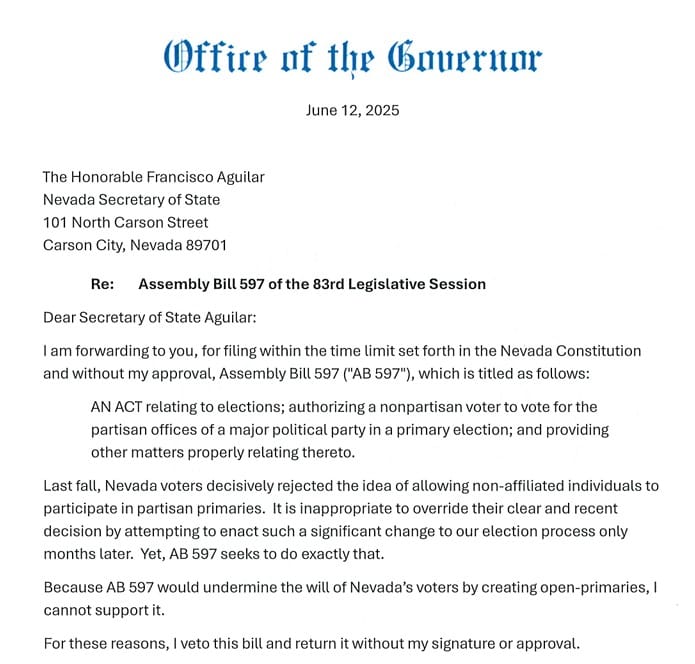
This veto notice is for AB 597. The bill would have established a semi-open primary system in which the state’s large independent voter population would be allowed to pick between a Republican and Democratic primary ballot.
Currently, these publicly administered elections are closed to party members only despite independent voters making up roughly 35% of registered voters and include more than 2.13 million Nevada citizens. This doesn’t include voters registered with a third party.
Here’s the thing: Lombardo falsely stated that voters “rejected the idea of allowing non-affiliated individuals to participate in partisan primaries,” referring to Question 3 on the November 2024 ballot. The measure failed 47% to 53%.
Question 3 implemented a nonpartisan, all-candidate primary in which all voters and candidates participated on a single primary ballot, regardless of party. Under the measure, the top 5 candidates would have advanced to a general election that used ranked choice voting.
It would have eliminated partisan primaries altogether in favor of elections that served a public function of narrowing the field of candidates most preferred by the electorate at-large, instead of selecting party nominees (something parties could do on their own dime).
AB 597, introduced by Nevada Assembly Speaker Steve Yeager:
- Kept partisan primaries
- Required party members to vote in their respective party’s primary
- Allowed independent voters to pick a party ballot
Notice the difference?
Notably, Yeager opposed Question 3. Both major political parties in Nevada and their leadership opposed the measure, but the biggest area of contention was not adopting open primaries. The parties’ main target was ranked choice voting.
Republicans called it a “California idea,” using the neighboring state as a political boogeyman to stir up objections in GOP and conservative circles. Democrats said it would be confusing for voters.
The parties and their aligned special interest groups knew how receptive voters were to open primary reform. In fact, critics of Question 3 accused its advocates of downplaying ranked choice voting in favor of the more popular open primaries proposal.
Mike Draper, the spokesperson for the “Yes on 3” campaign, called closed primaries “the most egregious” of problems the measure would solve, but it wasn’t the only focus. “The point is to create a system where (candidates) are incentivized to talk, to work together,” he said.
Yeager may have opposed Question 3, but he noted that the writing was on the wall. With the near passage of the measure and so many voters registered unaffiliated, it was only a matter of time before open primary reform passed:
The dam is going to break one way or another. The question is: Are we going to be part of the process?
Many Voters Don’t Know Enough About Their Own Electoral Processes
On top of mounted opposition from the parties and their allies, Question 3 faced another problem: insufficient voter education that stemmed from voters not knowing enough about the electoral system used in their state.
A 2023 Guinn Center survey highlighted widespread misunderstanding: 65% of Nevadans incorrectly believed primaries were already open, and 29% thought ranked choice voting was already in use.
From the Guinn Center:
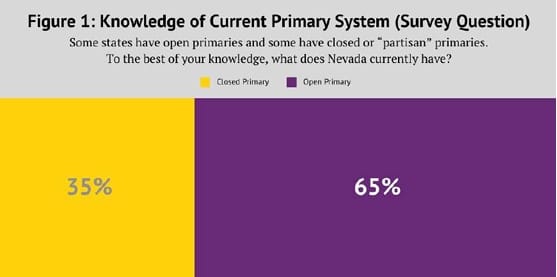
While this does underscore a lack of familiarity with the reforms, it also raises the question: How is it that two-thirds of the electorate could think the state already uses open primaries when more than 2 million voters are denied access to them?
Put simply, the electoral process in Nevada is already complex and confuses voters.
Independent voters still receive a ballot for some elections, but not all. For example, many cities and towns use nonpartisan primary systems, which can create the illusion of open primaries when local and state primary elections fall on the same day.
Then, in presidential cycles, there is the added complexity of the state’s closed presidential caucuses and primaries, especially as independent voters also receive sample ballots and campaign mailers.
The state does an inadequate job informing voters of their restrictions and options, which means reform advocates have to put even more time and resources into voter education while those who benefit from the status quo can simply target voter confusion.
The system and those that benefit from it already send mixed messages, and the governor telling people AB 597 violates the will of voters -- when it doesn't -- only adds more confusion to the issue.