High Court Says Law Enforcement Can Take DNA Samples without Warrant

 Shawn M Griffiths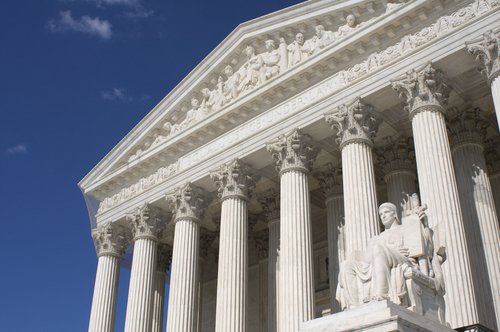
The Supreme Court of the United States ruled on Monday that law enforcement officers can take DNA swabs without a warrant for serious offenses.
Most 5-4 decisions fall on ideological lines, but not this one. Justices Stephen Breyer and Antonin Scalia “switched sides.” Breyer joined the conservative bloc to make up the majority and Scalia joined the traditionally liberal justices.
The high court ruled that there is no difference between taking fingerprints and obtaining a DNA sample to identify a suspect held without a warrant. The decision upheld a Maryland law that allows police officers to take a cheek swab from a suspect in custody for violent crimes, as long as there is probable cause for the arrest.
The court wrote:
"In this respect the use of DNA for identification is no different than matching an arrestee’s face to a wanted poster of a previously unidentified suspect; or matching tattoos to known gang symbols to reveal a criminal affiliation; or matching the arrestee’s fingerprints to those recovered from a crime scene."
In short, the majority opinion says DNA is identifying information which doesn’t require a warrant to obtain -- for the most part. Except, DNA is often treated as evidence. When it is not certain a person’s DNA can be linked to a crime, probable cause only gives law enforcement the right to get a warrant to obtain such evidence.
Scalia argued this point in his dissent. He said Maryland’s law “manages to burden uniquely the sole group for whom the Fourth Amendment's protections ought to be most jealously guarded: people who are innocent of the state's accusations.” In other words, the current state law challenges the idea of innocent until proven guilty.
The legal precedent set by the high court raises more than one question. Does the decision create a slippery slope? What constitutes a 'serious offense'? How could the definition of a serious offense change over time? If cheek swabs are just like taking fingerprints, is it possible that it will eventually become part of the booking process for all suspects arrested -- with or without a warrant -- regardless of crime? If so, what measures will states establish to ensure overworked labs do not make serious errors?
In all 50 states, DNA samples are collected from convicted offenders -- those found guilty in the court of law. Yet, Maryland is not the only jurisdiction to expand it to criminal arrests. Roughly ten percent of the profiles in the federal Combined DNA Index System are arrestee profiles.

In December, Congress passed the Katie Sepich Enhanced DNA Collection Act to help states pay for an expanded system to include arrestees. The federal grant program was named after a 22-year-old woman who was murdered in 2003, but the person responsible was not caught until three years later after being convicted of another crime.
Privacy groups have their own case to cite. Dwayne Jackson was convicted of armed robbery in 2003. A masked man broke into a Las Vegas home and attacked a woman and her two daughters. Armed with a baseball bat, the man demanded money from the mother. Jackson was one of two men arrested for the crime. DNA samples were taken from both men.
Though the woman could not identify her attacker, the DNA results that came back pointed to Jackson and that was the one piece of evidence that convicted him. He spent nearly four years in a Nevada prison before it was revealed that there was a DNA mix-up.
In the end, it is an issue of privacy versus public safety. While the high court’s decision has ruled in favor of Maryland, the issue at hand remains far from resolved for many. Since 911, laws that test the Fourth Amendment have become a growing concern for civil rights and privacy advocates everywhere.
You Might Also Like