
Photo: US News and World Report
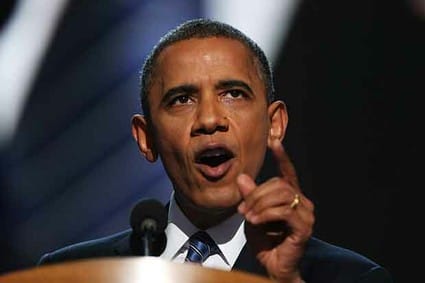
Carrying the key battleground state of Ohio, President Barack Obama has secured reelection to a second term in office, several news networks projected Tuesday evening.
In the weeks and days prior to the election, polling data and statistical projections consistently predicted a rather high likelihood of an Obama victory on election day despite a stagnant economy, which sixty percent of voters in exit polls Tuesday named as the number one issue on their mind. Health care clocked in at a distant second with only 17% percent of voters naming it as their top election issue.
Victory for an incumbent US president during economic stagnation and uncertainty is historically improbable, but Obama prevailed Tuesday, in part, because voters don't see the president as responsible for their economic struggles. Early exit polls found that half of voters still blame George W. Bush more than Mr. Obama for the country's economic woes.
"Victory" may also be too strong a word to describe Obama's reelection bid, which even commentators friendly to the president have criticized as overly-negative and half-hearted, especially compared to his historic, coalition-building 2008 campaign, which cast then-Senator Barack Obama as an inspirational, transformative figure, and focused on the positive themes of hope and change.
Historically, conditions were ripe for a Republican victory, as they were in 2010, when Republicans recaptured control of the US House of Representatives with a sweeping net gain of sixty-three seats. Instead of a Democratic victory this cycle, it may be more accurate to speak of a massive Republican fumble.
While the president's campaign lacked the heart of his 2008 bid, the candidacy of his main challenger, former Massachusetts Governor Mitt Romney, was an unmitigated disaster of negativity, policy vagueness, and constant missteps.
With the economy foremost in the minds of voters, the Romney campaign failed to offer a clear, positive, solutions-based plan of economic policy reform, and statements such as Romney's now-infamous 47% comments, made in an unguarded moment at a private dinner, left voters wondering whether a Romney Administration would make their economic well-being a priority.
Instead of reaching out to the entire electorate, the Romney campaign focused heavily on energizing the Republican voter base by making the repeal of Mr. Obama's signature legislative accomplishment, the Affordable Car Act, a centerpiece of the Romney campaign.
Unlike the 2010 election, in which the Tea Party largely set aside social issues and focused on the economy and mounting national debt, Republicans in 2012 piled onto the Romney campaign's missteps with a number of controversies over social issues, abortion, rape, and contraception.
The GOP may have set itself up for failure as early as the primaries, during which the constant refrain of movement conservatives, party leaders, and talking heads was that the most important thing for the Republican Party in 2012 would be to defeat President Obama, and that Mitt Romney had the best odds of securing the president's defeat.
American voters showed Tuesday that they are uninspired by a campaign of criticism without a clear, alternative set of substantive solutions.