Drug Wars in Mexico An Avoided Issue as Election Day Nears

 Kate Morris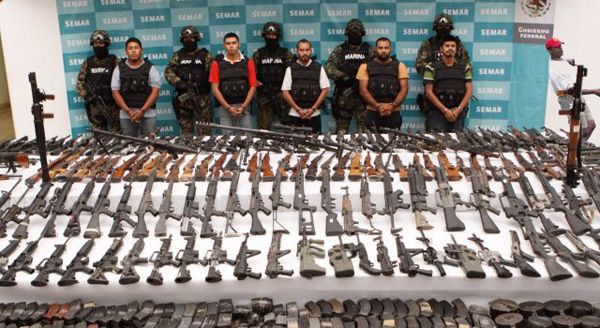
It was a January evening nearly three years ago when high school and college kids gathered for a birthday celebration in Ciudad Juarez, Mexico. They did not notice the twenty hired assassins pull up outside. Around midnight, the gunmen, working for the Mexican cartel, La Linea, made their move; opening fire on nearly sixty innocent kids. Then the hit men sped off, leaving fourteen dead and twelve wounded.
An estimated 60,000 Mexicans have died in turf war crossfires far too similar to the tragic massacre that occurred in Villas de Salvarcar. However, that tragic winter night opened the floodgates for a media sensation now widely known as the Fast and Furious scandal. Mexican officials identified three of the firearms the drug ring assassins toted as weapons supplied by the US government. Mexico’s military drafted a document linking the high caliber guns to a gun tracing operation run by the Bureau of Alcohol, Tobacco, Firearms and Explosives (ATF).
Univision News first exposed the document, identifying fifty-seven more previously unreported firearms which originated under Operation Fast and Furious. The effort was ATF’s attempt to monitor which high profile drug lords were obtaining and using unregistered firearms. The US government allowed 1,961 guns to ‘walk’ over the US-Mexico border and subsequently lost track of them. A congressional report concluded that many of the guns ended up in the hands of Mexican hit men.
Since Univision News’ initial report, more and more unsettling details have leaked about the controversial operation. A month ago, Congressman Darrell Issa and Senator Charles Grassley, the politicians spearheading the Fast and Furious investigation, cosponsored a letter to the Department of Justice's Office of the Inspector General, demanding further investigation in the scandalous case.
Despite the implications of the Fast and Furious scandal, the drug wars in Mexico weren't mentioned in any of the US presidential debates. The foreign policy focus centered on regions Americans perceive as potential threats to national security, such as China and the Middle East. This omission struck a livewire in Mexican communities on both sides of the border.
“I was shocked by the indifference,” said Sergio Arroyo, in a radio interview on PRI's The World.
Arroyo, a teacher at the Colegio de México, elaborated on his displeasure over the lack of focus on the issue by both candidates:
“I would have expected the recognition that something horrible is going on south of the border and that (officials) are starting to think and look at alternatives and work with the Mexican government.”
Romney’s official campaign site does say that “Mexico and the United States must take immediate action on the problem of violent drug cartels operating across our shared border.”

The GOP presidential candidate suggests that the solution to the issue is “an impermeable border fence protecting our southern frontier from infiltration by illegal migrants, trans-national criminal networks, and terrorists.” It is a highly US-centric remedy which does not mention or address active participation in conflict resolution.
Obama seems even more reluctant to address the issue. When Latin America came up in Boca Raton’s foreign policy debate, the incumbent leader steered the conversation to nations like Venezuela, Cuba, and Brazil. The president's focus was on nations in need of “greater freedom,” where we have opportunities to strengthen our economy or improve our global standing.
Ultimately, if Obama acknowledges Mexico’s uncertain future, he’d also be indirectly admitting failed policies in the region that happened under his administration. This is dangerous territory at a time when cross-border immigration is already a highly contested topic. Obama’s avoidance could be less about oversight and more about strategy.
Mexico is about to embark on a major shift in power. Last Summer, the country voted in a new president, Enrique Peña Nieto. Slated to take power this December, he will replace President Felipe Calderón, a leader who fought zealously to crack down on the gang violence destroying his country.
After Niento’s victory in July, the new leader promised he would continue combatting the nation’s drug cartels with the same bullheadedness as Calderón. Unfortunately the issue may be beyond his control. The political instability that comes with transferring power to a new head of state could easily welcome in a new wave of gang violence.
Whether America’s next leaders are deliberately avoiding the issue or not, this level of domestic focus could imply a troubling lack of priority on the issue. As bad as things are in Mexico, they could quickly become much worse.
You Might Also Like