Congressional Partisanship, in one chart

image
Published: 06 Aug, 2012
1 min read

Congressional partisanship is increasingly dividing lawmakers, policy debate is split along party lines, and the dissenting voice is diminishing in American politics.

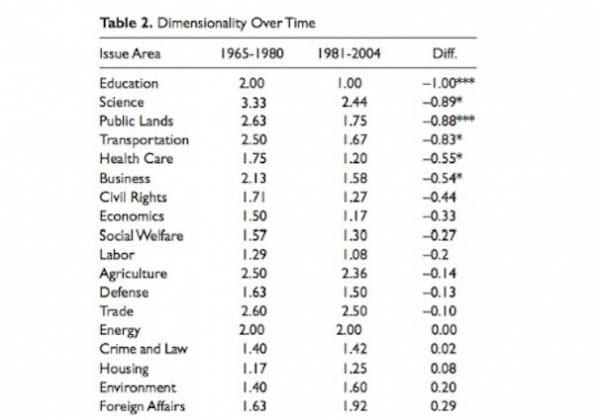
The cause? The increasing tendency of lawmakers to vote along party lines, making the debate over issues one-dimensional. The moderate voice in Congress has all but disappeared, and between the years 1965-2004, the dissenting voice has been muted.

Ashley Joachim and Bryan Jones further explain,

Issue-centric conceptions of congressional voting were replaced by ideological ones emphasizing the power of party and ideology to readily simplify the complexities of congressional life.

The Washington Post's Ezra Klein shows us why Congress is increasingly polarized, dissent is low, and debate is one-dimensional, in one chart:
Frustrated? So are most Americans, and Congressional approval ratings are at an all-time low. Join us Thursday, August 9 to discuss real solutions with non-partisan group No Labels on Twitter. Want more information about our tweet chat? Click here.

You Might Also Like

Trump sitting in the oval office with a piece of paper with a cannabis leaf on his desk.
Is Trump About to Outflank Democrats on Cannabis? Progressives Sound the Alarm
As President Donald Trump signals renewed interest in reclassifying cannabis from a Schedule I drug to Schedule III, a policy goal long championed by liberals and libertarians, the reaction among some partisan progressive advocates is not celebration, but concern....
08 Dec, 2025
-
5 min read
Malibu, California.
From the Palisades to Simi Valley, Independent Voters Poised to Decide the Fight to Replace Jacqui Irwin
The coastline that defines California’s mythology begins here. From Malibu’s winding cliffs to the leafy streets of Brentwood and Bel Air, through Topanga Canyon and into the valleys of Calabasas, Agoura Hills, and Thousand Oaks, the 42nd Assembly District holds some of the most photographed, most coveted, and most challenged terrain in the state. ...
10 Dec, 2025
-
6 min read
Ranked choice voting
Ranked Choice for Every Voter? New Bill Would Transform Every Congressional Election by 2030
As voters brace for what is expected to be a chaotic and divisive midterm election cycle, U.S. Representatives Jamie Raskin (Md.), Don Beyer (Va.), and U.S. Senator Peter Welch (Vt.) have re-introduced legislation that would require ranked choice voting (RCV) for all congressional primaries and general elections beginning in 2030....
10 Dec, 2025
-
3 min read