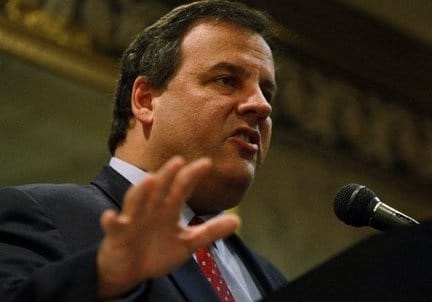
As recently reported, New Jersey’s Governor Chris Christie did what so many politicians are still unwilling to do: He called the War on Drugs a failure. In a speech at the Brookings Institution, Christie claimed that despite the benevolent intentions behind forty plus years of the drug war, the policy is ultimately a disaster: "We're warehousing addicted people every day in state prisons in New Jersey, giving them no treatment," Christie said during his speech. To belabor the point, the governor pointed out that the cost to New Jersey taxpayers for housing each prisoner is $49,000 a year. Though while Christie displays a willingness to break with Republican orthodoxy and strike out an independent position on drug policy, his proposed solution actually opens a new front in the War on Drugs.. The governor couched his approval of compulsory drug treatment in both moral and fiscal terms, saying that “very life is precious and every one of God's creatures can be redeemed, but they won't if we ignore them.” He also pointed out that a full-year of inpatient treatment runs about half the cost of imprisonment for a year. However, drug courts and drug treatment programs that rely on the criminal justice system are exactly the kind of well-intentioned programs that Christie acknowledges have failed.
Christie’s remarks came on the heels of the New Jersey Senate’s passage of S881, legislation that sets up a program requiring one year of mandatory drug treatment for first-time, non-violent drug offenders instead of jail. This law is essentially a companion piece of legislation to the drug courts that already operate in New Jersey– which Christie supports
While the idea behind drug courts sounds good in theory, law enforcement-managed medical treatment via programs like these offers up a whole host of perverse incentives and unintended consequences. The bill just passed by New Jersey’s Senate calls for mandatory treatment for all first-time, non-violent drug offenders. This legislation presupposes that all first-time, non-violent drug offenders are in need of drug treatment– which is most certainly not the case.
Not all recreational drug users are raging addicts, and some are very high-functioning. If Olympic Gold Medalist Michael Phelps had been arrested for marijuana possession, would he have needed medical treatment for an addiction? By mandating all first-time, non-violent drug offenders go to treatment for a year, treatment beds (which can be a scarce commodity for addicts) will be taken up by those who aren’t truly in need of a drug treatment and recovery program.
As Marquette Law Professor Michael M. O’Hear explains, the underlying problem behind this approach is combining the criminal justice system with drug treatment services. This turns law enforcement and police into the official gatekeepers for access to drug treatment. And someone legitimately in need of treatment for drug addiction shouldn't have to wait to be arrested before receiving the help they need.
When police are made aware of drug courts and new criminal justice-based treatment programs, it is quite likely that arrests for drug offenses will increase. Criminologists call this phenomenon net-widening effects. Essentially, police are now under the impression that arresting drug offenders and placing them into the criminal justice system will net a positive yield of some sort. These treatment programs are seen as new resources for handling drug cases, rather than as diversions, so police wind up arresting individuals that they normally would not. This can be seen from the experience of Denver, Colorado. The first year after instituting a drug court, drug filings in Denver increased almost 50 percent from the year before, when no drug court existed.
Moreover, once in the system, criminal justice-based drug treatment programs have high failure rates, so offenders can always be re-routed to prison for failing to complete the treatment program. Some offenders who fail drug treatment programs and wind up in prison end up serving longer sentences than if they would have simply been prosecuted conventionally. And the New Jersey law, which creates a blanket mandate for treatment for all first-time, non-violent drug offenders will undoubtedly send many casual users and unwilling participants into the yearlong treatment program, where failure for many of these individuals is almost a foregone conclusion.
I certainly applaud Gov. Christie’s willingness to acknowledge what the vast majority of the public already knows, though politicians won’t admit-- that the drug war is a major public policy disaster. However, continued reliance on drug courts and newly created criminal justice-based medical treatment (exactly the well-intentioned programs that the governor admits do not work) will not solve the problem that Christie seeks to address. In fact, it is entirely possible that these policies will have the opposite effect.
By bringing more drug offenders into the criminal justice system than normal, not all those arrested will be non-violent, first-time offenders and qualify for the treatment program– likely leading to greater levels of incarceration for drug offenders. Couple the high-failure rates of drug courts and mandatory treatment with the likelihood that many who qualify for this new program in New Jersey are likely to be recreational users and reluctant partakers in drug treatment, and the savings in costs to the New Jersey taxpayer that Christie has in mind when supporting this program may never be realized– all while more low-level, non-violent drug users are continually locked up in cages as prisoners in the War on Drugs.
If Gov. Christie truly believes in the failure of the drug war and wishes to seriously move away from the status quo, he should reconsider his position on the decriminalization of marijuana, a policy he has pledged to veto if it gets to his desk. Christie must also rethink his support for New Jersey’s medical marijuana law, which he only signed because of its extremely strict and narrow scope. That law must be loosened up to allow more patients access to medical cannabis than just those suffering from terminal cancer and other such debilitating medical conditions, as well as more dispensaries to make safe access to medical marijuana easier for those in need. Gov. Christie should also sign legislation that recently passed the state senate, making New Jersey’s pilot needle-exchange program permanent and open to any town that wishes to participate.
These are the kinds of reforms that will start moving us away from the War on Drugs and the ineffective criminal justice approach that has dominated drug policy for so long. The drug policy reform football is hanging in the air, waiting for someone to catch and run with it. As a pro-life Republican and former prosecutor, Christie is in a unique position to bring the moral cover required to make actual, serious, and lasting changes to drug policy. But actions speak louder than words, and for now, Gov. Christie is mostly bark and very little bite.