This California Disposable Vape Ban Could Devastate The Legal Cannabis Industry Even Further
 Cara Brown McCormick
Good intentions often make for compelling policy. But in practice, consequences rarely fall in line as neatly as the ideas that inspired them.
California’s flavored tobacco ban has been on the books for years. SB 793 passed in 2020, voters doubled down with Proposition 31 in 2022, and lawmakers piled on again with AB 3218 in 2025, creating an Unflavored Tobacco List and tougher penalties on paper.
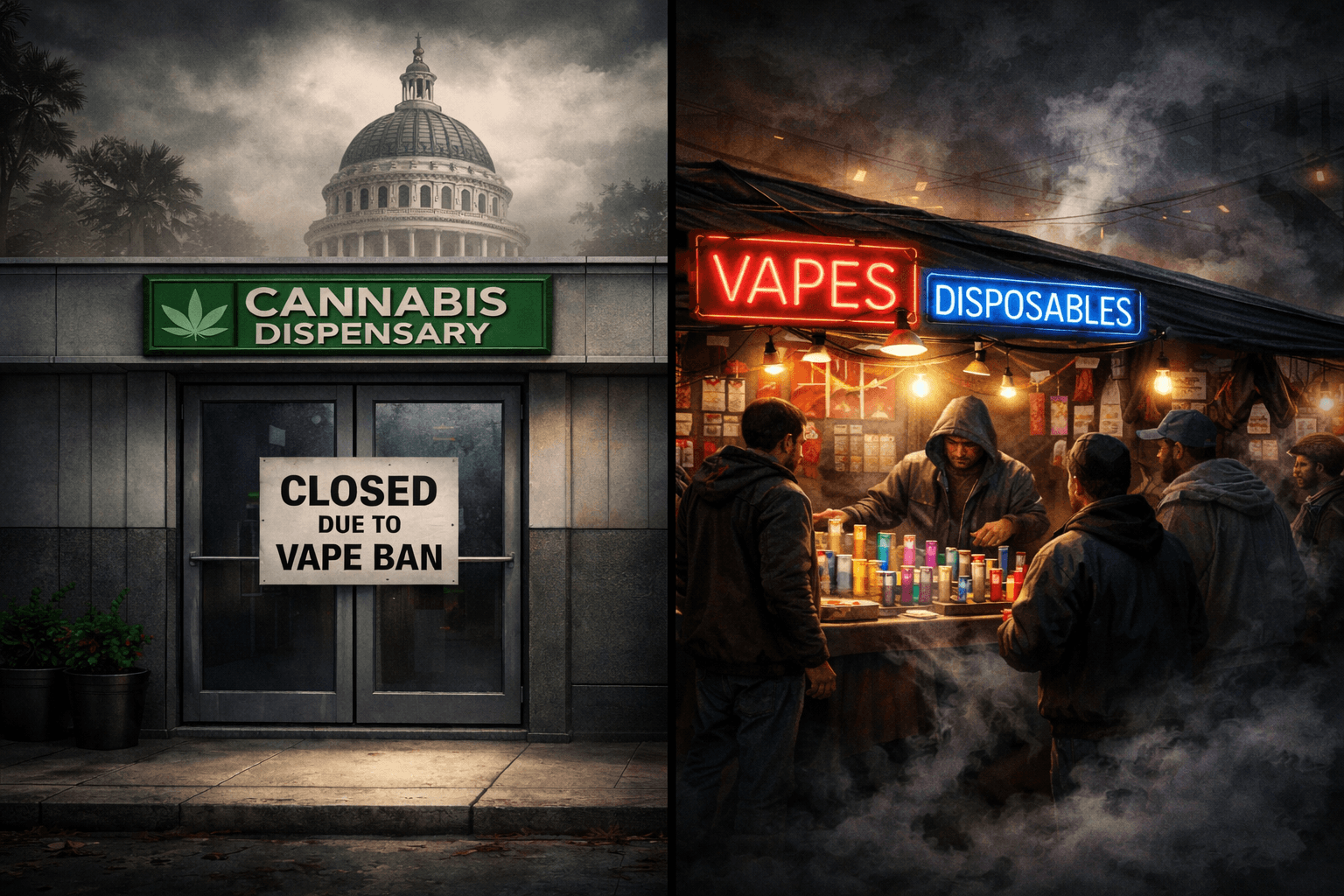
Yet walk into almost any smoke shop in California today, or even a kiosk sitting out in the open at a shopping mall, and flavored vapes are still available right there behind the counter. This is the reality of a ban without enforcement, where the only businesses actually harmed are the licensed, tax-paying retailers who try to follow the law and lose customers as a result. Consumers do not stop buying. They simply shift to the thousands of black- and gray-market sellers operating in plain sight, with little fear of consequences.
Now, California’s cannabis industry faces another pivotal test on Tuesday, January 13, when Assembly Bill 762 by Assemblymembers Jacqui Irwin and Lori Wilson comes before the Assembly Business and Professions Committee. The measure would prohibit disposable vape products, a proposal that supporters frame as an environmental reform and opponents warn could destabilize an already struggling regulated market.
For years, California’s legal cannabis businesses have been weighed down by high taxes, extensive regulation, and unfair competition from the illicit market. New federal tariffs on imported vape hardware, packaging, cultivation tools, and compost have intensified that pressure. “Those relying on exports from nations with tariffs, such as China, will need to take a serious look at how they might absorb the extra costs or alter partnerships,” said Bryan Gerber, CEO of Hara Supply. MJBizDaily has reported that some brands plan to pass those costs to consumers, which could make legal cannabis even less competitive with unregulated sellers.
Regulators have also acknowledged that high taxes keep the illicit market dominant.
“The black market is very pervasive, and it is definitely larger than the legal market,” said Bill Jones, head of enforcement for California’s Department of Cannabis Control.
AB 762 would ban all disposable vapes, including cannabis products, defined as any device that is not both rechargeable and refillable. Because refillable cannabis vapes are already prohibited under state law, the measure would effectively eliminate the entire category.
At an April 8, 2025, hearing before the Assembly Environmental Safety and Toxic Materials Committee, Amy O’Gorman Jenkins, Executive Director of the California Cannabis Operators Association, said that describing these products as single-use is inaccurate. “A half-gram device delivers around 150 doses, and a full gram provides more than 300. These are used over weeks or months, not discarded after one session,” she wrote in her testimony.

Assemblywoman Irwin argues that the bill is about environmental safety, citing concerns over battery acid from discarded vapes. “We must transition away from these harmful single-use devices, and AB 762 will do just that,” she said at a news conference covered by IVN last February in Sacramento.
O’Gorman Jenkins warned that removing regulated vapes from store shelves would push consumers further into the unregulated and unsafe illicit market, which faces none of the legal, environmental, or product safety requirements.
“California’s legal cannabis industry is among the most regulated in the world. In contrast, the illicit market faces none of these requirements,” she said. “The public health risks are real,” Jenkins added, referencing the 2019 EVALI outbreak, which the Centers for Disease Control and Prevention linked to illicit market vapes. “Removing compliant, tested products does not protect consumers; it exposes them to far greater harm.”
A coalition of organizations has written in support of AB 762, including its co-sponsors Californians Against Waste, the California Product Stewardship Council, CALPIRG, and ReThinkWaste. In their coalition letter, they wrote: “Single-use vapes contain embedded lithium-ion batteries that cannot be easily extracted from their plastic encasement, contributing to an egregious waste of valuable resources.”
Opponents argue that the bill would not reduce demand but instead shift sales to unregulated sellers. The American Petroleum and Convenience Store Association wrote that “AB 762 will drive consumers to the unregulated, illicit market, increasing risks to public health and safety. Prohibiting the sale of disposable, battery-embedded vapor devices will not eliminate consumer demand, but merely shift sales to the unregulated and illicit market.
This shift creates multiple risks. Products sold through the illicit market are not subject to the same safety standards, age verification, or quality controls that licensed retailers must adhere to. As a result, consumers, particularly young people, are exposed to potentially dangerous products that may contain harmful substances or defective batteries. Moreover, illicit sellers have little incentive to comply with California’s strict regulations, undermining the state’s efforts to protect public health and safety.”
The California Cannabis Operators Association added that “AB 762 is both premature and counterproductive to California’s efforts to build a safe, sustainable, and legally compliant cannabis market. Rather than achieving its intended goals, AB 762 will empower illicit actors, reduce opportunities to educate consumers on proper disposal, and undercut tax-generating legal sales that fund youth programs, public health services, and environmental restoration. We believe there are more balanced policy approaches that can improve environmental outcomes without jeopardizing consumer safety or weakening California’s regulated cannabis market.”
A report by the Reason Foundation estimates that as much as two-thirds of cannabis sales in California take place on the illicit market. Because unlicensed products are not tested or inspected, they can pose health risks. In August 2019, emergency department visits linked to cannabis vaping products increased sharply, with 2,807 hospitalized cases or deaths reported to the Centers for Disease Control and Prevention. Much of the outbreak was traced to unlicensed and untested products.

Similar concerns have surfaced in the tobacco sector. A 2023 study commissioned by Altria collected more than 15,000 publicly discarded cigarette packs and 4,529 vapor product packages from ten California cities. The findings showed that nearly all the discarded vapor products were flavored, despite California’s ban on flavored tobacco products, suggesting that illicit supply chains remain active.
Recent amendments to AB 762 update the effective dates to reflect the passage of time since the bill’s introduction. The revised language now prohibits import or manufacture of disposable, battery-embedded vapor inhalation devices beginning January 1, 2027, and prohibits sales and distribution beginning January 1, 2028.
Registered opposition includes the American Petroleum and Convenience Store Association, BizFed Central Valley, the California Asian Pacific Chamber of Commerce, the California Business Roundtable, the California Cannabis Industry Association, the California Cannabis Operators Association, the California Chamber of Commerce, the California Distribution Association, the California Fuels and Convenience Alliance, the California Grocers Association, the California Hispanic Chambers of Commerce, and NorCal Pheonix, Inc.
As lawmakers prepare for the January 13 hearing, the debate over AB 762 reflects California’s ongoing effort to balance environmental priorities with the economic realities of a legal cannabis market still in competition with a widespread illicit one.
You Might Also Like