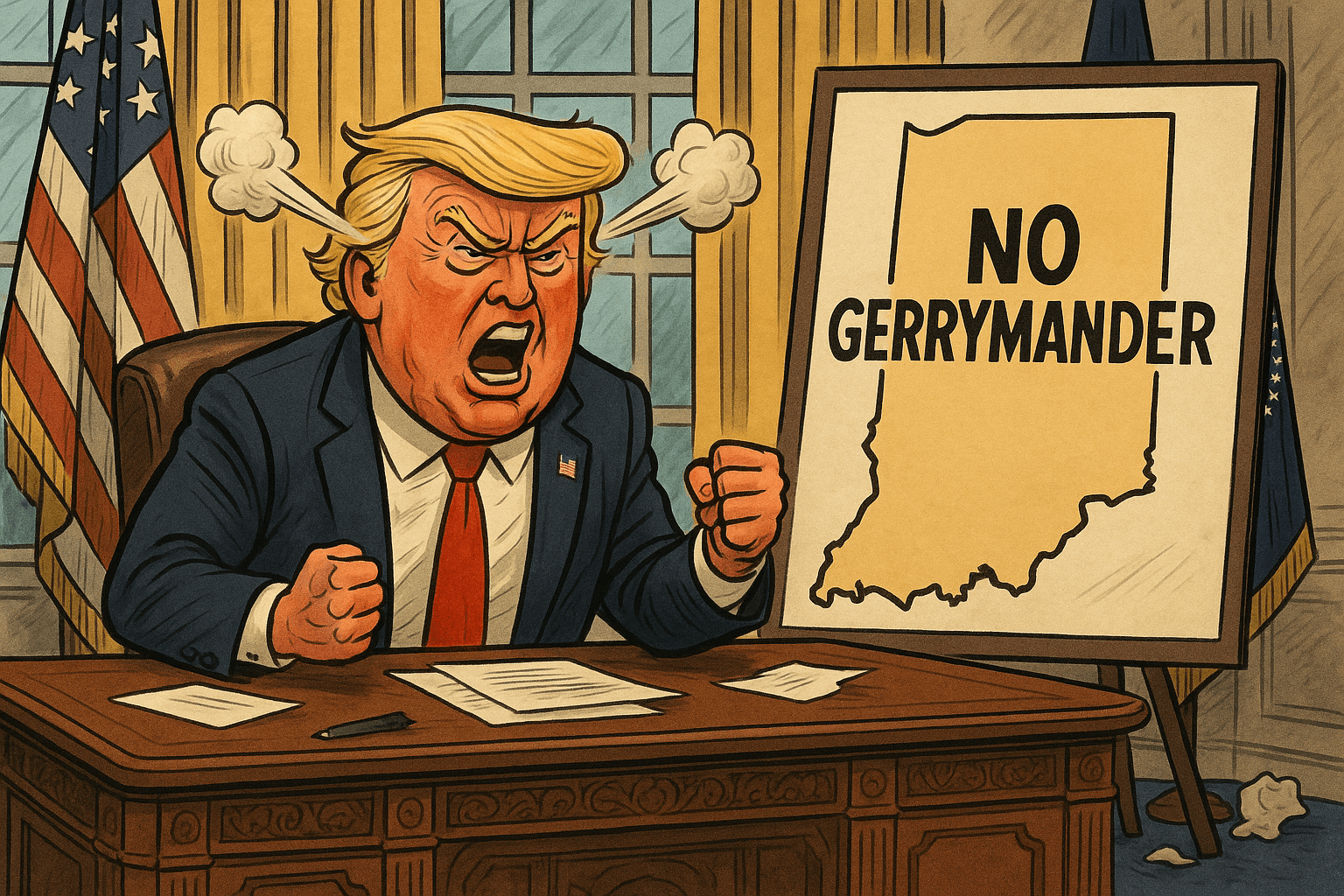
California Democrats are getting ready for a fight they can’t win. And taxpayers will foot the bill for the privilege.
Governor Gavin Newsom, backed by national party operatives, appears poised to put a statewide gerrymander on the ballot under the banner of “fighting Trump.” The plan? Overturn California’s Independent Citizens Redistricting Commission, redraw congressional maps, and lock in party control well into the next decade.
The problem? This isn’t really about Trump, and the Democrats’ own numbers suggest it’s a losing gamble.
A Manufactured Trump Crisis
The stated justification for a rushed special election is to counter Republican gerrymanders in states like Texas and Ohio. This ignores the fact that Ohio is required to redraw districts in time for 2026 because of a voter-approved initiative.
And if this is truly about “checks and balances,” why not let the maps expire in 2026? The answer is obvious: national Democrats want maps locked through 2030 to save money and shore up safe seats.
Newsom has made it clear he sees this as a fight he can’t walk away from.
“These guys are ruthless on the other side,” he said at an August 8 press conference. “We can control what we can control. We’re not going to unilaterally disarm. We’re not going to allow them to roll us over.”
And in a letter to President Trump on August 11, he issued a direct challenge:
If you will not stand down, I will be forced to lead an effort to redraw the maps in California to offset the rigging of maps in red states. But if the other states call off their redistricting efforts, we will happily do the same. And American democracy will be better for it.”
Some operatives are even floating the idea that Trump could run for a third term. This is a non-serious constitutional impossibility without an amendment requiring approval from 38 states. It’s a scare tactic, and that is all.
But Newsom’s stance has collided with an unusually broad wall of opposition. On August 1, 2025, leaders from groups as diverse as the California Farm Bureau, the League of Women Voters of California, Open Primaries, the California Hispanic Chambers of Commerce, the Independent Voter Project, and the California Manufacturers and Technology Association sent a joint letter urging him to abandon the plan.
Voters created this Commission through two ballot measures to remove self-interest and partisanship from the redistricting process,” the letter states. “It enforces strict conflict-of-interest rules, ensures diverse and balanced representation, and mandates public input at every stage. That reform — approved by the people — deserves protection, not political re-engineering.
The Math Doesn’t Add Up
Newsom has framed the move as both practical and principled. “It’s always the right thing to do the right thing,” he told reporters on August 8, even as his critics argue the numbers don’t justify the gamble.
Democrats now control 43 of California’s 52 House seats, including several competitive districts that flipped from Republican to Democratic hands last November.
Current congressional lines drawn by California’s independent commission are already winnable for Democrats. A targeted investment in competitive districts, like seats held by Reps. Kiley, Valadao, Kim, and Calvert, could flip at least four seats in a favorable cycle without the need to touch the commission.
Our national analysis of the proposed gerrymandered districts shows no guaranteed net gain for Democrats. Some newly drawn seats could even swing Republican in a strong GOP year.
Opponents note that California’s commission process has worked. In 2021, the commission passed congressional and legislative maps unanimously, without a single lawsuit. It held more than 250 public meetings, heard thousands of hours of testimony, and reviewed more than 35,000 public comments.
The result was widely hailed as transparent, independent, and fair.
A Costly Distraction
According to recent estimates, the special election alone could cost California taxpayers more than $200 million. This is before factoring in the hundreds of millions more that will be poured into newly competitive districts by both parties and their aligned super PACs.
Newsom said he wants the special election held on the first Tuesday in November, aligning it with local elections already scheduled in many communities. That timing, he argued, would make it easier to organize quickly and could help offset an estimated cost of more than $200 million — though he added that “there’s too much at stake” to be deterred by the price.
“How much did it cost to have the theatrics with the National Guard and Trump?” Newsom asked, pointing to the president’s recent deployment of thousands of troops in Los Angeles to quell immigration-related protests. “How many hundreds of millions of dollars was wasted?”
For Newsom, the price tag is part of the fight. “We don’t move unless they move,” he said on August 8. “They drew first blood.” It’s a framing that resonates with party loyalists but could alienate independents who view California’s commission as a national model worth protecting.
The August 1 coalition letter warns that using “the dysfunction of other states to justify dismantling California’s voter-approved reforms sets a dangerous precedent,” turning independent redistricting into a political bargaining chip that could sink California into “political quicksand.”
Of course, consultants on both sides are happy to take their cut. For them, a prolonged, high-dollar fight is lucrative. For voters, it’s just another reminder that political insiders see elections as an industry.
National Ambitions in Play
It’s no secret that Gavin Newsom wants a bigger role in national politics. Forcing a high-profile redistricting battle with Trump’s name attached is a way to insert himself into the national narrative heading into the 2026 midterms. But it risks alienating independent voters in California, who overwhelmingly support keeping the independent commission in place.
Newsom says he supports independent redistricting nationwide. Yet here he is, willing to dismantle the “gold standard” in his own state for a short-term partisan gain.
The Wrong Fight at the Wrong Time
Democrats could use the next cycle to build a majority the right way: by competing for the broad middle, leveraging California’s diverse electorate, and showing faith in the independent process voters chose. Instead, they’re poised to spend hundreds of millions on a partisan gambit that, at best, nets them nothing. A national gerrymandering contest could hand Republicans an enduring advantage.
“This is the time to defend and recommit to a democracy that puts voters, not politicians, first,” the August 1 coalition concluded.
This is not a national fight Democrats can win. But it is a fight they can lose, badly. And when it’s over, voters will be left wondering why the party that claimed to champion fair maps and voting rights was the one that tore them up in a state that had something to be proud of.
Missouri state officials are getting slammed with lawsuits over a new congressional map that People Not Politicians (PNP) says should be frozen after it submitted over 300,000 signatures to let voters decide to keep or reject the map....
People Not Politicians (PNP) submitted over 305,000 signatures last week to freeze a congressional gerrymander passed by the Missouri Legislature in September. However, state officials are doing everything they can to pretend this citizen revolt isn’t happening....
Things looked like they could get even more chaotic this week in the mid-cycle gerrymandering arms race between the two major parties as the Indiana Senate took up a new congressional map to give Republicans an even greater electoral advantage in the state. But Indiana Senate Republicans this week put their foot down and declared that they want no part in this race to the bottom....
The Institute for Mathematics and Democracy (IMD) has released what may be the most comprehensive empirical study of ranked choice voting ever conducted. The 66-page report analyzes nearly 4,000 real-world ranked ballot elections, including some 2,000 political elections, and more than 60 million simulated ones to test how different voting methods perform....
California’s 67th Assembly District stretches across parts of Orange and Los Angeles counties, connecting some of the region’s most dynamic and diverse suburban communities. It includes the entire cities of Cerritos, La Palma, Hawaiian Gardens, Artesia, Buena Park, and Cypress, as well as portions of Fullerton and Anaheim....
WASHINGTON — President Donald Trump announced Thursday that his administration will officially move cannabis from Schedule I to Schedule III under the Controlled Substances Act, a decision that marks the most significant change to U.S. drug policy since the early 1970s....


 Chad Peace