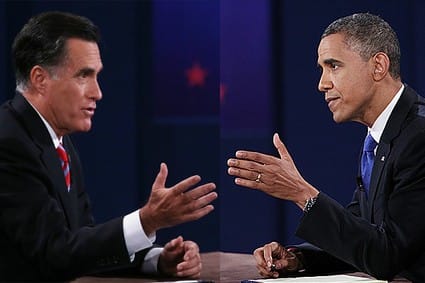
Post Debate Analysis: No Difference on Foreign Policy
By W. E. Messamore on 10/23/2012 in 2012, foreign policy, libertarian, Middle East, Obama, presidential debate, Romney, terrorism, War and Foreign Policy, war on terror with 33 CommentsRead Time: 4 - 6 minutes
Tuesday morning, all the partisan commentariat was abuzz with differing interpretations and spin on the presidential foreign policy debate last night. Mr. Obama’s sympathizers more or less, say he clearly won the debate. Mr. Romney’s sympathizers say he won. One post debate poll shows Obama with a two-to-one lead over Romney. Another shows Obama leading, but by much less.
The problem is, there wasn’t much of a debate for either candidate to win. It was more of a televised “agreement” than a televised debate. For all the talk of polarization, the foreign policy consensus between Washington’s two biggest party establishments and their presidential candidates is so tight that there is substantively little to no difference on foreign policy between Barack Obama and Mitt Romney.
Though the struggle and clash between the two candidates is more entertaining, so most mainstream media sources are going to great lengths to emphasize it even where it doesn’t really exist, in one pre-debate analysis at Politico, the writers were refreshingly on point:
“Mitt Romney has a clear-eyed and self-aware view of his chances in the final debate Monday, according to top advisers: It will be almost impossible to win, since the debate is focused exclusively on foreign policy, a strength for President Barack Obama.
This view isn’t merely about expectations-setting. Romney’s top advisers authentically worry that the swing voters they need to woo care little about foreign affairs right now. And, even if they did, the differences between the two men on many of the highest-profile issues — ending the Afghan war and the bloodshed in Syria — are too slight to draw sharp distinctions.” [bold emphasis mine]
Their prediction turned out to be all-too-true. Glenn Greenwald’s live blog of the foreign policy presidential debate tells the story:
“9.27pm: It’s 27 minutes into the debate, and so far the two have agreed on far, far more than they’ve disagreed. In fact, I’m not certain that they have actually disagreed on anything yet.”
Then seven minutes later:
“9.34pm: Both candidates are eager to ignore the topic of this debate – foreign policy – in order to talk about the economy because they perceive, accurately, that this is what most voters care about, and because they don’t really have much to disagree in the foreign policy area. And so they are now dispensing with any pretense and regurgitating their economics debate.
But US foreign policy actually does have a significant relationship to the economy- namely, the massive military, the constant aggression, war and occupation, the hundreds of military bases around the world all drain resources away from far more constructive purposes – but neither of these two candidates will dare to question any of those imperial premises, so they can’t actually address the prime economic impact of US foreign policy.” [bold emphasis mine]
And halfway into the debate:
“9.43pm: Obama boasts of the massive amount of military spending under his presidency. Romney then says he wants to spend more. It is inconceivable that anyone would suggest that spending almost more than all other countries on the planet combined is excessive. That is the election in a nutshell.”
Iran, Israel, Egypt, Syria, drones, US global hegemony as foreign policy… on down the list of foreign policy issues and zooming out for a broader look at US foreign policy in general, throughout this “debate,” the candidates were eagerly competing, not for voters’ support of differing foreign policies, but for voters’ belief in each candidate’s unwavering fealty to the exact same foreign policy consensus.
The debate wasn’t about whose ideas are better, it was about who is better committed to the same idea, an idea that politicians and journalists treat as unquestionable, not up for serious debate. That’s one reason why candidates like Jill Stein and Gary Johnson, who do have substantively differing foreign policy ideas, are not allowed into the televised presidential debates of the CPD despite appearing on enough states’ ballots that they could actually win in November if enough voters heard and liked their message.
The purpose of this editorial isn’t to take sides in the clash over foreign policy, but simply to point out that there should be a debate, that more than one side should be heard, and that the more ideas that are welcome to the table, the more dynamic our political process will be and the better policy results Americans will get.
Obama and Romney may be right about Iran, Israel, Egypt, and Syria. Their consensus on US foreign policy may be correct. But pretending that there isn’t an actually rather tight foreign policy consensus between the two is pointless and unhelpful, except for media advertising dollars. And how will voters know for sure that the Obama / Romney consensus is correct unless the media allots competing ideas more than a token amount of usually derisive attention?


Leave Your Comment →
33 Comments
Lucas Eaves
10.23.2012
@lucaseaves
Agreed that last night was not a real debate not only because of the agreements but because the 2 candidates clearly decided that they would take that debate as a last chance to describe their plan to boost the economy.
W. E. Messamore
10.23.2012
@W__E__Messamore
Anyone else realize it’s not a coincidence that when nations go to war that a recession almost inevitably follows? Post-war recessions (or mid-war recessions for a war that goes this long) are the “tax” workers end up paying for the war. That’s the irony here. They wanted to talk about improving the economy during a foreign policy debate so that they wouldn’t have to spend as much time talking about the foreign policies they support that are damaging the economy.
Terri Harel
10.23.2012
@tlharel
Absolutely. The amount of money that has been sunken into these wars can barely be comprehended and this isn’t the same world as after World War II and there is little opportunity to boost the economy in such a robust way as there was then..
I was very disappointed by the fact that they kept turning the conversation back to the economy. American involvement throughout the globe is important to pay attention to, especially where we are sending a huge amount of money, number of troops, and resources.
Alex Gauthier
10.23.2012
@alexg
their agreements were partly the fault of the questions being asked. there are many other areas of foreign policy that were largely ignored. things like the euro banking crisis and others could have given the candidates the ability to distinguish opposing viewpoints.
Chelsea Perera
10.23.2012
@cmperera
I agree, I think both candidates focused on their relationships with more high profile countries , most obviously Middle Eastern nations. Mexico and Latin American countries also went largely untalked about as well.
W. E. Messamore
10.23.2012
@W__E__Messamore
Right? There’s a massive drug war with body counts rising in countries that are neighbors with the US, and it was overlooked in the FP debate. Very poor topic selection in my opinion.
William Boardman
10.24.2012
@williamboardman
The “War on Drugs” really isn’t a foreign policy issue.
Nor should it be.
Michael Higham
10.23.2012
@michaelhigham
“The debate wasn’t about whose ideas are better, it was about who is better committed to the same idea.” Could not have said it better myself.
The tried to find their differences, so much so that they began to talk about education and job growth. 20 minutes into the debate. And of course watching the post-debate analysis on TV was fun. Fox News had a great time talking about Romney boasting military spending and shutting down Obama the whole night. It’s just so superficial to talk about who “wins” debates. It’s not constructive and it hardly even matters. Let’s take these debates for what they’re worth.
Tim LCR
10.23.2012
Wes: Your thoughts match mine precisely; there was no discernible difference between the two men “discussing” foreign policy last night. We have to look elswhere for a presidential candidate who thinks outside the box on foreign policy.
Laurence Bernard
10.23.2012
Both will attack Iran and risk the possibility of triggering WWIII by provoking China and Russia, both are puppets of special interests. Why should we have any foreign policy at all? Stay out of the business of other countries and worry about cleaning up your own backyard first
Jimmy Kidwell
10.23.2012
There use to be a difference between them, then Mitt changed positions again, and again, and again, and again, etc etc….
Ed Walsh
10.23.2012
You missed it or I did. What was Romney’s again ???????
Michael Snider
10.23.2012
Romney’s position was the same as Obama’s. If Gary Johnson had been in the debate there would have been serious, thought provoking discussion of foreign policy issues
Hudgens Tee
10.23.2012
“When you are a blind man in the woods, you just follow the one who can see instead of stumble around and make yourself look like even more of a fool.” He agreed with everything because he didn’t know what to say anyway! His foreign policy is made up of 17 out 24 of Bush 43′s old policy advisors… no one in their right mind will go for that crap again.!
Peteeyy DeNicola
10.23.2012
they’re both pathetic!!
Pamela Moyer
10.23.2012
It’s hard to have a discussion of policy when one person just keeps parroting the other. I agree with that, and that, and so on. It wasn’t very helpful in understanding the differences between the two, I agree.
Kelly Craven
10.23.2012
It’s not that there isn’t a difference, it’s that Romney wants people to think there’s no difference in a lot of his/GOP’s positions to those of Obama/Dems’ — there are actually quite stark differences on almost all issues, including foreign policy and the fact that Romney knows that he needs to lie about them to get elected should tell you something about those positions.
Adrian Todden
10.23.2012
Both of these guys are off base. Bring in Gary Johnson.
Johnny Ritchie
10.23.2012
No. If a third party had a shot they would have been included. Much damage can be done in four years or much gain filling in Bush’s Great Recession. Obama 2012.
Tom Tanton
10.23.2012
at one point I actually thought IVN was in fact Independent. Now I know they’re just shills for Obama campaign. Only an idiot, at this stage, would think that a vote for a third party does anything than guarantee four more years of wasteful cronyism, divisiveness, and charade. Look at the actual behavior of Obama, not his trite words last evening, filled with positions diametrically opposed to his actions. No daylight between us and Israel? Ask Benjamin N.
Lucretia Lulu Talley
10.23.2012
^^^ Boy Bye ^^^ being INDEPENDENT gives you the right to vote for whomever we choose! I’m #INDEPENDENTforOBAMA2012
Jamianne Von Prude-Elle
10.23.2012
Ditto to Tom Tanton above comment
Jessica Horman
10.23.2012
Did any of you watch the expanded debate on Democracy Now. They live streamed pausing for third party response from Jill Stein and Rocky Anderson. You can go back and watch it on democracynow.com Also there is a third party debate on tonight on Free and Equal.
William Boardman
10.24.2012
@williamboardman
Good stuff —
pitched a story on it —
no response from IVN
Nanson Hwa
10.23.2012
We have millions upon millions of business men in America but it takes a different set of skills to be a President.
Scott S DiVincenzo
10.24.2012
No such thing as independent voter ! Of the two parties YOU lean 49% / 51% ! No such thing as independent voter.
Norio Mold
10.24.2012
it isn’t wasting a vote. you are voting. Not voting is a waste of a vote.
William Boardman
10.24.2012
@williamboardman
Looks like folks missed the disclaimer at the end —
the one that said:
“I’m Mitt Romney and I approved the President’s messages.”
William Boardman
10.24.2012
@williamboardman
This piece misses the central — and important — dynamic of the debate:
Romney played the yes-man.
That obviates debate.
Obama’s presidential actions are what they are,
and they can only be debated is someone takes them on.
This is an example of how being “even-handed_ can be misleading.
Casey Tench
10.24.2012
WWRPD?
Paula Hooper Denmon
10.24.2012
I took the online quiz and agree with Jill 96%, Obama 90%, Libertarian 36%, Republicans 0%. But I will vote for Obama, because I do believe that votes count… and I could not in any way let my vote help Romney.
Wayne Alexander
10.25.2012
Our Foreign Policy is a joke!
Hai
10.25.2012
@hailife
Foreign policy issues that I think should’ve been addressed in this debate:
1. North Korea
2. Anti-ballistic missile defense
3. International trade and piracy
4. Tension in the South China Sea
5. Iraq and Afghanistan Status of Forces Agreements
6. Mexican violence and corruption