California Auditor Finds Millions In State Funds Wasted

 Alex Gauthier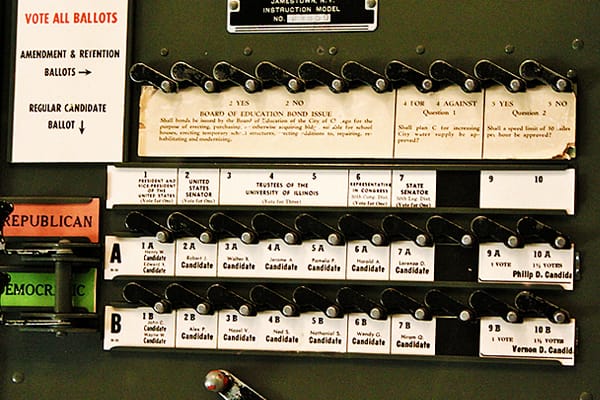
Lever operated voting machine // Credit: RadioFan
An August 9 California State Auditor report found millions in wasted public funds spent over the last decade on outdated or unusable voting systems and a public-private contract gone awry.
The Help America Vote Act, passed in 2002, allocated $380 million to upgrade California's election infrastructure. Of that, nearly $131 has gone unused, whereas an estimated $22 million went towards "replacing voting systems with new systems that counties and voters cannot fully use."
According to the report, the issue stems from conflicts between subsequent Secretaries of State. Chief among them, the decision to implement (then revoke) some touch-screen or DRE, computer-based, voting systems.
"As a result, some counties that used HAVA funds to buy certain voting systems subsequently found that they could no longer use these systems or could use them only with significant restrictions."
The current Secretary of State, Debra Bowen, plans to implement standardized regulations by 2015, set to be drafted this October.
Likewise, the current CalVoter database was described in the audit, by the deputy secretary for HAVA as "not a sustainable solution." This prompted the CalVoter system to be updated, and VoteCal take its place. The project is set to cost $98.2 million of the unused HAVA funds, however an initial attempt failed in 2012 when the private consulting firm Catalyst Consulting Group failed to meet key deadlines exacerbated by contractual ambiguities and ultimately costing taxpayers $4.6 million.
CGI Technologies and Solutions, Inc. won the latest contract to take on the VoteCal project at nearly double the cost ($38.7 million) of Catalyst's proposed budget. It was the only bidder.
New features like polling place look-up, online ballot tracking, and additional tools for online voter registration can positively impact voter registration. VoteCal is expected to be fully deployed by June 30, 2016.
A variety of recommendations were made by the auditor's report, primarily it emphasized that public funds could be utilized more effectively on the state's voter registration and election systems:

- Formally renegotiate its agreement with by discussing the need to pursue VoteCal and obtaining clarity as to what aspect of the current CalVoter system, if any, does not meet HAVA’s requirements.
- The Secretary of state should make it a priority to develop regulations describing voting system standards in accordance with state law.
- The Office's practice of providing the Legislature with financial information that does not come from its accounting system unnecessarily weakens a key accountability and transparency tool.
You Might Also Like