

We’ve all seen that road before: The “Pothole Express.” It’s a violent massage for you and your car.
Across the political spectrum, many Americans agree that the government is responsible for building and maintaining highways. All highways are not created equal, of course. The quality of the pavement and the efficiency of highway management vary from state to state. A variety of factors contribute to these results, but recent research by Truth in Accounting (TIA) suggests that a state’s overall financial health plays a significant role in explaining if you’ll be driving in the fast lane on “Smooth Street” or bouncing your way along “Bump Boulevard.”
Recently, the Reason Foundation released their 20th annual evaluation of state-owned highway systems. This study covers eleven main categories, including congestion, road and bridge condition, fatality rates, and the cost-effectiveness of highway spending. The study produces an overall ranking of the states on highway performance. (Find your state’s rank here.)
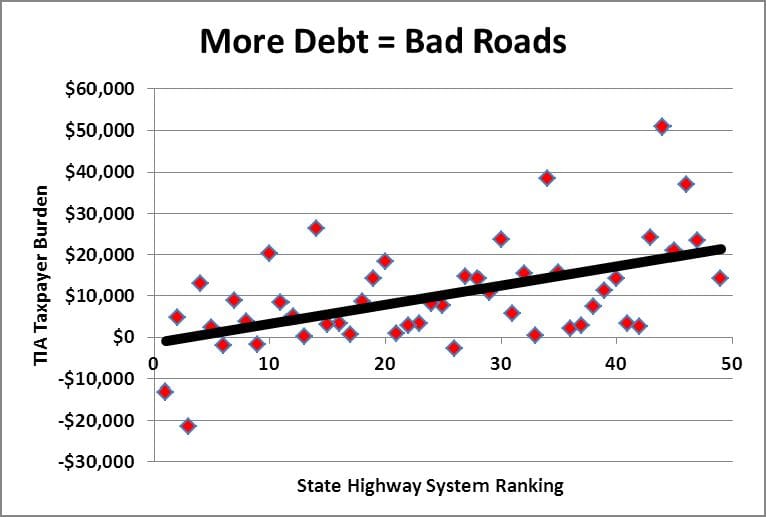
Looking at the latest highway performance ranking for the 48 continental United States, TIA noticed something interesting and meaningful. States with better financial conditions have better highway performance, as appraised by the Reason Foundation, while states in higher fiscal stress tend to have lower rankings.
This result is consistent with other evidence of reduced government service quality in states with worse fiscal health as measured by the Taxpayer Burden. Both Medicaid acceptance and ability of non-profits to operate efficiently generally improve in states that have a strong financial position.
We are looking forward to studying the relationship between Truth in Accounting’s findings and the Reason Foundation’s study further. For now, we note one other element of common interest – the need for timely reporting. TIA recently wrote on the tardiness of certain states’ financial statements, and the Reason Foundation noticed a similar trend. Their latest highway study arrived in July 2013, but much of the latest data on which researchers relied only covered the years up to 2009. Commenting, the research leaders offered the following lament:
“Unfortunately, the release of some data (such as for pavement condition, financial statistics and mileage) is increasingly delayed, while the release of other data (such as for traffic accidents, congestion and bridge condition) is more timely. In the internet era we should not have to wait more than two years for basic information on road conditions, financial statistics or other key measures. These delays threaten the timely usefulness of our national data reporting systems and directly impact our ability to make sound policy decisions based on recent data. Until these issues are resolved it will be difficult to track, in timely fashion, the overall condition of the U.S. highway system against targeted goals or to identify and assist states that need help in meeting goals."
--David Hartgen, professor emeritus at University of North Carolina-Charlotte, leader the Reason Foundation study. In an age where so much data is being put to such great work and creating so many efficiencies, perhaps our governments could find a way to produce more timely data.
Want to see how your state stacks up, on these and other metrics? Check out State Data Lab.