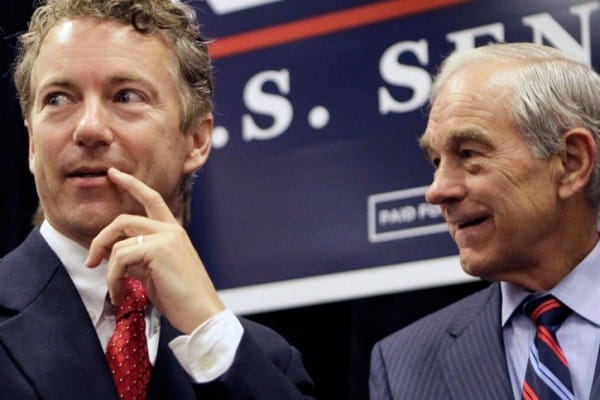
Ron Paul Retires From Congress; His Influence Still Abounds
By Drew Martin | 01/09/2013 | Activism, Congressional, Headline, Movements, Organizations | 26 CommentsRon Paul retired from Congress last week, yet his influence is only growing. Despite not winning the Republican Party’s nomination for president, the 77-year-old resident of Texas has no doubt made his mark on American politics.
To the armchair pundit, it may appear the longtime maverick ruffled a few feathers in office, but ultimately his movement’s time in the spotlight faded. Yet, nothing could be further from the truth.
Even Dr. Paul stated in his farewell address to Congress that, on the surface, his career has seemingly had little influence:
In many ways, according to conventional wisdom, my off-and-on career in Congress, from 1976 to 2012, accomplished very little. No named legislation, no named federal buildings or highways-thank goodness. In spite of my efforts, the government has grown exponentially, taxes remain excessive, and the prolific increase in incomprehensible regulations continues. Wars are constant and pursued without Congressional declaration, deficits rise to the sky, poverty is rampant and dependency on the federal government is worse than any time in our history.
Paul added, “The ultimate solution is not in the hands of the government. The solution falls on each and every individual, with guidance from family, friends and community.”
It is this sentiment that has not only set him apart from his now former colleagues, but spawned an intellectual revolution throughout the country and even the globe. Perhaps the most unique characteristic of Paul’s career and his supporters is their trademark emphasis on the importance of ideas versus personality or partisanship.
Rather than parroting talking points of how he would more efficiently manage the federal government, Paul dared to ask more fundamental questions such as what is the proper role of government in the first place and why do we allow the government to meddle in our personal lives at all?
From Paul’s perspective, the sole purpose of government is to protect the individual’s right to life, liberty and property and nothing more.
For years, these ideas were championed on the floor of Congress, but often fell on deaf ears as the mild-mannered former obstetrician gave dyer warnings of an aggrandizing police-state, recessions induced by central banking, and a costly, counterproductive foreign policy; much to no avail.
Paul was a man in the wilderness and his calls for strict adherence to the constitution were viewed as archaic rantings from a man out of touch with reality.
When those warnings were presented on national television during the 2008 presidential campaign and were later proven correct however, many Americans took notice.
The turning point that launched Paul into stardom was a rather heated exchange he had between former governor of New York, Rudy Giuliani, in which Paul insisted that terrorism was an unintended, yet predictable consequence of an interventionist foreign policy.
After being chided for his remarks and urged to rescind them, Paul doubled-down and cited the CIA theory of “blowback” which suggests that intervening in the affairs of other nations, no matter how well-intended, often produces unforeseen and problematic results.
Paul cited the invading of Iran and installing the military dictator Shah in 1953 that would provoke the taking of American hostages years later. He has since noted the ill-fated relationships the U.S. government has created with Saddam Hussein, Osama bin Laden, Hosni Mubarak, and our interventions in Libya.
Overnight, this unconventional Republican became a YouTube sensation as thousands of young people, conservatives, libertarians, disaffected liberals, and independents became enamored with this most unlikely of heroes. By simply standing his ground and refusing to toe the party line, Paul unwittingly sparked a fire in the hearts of millions.
By proposing more substantive solutions to the problems America faces, Paul was not only able to expose Americans to different ideas, but he also challenged them to consider why they held their current beliefs in the first place.
Paul’s 2008 campaign fell well short of top tier status. It would, however, inadvertently inspire a separate movement of grassroots activists outraged by excessive spending, higher taxes, and unbalanced budgets: the tea party.
This spontaneous and organic groundswell of concerned Americans bolstered a class of first-time candidates to victory in 2010, including Ron Paul’s son, Kentucky Senator Rand Paul, Representative Justin Amash (R-MI), and Senator Mike Lee (R-UT).
Riding a wave of discontent throughout much of the country in the wake of TARP and the passage of the Affordable Care Act (Obamacare), these freshmen “tea partiers” immediately sought to change the conversation in Washington.
Senator Paul, in particular, quickly made a name for himself by presenting a plan to balance the budget in only five years, calling for drastic spending cuts and abolishing four federal departments altogether. Paul failed to get the budget passed, but he succeeded in shedding light on how many in both parties fail to address these issues seriously and often fail to live up to their rhetoric.
In the two years since their election, senators Paul, Lee, Rep. Amash, and others have made their presence known by echoing calls for spending cuts and limited government that for years were only heard from a lone congressman from Texas.
From calls to abolish the TSA to bridle indefinite detention to opposing tax increases, the “constitutional conservatism” of Ron Paul’s disciples has successfully ushered in a new generation of Republican leadership and has set the standard for what it means to be so.
Congressman Paul fell short again of winning the GOP presidential nomination in 2012, but doubled the total number of votes he received in 2008 to two million in the primaries and left Congress with many achievements, including the overwhelming passage of his “Audit the Fed” bill in the House.
Despite the fact that President Obama was re-elected, last November demonstrated two significant points regarding the future of American politics.
First, the election of several “Ron Paul Republicans” to the House, as well as Ted Cruz to the Senate, and numerous states opting to determine their own positions on gay marriage and marijuana legalization are indicative of a sweeping change among the electorate who are yearning for decentralization, constitutionalism, and self-government.
Most importantly, it delivered a clear message to the Republican Party that it must adopt these Jeffersonian principles if it wishes to remain relevant in the future. All of this is the result of one man’s tireless struggle to bring his party back to what he considers its roots.
From the tidal wave of tea party activists, to the resurgence of monetary policy being discussed in the mainstream media, and the influx of constitutionally-minded conservatives now taking their places on Capitol Hill, it’s quite evident Ron Paul’s career will not be remembered as a mere flash in the pan; but as the source of a growing tide from which we will likely see ripple effects for years to come.


Leave Your Comment →
26 Comments
Jane Susskind
01.09.2013
@jsusskind
Ron Paul has undoubtably had a huge influence on political ideology in America. It will be interesting to see who steps up and continues his legacy, so to speak.
Adam
01.09.2013
Maybe this guy…
http://ivn.us/2013/01/06/georgia-rep-paul-broun-introduces-audit-the-fed-legislation/
Drew Martin
01.09.2013
Jane it’s difficult to say. There will never be another Ron Paul. He’s far too unique in personality and the manner in which he carries himself. But Amash, Thomas Massie, Ted Cruz (who was endorsed by both Ron and Rand) and others have the ability to carry his ideas forward. But my money is on Rand. I see Ron and Rand as two sides of the same coin: Ron’s the purist philosopher which was necessary to inspire a movement, Rand is the chess player who’s very talented at playing the political game to make libertarianism more mainstream. But only time will tell.
Lucas Eaves
01.09.2013
@lucaseaves
Even if i do not agree with most his ideas, i respect the way he always remained constant and did not change his opinion every election cycle to please the voters.
Alex Gauthier
01.09.2013
@alexg
I think it will be a long time before another political figure like Ron Paul emerges again
Shawn M. Griffiths
01.09.2013
@shawntx
Ron Paul is considered the godfather of the tea party movement, but I think it has moved away from him. It has been taken over by the far right, which isn’t always in line with Dr. Paul’s thinking. I wouldn’t call Ted Cruz a “Ron Paul Republican.” He is a tea party Republican, but I don’t think the two are synonymous.
Drew Martin
01.09.2013
I think that’s debatable Shawn. The original Tea Party you’re right was fare more aligned with Paul’s views because it grew out of his 2008 campaign. I wouldn’t say it’s drifted to the “right” however, at least not as I perceive that. To me Ron and Rand Paul represent conservatism proper. In my humble opinion, authentic conservatism is in line with the Barry Goldwater/Robert Taft mentality and sometimes almost indistinguishable from libertarianism. The American conservative movement itself grew out of the libertarian ideas of radicals such as Albert Jay Nock, Ludwig von Mises and others in the early 20th century. I do think the Tea Party has become more dominated by social conservatism than it was before, (which I don’t have an issue with; I’m a social conservative-but I’m also libertarian). More than anything I believe the Tea Party has become more moderate in the sense that it’s essentially become a cheering squad for the establishment GOP-directly the opposite of what it was originally intended to be. I don’t consider the GOP establishment to be “right-wing” at all, but mostly liberals and neoconservatives who’ve drifted to the GOP for political influence.
Drew Martin
01.09.2013
far*
Jonathan Flowers
01.09.2013
Thank god!
He’s a freaking loon!
And son Rand is worse then he is!
Joshua Boschke
01.09.2013
I didn’t realize that following the constitution, restoring sound money, and actually thinking before we go into war was considered loony. He was right. We are too far gone.
Jason Harsha
01.09.2013
His influence was not enough to sway either party away from their path of totalitarianism. Both sides want to limit our freedom while taking more and more control of our lives. RP at least wanted to get back to Constitutional government, but I fear that will never be as those in power remain there so long as the electorate remains a bunch of group thinking, scared idiots.
Ty Lott
01.09.2013
He opened my eyes to the idea of liberty and how corrupt are government is. He taught me the constitution is what we need and that the fed must be abolished.
Krystal Gleiche
01.09.2013
Ron Paul is and forever will be my HERO! <3
Gray Fox
01.09.2013
http://cdn.memegenerator.net/instances/400x/23666054.jpg
Kathryn Leighton
01.09.2013
Hey, Libertarians!!
So what do you kids think of the government forcing people in some cases to get a flu shot or either get fired or not be able to go to school? How does it sit with Ron’s kids??
Joel Hadley
01.11.2013
@joelhadley
No one should be forced to put something into their body. Individual employers should set their own requirements for employment. Schools should be run independently and set their own requirements for enrollment.
Davis Jackson
01.09.2013
Ron Paul will be recognized as a legend after everything is said and done.
Judy Ferro
01.09.2013
He’s been like a pressure valve when people got too mad at the Rs…
Susan Crouse
01.09.2013
A legend in his own mind.
John Stewart
01.09.2013
He was a great independent thinker who has thankfully left a lasting impact. I may not agree with him on everything but he’s certainly a legend.
Jonathan Flowers
01.10.2013
His theories are flawed just like most libertarians.
Shrink the gov’t into nonexistence.
Meanwhile leaving the poor and elderly to fend for themselves.
Get rid of the dept of education so states like Mississippi and Texas can go back to the good ol separatebut equal days.
Get rid of the EPA because clean air and water are just “special interests”.
Looney.
Jenny Jo
01.10.2013
Classic example of someone who doesn’t understand libertarianism, Ron Paul and what he stood for, nor states’ rights and what this country was founded on. Maybe try reading what he actually stood for next time, rather than spewing socialist progressive talking points, before making yourself look this silly again.
Joel Hadley
01.11.2013
@joelhadley
We put the the government in charge of educating our children, then wonder why they emerge from the experience believing the government is a benevolent, capable friend (in addition to knowing nothing about history, economics, or how the government actually functions). This is the result, people!
Drew Martin
01.12.2013
@dmartin1010
Jonathan as the great political economist Frederic Bastiat stated, for those who advocate for state control, always presume that if we object to government doing it, that must object to it being done at all. This is is not a counterargument, it represents a lack of one. First, I strongly believe in charity and helping the poor and elderly-but stealing from someone else does not give you any moral credit, it actually discredits you from having any moral ground to stand on. Secondly, the government you claim has protected the environment so much is actually one of the worst polluters in history due to its massive wars, dumping of toxins, etc. Also, a basic understanding of economics would demonstrate that the same government you believe has protected the poor has been making them poorer and adding to their number for a century. By increasing the money supply, it destroys the value of the dollar and actually steals the savings and earnings of people, while transferring that wealth and purchasing power to the wealthy and politically-connected; thus the massive income gap we now see in the US. Whereas prior to the Fed and central banking, we had begun to grow one of the largest middle classes and most economic mobility ever seen. It’s also worthy to note that same government is responsible for taking trillions of dollars from the poor and middle class and giving it to Wall Street as well as to various foreign banks and governments. So much for them caring about the poor. Are you also aware that due to government inflating the money supply, those receiving social security are actually receiving less than they put it in terms of purchasing power and thus lost that wealth? And my generation will never see that money-it’s been given to special interests.
As for racism, history demonstrates that it was at the hands of government that the worst racial atrocities occurred. Don’t believe me? Ask the Japanese-Americans that were detained, or the blacks in the Tuskegee Project that were intentionally poisoned as well as other countries in Central America. The Fugitive Slave Law was a federal law that Lincoln strongly supported, as was the Corwin Amendment that would have become the 13th Amendment had the war not kept it from being ratified by all of the states (it passed both houses of only Union reps) which explicitly forbid the feds from touching the issue of slavery. Lincoln strongly supported this as well. Also, the segregation that was enforced in the 1900s was due to state and local governments-it was people resisting government and those unjust bigoted laws that helped to change the tide and give blacks, women and minorities their equal God-given rights.
Ultimately Jefferson summed up the problem the best: It has been said that man cannot be trusted to govern himself, but then how can he be trusted to govern others?
It’s true power from politics and/or money corrupts as Lord Acton warned us, thus the only logical conclusion is decentralization and giving people as little power as possible so that it empowers individuals, minorities and communities to either change those in power or seek refuge elsewhere. If you are so distrusting of people with power to protect the environment, care for the elderly, poor or minorities-why would you then turn to an institution that claims an exclusive monopoly right to rule over others and give them that power?
I can respect and appreciate someone who disagrees with libertarianism, but at least make it an informed objection instead of simply giving caricatures and poorly informed talking points from politicians.
Drew Martin
01.12.2013
@dmartin1010
Also Jonathan, a quick note in regards to racism: as Dr. Paul has stated before, it’s simply a very ugly form of collectivism: the notion of identifying people by groups rather than as individuals and believing that the individual should be sacrificed for the good of the collective. Libertarianism is fundamentally rooted in individualism: We do not believe in identifying anyone by their race, color, creed, nationality, religion, sexual orientation, politics, what have you. We value every individual as a sovereign human being–our philosophy is diametrically opposed to racism, sexism and the like. It is actually the proponents of blind collectivism whether it be based on race, socio-economic background or otherwise that perpetuates bigotry because it is fundamentally based on a reverse bigotry and further emphasizes only recognizing people by what demographic they are from. Study individualism Jonathan, and Bastiat and Ludwig von Mises and while you’re at it, actually read Dr. Paul’s works before painting him with such a broad, inaccurate brush.
Jenny Jo
01.12.2013
Great posts, thanks very much.