

Source: ABC/Washington Post Poll
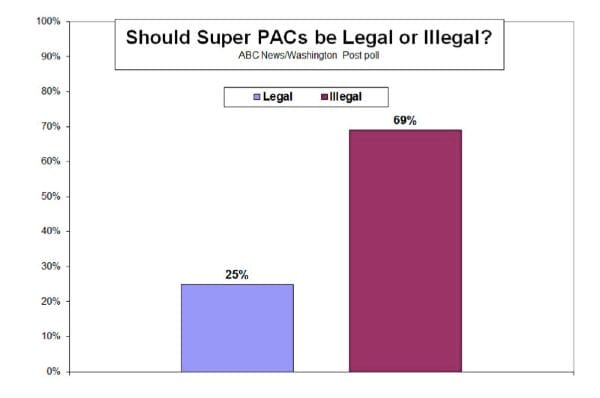
Almost 70% of Americans would ban Super PACs if given the chance, according to an ABC/Washington Post Poll. Several reasons for opposing “independent expenditure only committees” include the extremely deep pockets and glaring lack of oversight allotted to Super PACs. Organizations like American Crossroads, Restore our Future, and Priorities USA Action are not only tax-exempt and not required to immediately identify donors, but are able to spend money however they choose, so long as it does not coordinate with a specific candidate or party.
This leniency exists because organizations like Super PACs are categorized under the U.S. Internal Revenue Code title 25 paragraph 527. Also referred to as ‘527s’ Super PACs cannot ‘expressly advocate’ for a specific candidate/party or coordinate directly with them. Aside from those caveats, no regulatory controls exist to determine how Super PAC money is spent.
Opensecrets reports, “As of December 19, 2012, 1,285 groups organized as Super PACs have reported total receipts of $836,107,228 and total independent expenditures of $644,563,550 in the 2012 cycle.” This money has been largely spent on television commercials, but could easily end up being used for personal reasons.
There are no contribution limits for these committees, whereas limits do exist for candidates and their political action committees, currently at $2,500 and $5,000 respectively per individual. $117,000 is the total allowable limit for an individual to donate to political groups per election cycle, a far cry from Sheldon Addelson’s $150 million he donated to several Super PACs.
Although funds can’t be truly unlimited in a literal sense, the absence of contribution caps that exist for both the candidates themselves and traditional Political Action Committees require that more than one individual or small group of individuals invest in a political campaign.
Donations under $250 do not require disclosure by the FEC, but even massive contributions can, and have been, donated from companies that exist solely on paper, only to disappear days later. Recent efforts like the American Anti-Corruption Act would require immediate disclosure, within 24 hours, for political contributions over $10,000, but precedent set by the Citizens United case prevents any spending caps from being instituted. Only by overturning the Supreme Court's 5-4 decision in that case will ‘unlimited’ funding for Super PACs end.