
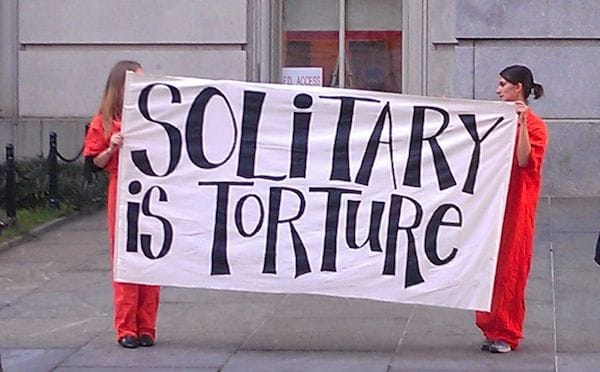
Photo: Francisco Quinones // solitarywatch.com // A demonstration against the use of solitary confinement in prisons.
Last week the United Nations held a meeting on prisoners’ rights in Buenos Aires. The conference, called the Inter-Governmental Expert Meeting (IGEM), resulted in an important updated Draft Report of the Standard Minimum Rules for the Treatment of Prisoners (SMRs), an agreement which had not been updated since its promulgation in 1955.
The U.S. continues to treat the SMRs as a “valuable set of general rules by which to manage correctional systems and facilities” rather than a strict set of guidelines based on recent advances in “correctional science and best practices.” According to a report by a representative of the ACLU, the U.S. delegation noted in their opening remarks the need to update the SMRs and distinctly welcomed non-governmental organizations to offer their advice in the process.
Despite this more welcoming, open attitude by the U.S. government, many human rights activists, in particular the ACLU, have been vocal about their disappointment in the United States’ response to the review process. While the U.S. appears to have made some promising, constructive progress in their approach to corrections and prisoner treatment, specifically in the field of health care, they have stopped short of budging on important modifications to their long-term solitary confinement policy.
Solitary confinement has damaging psychological effects on prisoners, which can manifest in self-inflicted physical harm, and is considered by some to be cruel and unusual punishment. According to the ACLU report from Buenos Aires:
“The U.S. continues to defend the use of long-term solitary confinement. Several governments and NGOs endorsed a 15- or 30-day limit on solitary confinement, as well as an absolute ban on solitary for vulnerable groups like juveniles, pregnant women, and persons with mental illness. The U.S. delegation rejected all of these proposals.“
The ACLU does add, however, that the U.S. delegation was not the only government to resist adjustments to solitary confinement policy.
The ACLU offered an official response to the U.S. position, making it clear that addressing solitary confinement in the SMRs is essential to ensure the U.S. remains consistent with international human rights standards. Two recommendations were made by the ACLU with regards to solitary confinement policy: 1. Solitary confinement only be used in cases deemed absolutely necessary to “prevent death, bodily injury, or a major breach of prison security.” 2. Solitary confinement should not exceed 30 days, and if so, it is deemed inconsistent with international standards, i.e. the updated SMRs.