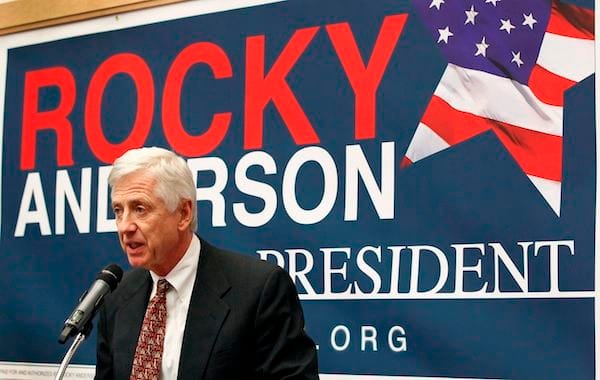
Rocky Anderson, Justice Party Set Sights on Building Movement
By Nate McIntyre | 12/01/2012 | Activism, Ballot Access, Elections 2012, Electoral Reform, Movements, Organizations, President | 20 Comments
Photo: George Frey
The 2012 election saw a sharp increase in the visibility of third-party candidates driven by voter dissatisfaction with the Republican and Democratic parties. Libertarian candidate Gary Johnson and Green Party candidate Jill Stein received the most attention and the highest vote totals among third-party candidates, but there was another entrant who left his mark on the campaign and may be a force in future elections: Rocky Anderson and the Justice Party.
After breaking with the Democrats to establish the Justice Party less than a year before the general election, Rocky Anderson was able to gain ballot access in 39 states — something unprecedented for a party so young. Anderson, the former mayor of Salt Lake City, received a total of 34,521 votes in his first campaign for president and plans to build upon that momentum heading into 2013.
In an e-mail to supporters a few days after the election, Anderson said, “I ran the race to heighten awareness and to inspire people toward effective action. As demonstrated by third-party candidates in the past (e.g. Teddy Roosevelt and Ross Perot), a third-party effort can win far more than an election if it helps to catalyze a persistent, broad-based democratic movement for real change.”
He went on to say that his campaign was a call to the people of the United States to take charge of a long list of outstanding national issues, including reigning in partisanship, wars, and plutocratic tendencies in government and reexamining the current role of the Constitution. In particular, the Justice Party seeks to “restore” the rule of law and most fundamental freedoms guaranteed by the document.
In a separate e-mail, Justice Party Communications Coordinator Laura Bonham confirmed that the party is planning to hold a national convention in Oakland during President’s Day Weekend in February 2013. However, there is a possibility that the convention will be delayed until later in the year in order to allow more time for fundraising efforts. At the convention, the Justice Party will look to establish its vision for the future and continue building a viable alternative to the two-party system. Supporters are invited to become official members in order to help build state-level parties that will send delegates to the convention and sustain the party’s momentum afterward.


Leave Your Comment →
20 Comments
Marc Schenker
12.01.2012
@marcschenker
I question if Rocky Anderson is truly removed from the Democrat Party mentality that he belonged to for so long. Sure, he can call his new “movement” the “Justice Party” (I wonder if that is secretly affiliated with the Justice League of America…hmmmmm), but I wonder if it’s not just another version of Democrat ideology dressed up as something else.
Ronald Edwards
12.02.2012
Sigh, the solution isn’t more parties it’s none.
David Schwartz
12.02.2012
What I think the Justice party needs to do is work on grass roots. Get people on the ballot for local offices, get them elected. Without a base and other elected party members, even if a third party gets elected president and they don’t have members of their party in congress, it will be very hard to get any of their agenda passed.
Raymond Davis
12.02.2012
We tried on in WV nobody was interested. To make a long story short the JP is like the GP and LP. Unless someone can unite all these different fractions into one party you are just spinning wheels.
Johnny Ritchie
12.02.2012
A radicle view Party will never, never get a toe hold. The only reason the Tea Party did was due to their base was the Republican Party. Come to find out after two years they were an obstructionist Party of the Republican party and actually hurt the Republican Party….as shown by the last election and the seats the Tea Party lost. Loobyist for the last election at least did not “buy”…over votes. Grover Norquist has lost “bought” seats. Rove lost bought seats. The Green Party will never get a toe hold as long as they stay green first over people first (when a wolf or polar bear is put over a hungry person) they are going to lose to the human race. The only way a third party will get a significant toe hold is 98% of the PEOPLE first. Take the “whats good for 98% of the people” from each party, then you have third party.
Tim Locke
12.02.2012
I listened to Rocky when I could, I liked what I heard. Need to hear more, but so far, seems like a Great Start.
Jack Knapp
12.02.2012
I signed up to get emails from the JP; I also get such from the Coffee Party, which is similar in goals. There are probably a dozen or more nascent parties that have near-identical goals, and perhaps if we could get them to unite under one central leadership team, we could do more to get the attention of the two major parties.
Meantime, I support generally what they stand for.
Carlos Perez
12.02.2012
To be a real democracy we need at least 5 more parties,
Alex Gentry
12.02.2012
Why only one third party? Canada has five major parties, France has eight, Germany has six, and the UK has three!
Alex Gentry
12.02.2012
Correction Germany has five major parties!
Chris Conrad
12.02.2012
It would be nice to see 5 major parties. Republican, Democrat, Libertarian, Green, Justice. Add or subtract. It does amaze me that other countries can have more than 2. Yet in the supposed land of the free. We are subjected to only 2.
Ron Minto
12.02.2012
I didn’t think it was possible to be left of the Democrats until now. What prefix is further than the center than “ultra”? Perhaps über?
Duncan Webb
12.02.2012
More parties = more extremism, more perversion, more corruption. Things are bad enough with the democrats and republicans. I prefer NO parties at all, as the Founders intended.
Andrew Mahone
12.02.2012
Ron, the American Democratic party is a centrist or center-right institution for the most party. Other countries have many examples of successful parties that are farther to the left.
Andrew Mahone
12.02.2012
Duncan, you’re not going to get people to stop organizing groups based on common interests. More viable parties will mean they have to cooperate to act, instead of taking turns being “in charge”.
Jacob Broge
12.02.2012
Considering the fact that they absolutely exploded out of the gates this election season, I look forward to whats to come from the Justice Party. 36,000 votes for a first-year party? Very well done on their part. I can see them, in quite a few years, surpassing the Green Party as the leading TRUE progressive party. Too many people see the GP as a single-issue party, only caring about the environment. That will never gain the critical-mass needed to break through the 2-party wall. The Justice Party can definitely do that if they ever have a national convention and fully develop their platform
Rob Harrington
12.02.2012
Derivatives expert Janet Tavikoli explains the financial crisis. IT ALL STARTED WITH FRAUDULENT PREDATORY LENDING AND FINANCIAL ALCHEMY OF TURNING A SINGLE MORTGAGE INTO MULTIPLE MORTGAGES VIA FINANCIAL ALCHEMY CALLED SECURITIZATION. OUR FEDERAL AND STATE GOVERNMENTS ALLOWED THIS TO HAPPEN THROUGH LACK OF BASIC REGULATORY ENFORCEMENT OF FRAUDULENT AND PREDATORY LENDING AND PREDATORY FRAUDULENT SEC
URITIES SALES VIA MORTGAGE BACKED SECURITIES – YOUR PENSION PLANS. (Kiss YOUR financial future goodbye!)
She explains this very clearly in this article.
“The financial crisis resulted largely from the use of credit derivatives. How?
We saw them hide risk and create a lot of leverage in the global financial system in securities and securitization, where one bad mortgage could be levered up to be in numerous different deals. That kind of malicious leverage had a big impact. A lot of fraudulent securitization provided funding for corrupt lending. Had we not done that, our housing crisis — and the situation we still have today — wouldn’t have been nearly as bad. Derivatives helped supply the leverage to inflate the bubble.
Are they still dangerous?
Today we see a credit derivatives market that is poorly understood by regulators and even by many of the banks who are participating in the market. And there just doesn’t seem to be a will to clean it up.
What should be done about sovereign credit default swaps?
When they were [first] sold, the hype was that they were useful hedging tools. The result is that they have been a game for speculators more than a hedge for hedgers. Speculators can go in and depress sovereign debt just when a sovereign needs to roll over debt — and of course the price of the credit default swap will shoot up. These games create temporary dislocations in the market. Given that we haven’t driven speculators out of the market, it’s a good idea to ban credit default swaps altogether.
What else can be done now to try to prevent another financial crisis?
In terms of money flow in the U.S., we have to write down debt and maybe have some sort of debt forgiveness. That’s a radical thought, but some people will never be able to get out from under their debt in their lifetime. Going forward, we have to make responsible loans.”
http://www.advisorone.com/2012/04/25/finding-the-culprits-of-the-crisis?t=economy-markets&page=4
Nancy Benhardus
12.02.2012
no
Charlie Harrell
12.03.2012
I’m listening.
Javier Gonzalez
12.08.2012
@jgonzalez
Good idea, bad name.