Jill Stein Addresses Mainstream Debate’s Sidelined Issues
By David Schwab | 10/17/2012 | Activism, Ballot Access, Elections 2012, Electoral Reform, Headline, Movements, President | 31 Comments
Photo: JillStein.org
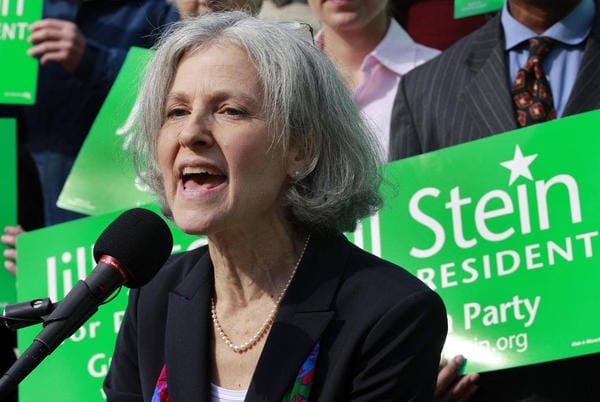
One of the enduring paradoxes of American politics is that, despite a campaign season that stretches nearly a year and gives candidates ample time to air their views, there are some issues that hardly ever get a moment in the spotlight.
Climate change is a prime example. In the first televised debate between Barack Obama and Mitt Romney, the words “climate change” and “global warming” were never mentioned.
Green Party presidential candidate Jill Stein addresses the mainstream parties’ exclusion of these “outcasted” issues. The 67.2 million people who watched the last presidential debate heard very little about the drug war, immigration, same-sex marriage, corporate personhood, or the National Defense Authorization Act, to name just a few issues that were sidelined.
As little attention as these topics get, however, perhaps none are quite so neglected as the issue of electoral reform. Green Party presidential candidate Jill Stein is working to change that, by making democratic reform an integral part of the Green New Deal– a four-part platform at the center of her campaign that also includes an economic bill of rights, sweeping financial reform, and a large-scale transition to a sustainable economy.
In Stein’s words:
“We won’t get those vital reforms without a fourth and final set of reforms to give us a real, functioning democracy. We don’t have that in America today.”
High on the Green Party’s list of institutions in need of reform are the presidential debates themselves. The Commission on Presidential Debates– a corporation created and jointly owned by Democratic and Republican Party leaders after a host of issues between them and the League of Women Voters in 1988– has drawn criticism from organizations such as Open Debates for effectively excluding candidates outside those parties from the debates and for drastically limiting the terms of discussion.
As the Green Party platform points out, throughout American history, candidates outside the two-party establishment have introduced important ideas and needed reforms to the public’s attention, from the abolition of slavery and women’s suffrage to the eight-hour workday and African American civil rights.
When Greens, Libertarians, and other independent candidates are locked out of the debates, vital issues such as climate change and civil liberties too often get ignored.
In addition to advocating equal access to the debates for all qualified candidates, Jill Stein’s Green New Deal calls for a constitutional right to vote, abolition of the electoral college, an end to partisan oversight of elections, and mandatory use of audit-able, hand-counted paper ballots.
In the spirit of 2000 Green Party nominee Ralph Nader’s claim that “voter rights aren’t worth as much without candidate’s rights giving you more choice on the ballot,” Stein promises to remove onerous ballot access barriers to “restore the right to run for office and eliminate unopposed races.” She also supports statehood for the District of Columbia to give DC residents full representation in Congress and full powers of self-rule.
The corrupting influence of money in politics is a consistent theme in Green campaigns. As the Green Party platform states, “all Green candidates pledge not to accept corporate money for their campaigns,” a measure intended to ensure that they remain accountable only to voters, and not to deep-pocketed donors looking to buy access to power.
Jill Stein’s Green New Deal takes the same tack, pledging to “get the big money payoffs out of politics by implementing public funding of elections.” Stein supports reversal of the Citizens United decision that allowed unlimited corporate money in elections, through enactment of a constitutional amendment barring “corporate personhood” and affirming that money is not speech. She also favors equal and free access to the airways for all qualified candidates.
Green Party candidates like Jill Stein, as well as other candidates outside the two establishment parties, are frequently attacked as “spoilers,” yet Stein’s Green platform contains two elegant solutions to the so-called “spoiler” problem: instant runoff voting and proportional representation.
Instant runoff voting, used in cities including Minneapolis, San Francisco, and Portland, Maine, allows voters to rank their choices in single-winner races like mayoral elections. If your first-choice candidate places last, they are eliminated, and your vote transfers to your second-choice candidate. This process continues until one candidate has more than 50% of the vote. Instant runoff voting allows voters to vote for the candidate they agree with most without fear of inadvertently helping the candidate they least agree with, and it ensures that no candidate can win without majority support.
Proportional representation (PR) is used to elect legislatures in 80+ democratic countries around the world, including Finland, Costa Rica, Germany, Israel, Tunisia, South Korea, and New Zealand. In elections using PR, a party that earns 25% of the vote receives 25% of the seats in the legislature. This frees voters to vote for the party they most agree with, knowing that their vote will gain them representation in the halls of power, rather than feeling compelled to vote for the “lesser of two evils” as is too often the case in American elections.
Electoral reform, like climate change and other pressing issues, gets precious little attention from the carefully stage-managed debates or the mainstream media. Yet the very fact that so many important issues go ignored reveals the urgent necessity to open up the American political system to more voices and more choices. Jill Stein and other non-mainstream candidates are starting that badly-needed discussion about democratic reform, and showing American voters that a better way is indeed possible.


Leave Your Comment →
31 Comments
Chad Peace
10.17.2012
@Chad_Peace
“The Commission on Presidential Debates, a corporation jointly owned by Democratic and Republican Party leaders after a host of issues between them and the League of Women Voters in 1988.” This bleeds everywhere in our electoral system, from election laws, to the media, and even in the court system. We’ve established two-party rule by accepting its presumption. Bravo Jill Stein, and excellent article David!
Terri Harel
10.17.2012
@tlharel
Thankfully there are candidates brining to light important issues that are often sidelined. It is important to pay attention to all candidates since collaboration and exchange of ideas breeds change and keeps democracy vibrant.
Jane Susskind
10.17.2012
@jsusskind
While i understand it’s hard to cover ever topic in the 1.5 hour debates, especially when both candidates interrupt each other constantly, I was upset that last night’s debate did not cover more issues. The same issues that were discussed in the VP debate and the first debate keep reoccuring and while they are incredibly important, so it green energy, so is electoral reform, so is ending the war on drugs. I doubt these will be covered in Monday’s debate either.
Shawn M. Griffiths
10.17.2012
@shawntx
I would have liked to see some of these sideline issues addressed, but many of them are labeled “sideline issues” for a reason. Still, it would have been very interesting to hear how much Romney’s rhetoric has changed since the GOP primary and how much Obama’s rhetoric has changed on some of these issues from four years ago.
Sam-sex marriage is a state issue, but I would have liked to hear from the candidates on the issue, especially Romney who said he wanted a constitutional amendment banning same-sex marriage. I bet he has toned down the message since the primary season. It is important to have candidates that will address these issues not talked about in the debates.
Jane Susskind
10.17.2012
@jsusskind
I agree. I don’t think the debate is the only time to talk about these issues either. They should be talking about ALL the issues throughout the campaign. Of course Romney has kept quiet on same-sex marriage and has avoiding conversations about women at all cost (reason why was proven last night with his whole “binders” comment) but Obama has been keeping quiet on certain issues as well. Mainly, I think voters deserve a straight up answer on the economy and both Obama and Romney should do more to cover all issues, not just the ones that will win them support.
Michael Higham
10.17.2012
@michaelhigham
“Stein’s Green platform contains two elegant solutions to the so-called “spoiler” problem: instant runoff voting and proportional representation.” I’ve been a fan of proportional representation ever since taking an electoral systems class at UCSD! I understand there are short-comings to having coalition governments but the winner-take-all system fosters a mentality of “us v. them” and partisanship.
Lucas Eaves
10.17.2012
@lucaseaves
I really like the expression used by Jill Stein in her talk in San Diego when she says that “we have to get out of that abusive political relationship”. This is the case, a lot of us are not happy with the 2 parties but we cannot leave because they control the system. I hope to see more change in the future.
Alex Gauthier
10.17.2012
@alexg
as a voter Proportional Representation should be your preferred mode of voting. It affords smaller constituencies at least a chair at the table in terms of representation. However, it is unlikely to become a reality in the US given our constitutional dogmatism.
Michael Dishmon
10.17.2012
@bizurk
Hopefully enough people will watch this debate between Jill Stein and Gary Johnson, and realize all the issues the big two and ignoring.
Ian Dawes
10.17.2012
@iandawes
U.S.energy and oil consumption and environmental consequences should never be a sidelined issue. I am looking forward to Dr. Stein addressing global warming and clean energy.
LNorman
10.17.2012
The use of PUBLIC lands for private profits. Taxpayer subsidies to million/billion $ corporations. Billions of taxpayer dollars used to eradicate wildlife by the blm, forest svc, etc. Blm’s criminal activity, for instance violating their federal mandate to “protect & preserve” the American Mustang but are eradicating at taxpayer expense for special interests on PUBLIC lands. This is kleptocracy. Fracking poisoning water & air, can’t drink or breath gas (and why are natural gas prices higher?) Lack of law enforcement at high levels of government (a deaf, dumb, blind Federal Justice Dept). Protection of our most vital resource: water.
Renard Prather
10.17.2012
Poor people, the homeless
Lana Gail Osborne Dearing
10.17.2012
Drug war
Suzi SassyRaffe
10.17.2012
NDAA
Ricky Gandhi
10.17.2012
The Eurozone crisis, primary and secondary education, governmental reform
Jason Polk DC
10.17.2012
How about the 16 trillion dollar handout the Fed gave the banks without congressional approval?!?!
Amber Schmidt MacDonald
10.17.2012
Media time for candidates who are not Dems or Reps.
Jacob Healey
10.17.2012
Monsantos running the FDA
Jennifer Berreth Frederick
10.17.2012
mentally ill and how funding for mental health continues to be cut and underfunded
Scott Bludorn
10.17.2012
Federal Reserve
Victor Jimenez
10.17.2012
Guantanamo Bay, Afghanistan, and why is all the Iraq oil contracts are going to the Chinese.
Nona Eggerman- Windus
10.17.2012
Closing our borders
Michael Sullivan
10.17.2012
Not all of the Republican Plutocracy are racist! However most racist vote Republican !Racist, Guns, Nazis, Jesus, and the Super Rich ! What a Hell of a group these Republicans are !!
Jim Keith
10.17.2012
Campaign finance reform. Our elections are a joke. A bad joke.
Christy Secchitano
10.18.2012
Getting rid of the “electoral college”!!! How about having everyone’s vote count?!?
doug
10.18.2012
In recent elections the “boxing out” of 3rd parties has been fairly easy to accomplish, especially since the parties themselves complied when they were asked to ultimately “fall in line” for the good of either Democratic or Republican candidates so as not to “spoil” the election of a lesser evil.
This year has been different, not only in the drive exhibited by 3rd parties, and most especially Jill Stein & the Green Party, but also in the degree of fear experienced in the “big two” parties. All the usual tactics have been employed, but this time Stein & the Green Party have defied the “encouragement” to step back and defer to Obama (in this case).
Notice how quickly that has raised the level of fear in the Obama camp (read “Corporate Camp” – to which both Obama & Romney belong). In fact it has led to strong-arm, legally questionable tactics such as the one seen prior to the second debate. Years ago Eugene Debs was imprisoned of course, displaying an even higher level of fear. And now Stein has been climbing relentlessly, and so the arrogance of oligarchs has entered the picture more dramatically than it has had to in a long, long time.
One can see at work here a somewhat restrained form of enforcement of the NDAA bill, a bill that Obama pushed through, and then also appealed a permanent injunction against it due to its unconstitutionality. In other words, a grotesque interpretation of its content sets the stage to make yesterday’s arrest normal procedure for ANY protest – even by a legitimate candidate for the office who’s very existence REQUIRES that they differ, object and protest. Orwell finessed.
Increasingly the Green Party, along with other 3rd parties, are being included in the debates – first (and continuing) on Democracy Now with Amy Goodman, then with the Independent Network for Voters, and now coming on Oct. 23, the day after the final “official” presidential “debate,” with the Free and Equal Elections Foundation; that debate will be moderated by Larry King.
Share with everyone you can these upcoming events, and get more people to listen. This is especially true for those people who you know plan NOT to vote at all. There are 90 million of these people. Even to capture half of 90 million votes could very well put Jill Stein in the office of President of the United States. Then, and only then, do we have a chance to turn this sick, sick system around.
Blake Bunch
10.18.2012
@blakebunch
Electoral reform is a major issue in every election. Stein specifically, as well as Johnson have placed more attention on this issue than the big two.
Roy Dickinson
10.18.2012
here’s my question – with the transformation of most Latin American countries to participatory democracies, and self reliant economies, isn’t it time for the President of the United States to respect their sovereignty and revoke the Monroe Doctrine ?
Dan Healy
10.18.2012
Campaign Finance Reform! Our major party candidates are completely beholden to special interest groups that are mainly multi-national corporations. They donate minute amounts of their net worth to the campaigns of these politicians and in return get rates of return that are at times in excess of 2000% in the forms of beneficial legislation, tax credits etc. This is the most important issue facing our democracy today.
Lana Thomas
10.18.2012
GMO’s!!! I would like to hear both candidates talk about their position on Prop 37 (but espacially from Jill) in CA and also what they would do to (if anything) to get Monsanto & the biotech industry out of power positions in the FDA and USDA. Everyone has been avoiding this issue, most likely either because they are getting handouts or threats from the biotech industry. The fact that around 90% of Americans think that genetically engineered food should be labeled shows that this is a big issue that needs to be discussed!
Christopher Hood
10.19.2012
Many things- like why are we the world police?, why is our government no longer united- they act like they are foreign and the idea that the class system makes up a class system within government?
I don’t expect answers because politicians no longer believe they work for people because of the ppl.