As we near the U.S election in November, the next president's foreign policy will play an important part in the perceived success of his administration. Currently, foreign policy is slowly making itself a more prominent issue in the election. The president will have a plethora of global issues to tackle, but these five will make it to the top of his lists:
The Iranian Nuclear Program
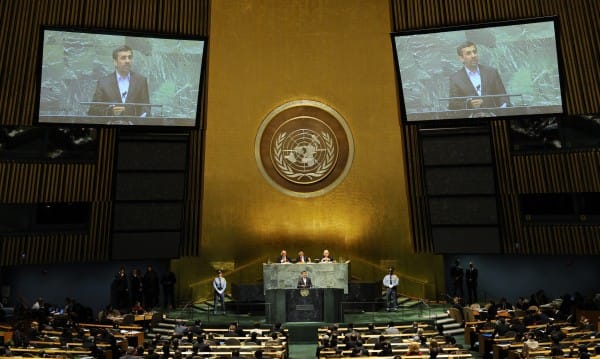
The Iranian nuclear program has caused great concern in Western countries, as President Mahmoud Ahmadinejad has called repeatedly for the destruction of Western countries, primarily Israel and the United States. Examining the exact rate at which the program is developing is extremely difficult because of limited access to nuclear facilities. According to a report done by Valerie Lincy of www.iranwatch.org, the rate of progress at Fordow (an underground uranium enrichment plant), means the plant should be fully outfitted with nearly 3,000 first generation-centrifuges by November -- a difficult prospect for the United States and its partners to face. If this is indeed the case, Iran has the potential to near acquisition of a nuclear bomb. The US would have to choose whether it would want to co-exist with an Iran with a nuclear weapon or to go to war and try to dismantle the process.
Mexico
The situation in Mexico has been spiraling downward since 2000, when a sharp increase confrontation between government forces and violent drug cartels began. The inability of the military to fight multiple cartels at one time has led to thousands of deaths in each state. The death toll is reported to be roughly 47,000, a number that surpasses the combined death toll of American troops and civilians in the 10 year-long war in Afghanistan, according to this report by the Huffington Post. Also, Mexican President Felipe Calderon's departure from office at the end of this year will mark a new and uncertain starting point in Mexican-American relations and the drug war.
The Euro Crisis
The debt crisis that started in Greece has spread to Spain, Portugal, Ireland and Italy. The crisis started in 2009 when investors began to worry about the ability of Greece to pay back its debt and has continued for the last 3 years as the government of Greece has not been able to compromise on the best way to implement austerity measures.
Greece's external debt to GDP ratio is at 231.% of its economy, a number that is gravely worrying investors and other members of the EU. Besides Greece, four other countries currently have an external debt to GDP ratios over 100%: Spain (242%), Italy (170.00%), Ireland (1,269.00%), and Portugal (263.25%). These numbers represent a potentially dangerous trend, as many of these countries could default, a situation that would cause serious economic distress throughout the world.
The Syrian Revolution
The Arab Spring that has swept the Middle East and North Africa in the last couple years will be a continuing phenomenon for the President to address. Specifically, the long standing revolution in Syria, which started in March of 2011 and has essentially evolved into a civil war, has left anti-government revolutionaries and the Bashar Al Assad administration in violent gridlock. The death toll from the uprising is reported to be up to 19,980. 93% of those casualties are civilians. The predicament comes for the next president-elect on whether to remain distant from revolutionary efforts or be more aggressive with the Assad government by threat of military force.
North Korea
Although North Korea hasn't been in the media spotlight recently, it remains a rogue nation that requires continued attention. The nation is a continuous nuclear concern and remains an aggressor towards South Korea. In 2010, the situation in the Korean peninsula seemed to hit a boiling point as the North shelled the South Korean island of Yeonpyeong and was accused of sinking the South Korea ship, the Cheonan, that resulted in numerous South Korean deaths. Most recently, the US and North Korea have been locked in a tension filled quid pro quo in which the North Korean's say they will suspend weapon development programs in exchange for US food aid.