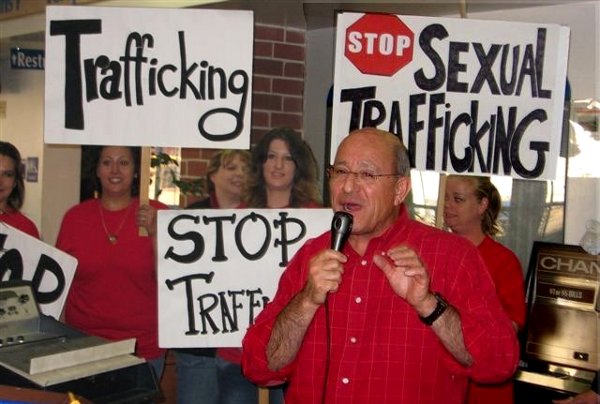
California Proposition 35 Increases Human Trafficking Penalties

By Bob Morris | 10/08/2012 | Ballot Initiatives, California, Headline | 14 Comments
Credit: vcreporter.com
Human trafficking is forcing a person into prostitution or making them to work against their will. California Prop 35 increases human trafficking penalties by expanding its definition and increasing the severity of sentences and fines. For example, a defendant can no longer claim they did not know the person was a minor. Prop 35, to clear up a possible source of confusion, does not apply to human smuggling, which is bringing people across the border illegally (except of course if those smuggled are then forced into labor or prostitution.)
Proposition 35:
- Increases criminal penalties for human trafficking, including prison sentences up to 15-years-to-life and fines up to $1,500,000.
- Fines collected to be used for victim services and law enforcement.
- Requires person convicted of trafficking to register as sex offender.
- Requires sex offenders to provide information regarding Internet access and identities they use in online activities.
- Prohibits evidence that victim engaged in sexual conduct from being used against victim in court proceedings.
- Requires human trafficking training for police officers.
Among its more controversial measures, Prop 35 prohibits using evidence that a person was involved in prostitution if they were coerced or under 18. Further, it bans attacking the sexual behavior of a victim in court to undermine their credibility.
These provisions concern both the No on 35 campaign and the Sacramento Bee, which also opposes Prop 35, saying the proposition is well-intended but flawed.
Some prosecutors worry that the initiative’s broad wording will undermine their ability to prosecute traffickers.
It also makes the “commercial sexual act of a victim inadmissible to attack the credibility or impeach the character of the victim in any civil or criminal proceeding.” In doing so, the proposition may also deprive accused traffickers of a fair trial, making it vulnerable to constitutional challenges.
The Sacramento Bee is also concerned that some who have not committed sexual offenses might have to register as sex offenders and wonders how law enforcement will manage handling the sometimes dozens of screen names used by 90,000 registered offenders who would be mandated to report all of them on a continuing basis.
The California Council of Churches also opposes Prop 35 saying it “eradicates any aspect of human trafficking other than sex slavery, and this is a dangerous and irresponsible action.”
The Yes on 35 campaign strongly urges voters to vote for it.
Proposition 35 will deter traffickers with higher penalties and fines, use fines to fund victim services, remove barriers to prosecute child sex traffickers, mandate training for law enforcement officers, require convicted sex traffickers to register as sex offenders, require all sex offenders to disclose Internet accounts, and protect victims in court proceedings.
Additionally, the Prop 35 will raise awareness and unite Californians to take action. With up to 17 million voters, this will form the largest single movement against human trafficking in the U.S.
Voters are encouraged to study what both sides say. More information on Proposition 35 can be found on the IVN Election Center.


Leave Your Comment →
14 Comments
Chad Peace
10.08.2012
@Chad_Peace
I haven’t done my homework on Proposition 35, but a lot of these emotional laws get rushed through by the initiative process without a clear understanding of the legal and political ramifications from an otherwise well-intended bill … still gotta do some reading
Matt Metzner
10.08.2012
@mmetzner
Increasing the penalties for these crimes is not a bad thing and it would be difficult for me to vote against the prop because it does not cover every aspect of the crime. Essentially, something is better than nothing.
Jane Susskind
10.08.2012
@jsusskind
This is the type of proposition that deserves more research. On face, I find it hard to oppose a law that would crack down on human trafficking, but I don’t know the legal workings behind it. I will definitely do some research on this one. But generally, I’d have to agree with Matt…something is better than nothing, and the sooner these laws get passed, the better.
rich mckone
10.08.2012
@user1785
Why didn’t the legislature just pass a law with the same features as Prop. 35? Propositions are usually placed on the ballot because the Legislature refuses to make a law change that voters want. How could that be the reason for not passing this law? Please don’t report that it was because sex traffickers have too much political influence for such a bill to pass. That would be a bit much for most voters to believe, even about our dysfunctional Legislature. Most voters would probably be very interested in the real explanation of why Prop.35 is on the ballot!
Lucas Eaves
10.08.2012
@lucaseaves
Nobody can be against fighting human trafficking on moral grounds so if some people are against this proposition, it will be worth looking into all its consequences in more details. It is not rare that well intended laws have disastrous consequences.
Emma Goda
10.08.2012
@emmagoda
Human Trafficking is more of an issue than many of us know and Prop 35 will enable us to increase penalties which is important.
Michael Higham
10.08.2012
@michaelhigham
I think this proposition will easily pass. For those who make their decision on election day and go off the ballot statements, it’ll be hard to vote against a law that further criminalizes human traffickers and reallocates fines to assistance programs.
Blaz Gutierrez
10.08.2012
@blazgutierrez
So far as I understand, the language of prop 35 tries to emulate the federal definition of human trafficking. There are really so few of these crimes prosecuted under state law as it is though because the feds have jurisdiction over crimes that cross state or international boundaries – as much of trafficking involves. Right now there are only 18 offenders in CA state prisons on charges of human trafficking.
Secondly, the vast majority of the funding behind 35 is coming from Chris Kelly who ran unsuccessfully for CA Atty General in 2010. I see this as a safe (albeit expensive) way of padding his resume for voters to take note of in future elections.
Alex Gauthier
10.08.2012
@alexg
Everything but that 5th provision seems reasonable. It’s almost as though the prop seeks to predetermine guilt for every case that’s brought up regarding human trafficking.
Mareike Lucht
10.08.2012
@malu
regarding the paragraph starting with “among its more controversial measure”: What is stated there is already existing law: better known as “rape shield”. The banning of evidence regarding sexual behavior of a victim, or their involvement in coerced prosecution does already exist. “….the proposition may also deprive accused traffickers of a fair trial, making it vulnerable to constitutional challenges.” A concern that might be valid, but again, the Federal Rules of Evidence already provide for that: again in the so-called “rape shield rule”. I lack the comprehension what is so controversial about it.
Blake Bunch
10.08.2012
@blakebunch
I think it would be rather difficult to monitor the online use of nearly 90,000 registered offenders. However, it is a good thing that officers would be undergoing human trafficking training. I just read another article about how Prop 35 would effect prostitution in the area, especially the infamous “mile of cars.”
Bob Morris
10.08.2012
@Bob_Morris
Th Sac Bee is levelheaded and so is the Council of Churches. That they oppose it is certainly of note. And there already are penalties for human trafficking.
James
10.10.2012
I think there are pros and cons to this law, First there are already laws in place to stop human trafficking. If this practice becomes more illicit more people will want to do it look at Prohibition and alcohol in the 1920s more a larger percentage of people consumed it when it was illegal rather than legal. It is the same with cannabis today, but back to the point Not all human trafficking is part of the sex trade. Currently Mexico is experiencing trouble, with rampant violence, and control of provinces residing with cartels. A man’s family in Mexico fleeing the country as a refugees, if that man were to arrive in the us and be caught he would have to register as a sex offender for trying to help his family before being jailed in the us or being deported.
Richard Gorin
10.13.2012
@jaguar943
1. Increased penalties result in increased incarceration costs. I have yet to see any evidence that increasing the penalties will result in a decrease of the activity. Setting criminal penalties on the basis of how disgusted I or other voters are by the behavior to be criminalized is not sound public policy.
2. Human trafficking may be sexually related or not. Treating someone who is guilty of enslaving others to work in sweatshops is abhorrent; treating them as registered sex offenders is irrational.