
Bay Delta Conservation Plan Could Tunnel California Funds

By Cheyenne Cary | 09/24/2012 | California, Energy and Water, Headline | 10 Comments
A slide from BDCP’s August 29 public meeting. Credit: BDCP
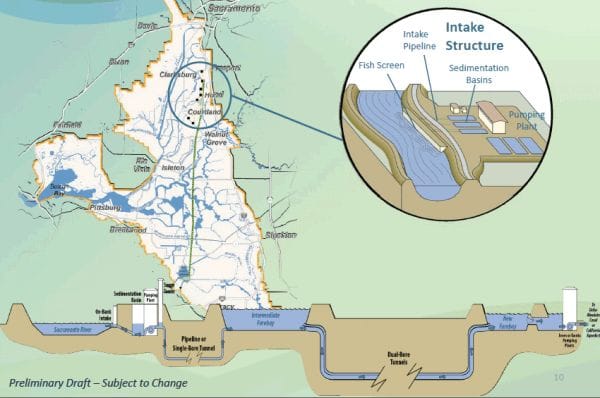
With a price tag in the tens of billions, the proposed Sacramento-San Joaquin water conveyance system is a financial heavyweight of a project. Five years of construction would create an historic new piece of California’s infrastructure that would funnel water from the Sacramento River Delta southward through the city of Tracy and beyond. Ultimately, the project would move water toward the thirsty cities and farmland of southern California.
Cost estimates from the Bay Delta Conservation Plan start at $23 billion and independent analyses spiral upward to $47 billion or more. The conveyance system would provide southern California with greater access to an essential commodity, but how can funding be sourced? How will the project impact ratepayers? Can the expense be justified?
After six years and $150 million in planning, the official answer remains “we don’t know.” Due to some political finagling, the tunnel project escaped a required cost-benefit analysis and funding sources remain largely unidentified. Skeptical lawmakers introduced a bill that would prevent the BDCP from moving forward until such a cost-benefit analysis was completed, but the Assembly Appropriations Committee killed the bill back in May.
The consequences of this is that the whole project can keep flowing smoothly without so much as a vote in the Legislature.
Under the State Water Project, the tunnel plan is off-budget, meaning that all costs are free from Legislative oversight. The nonpartisan Legislative Analyst’s Office reported that “SWP’s off-budget status makes it difficult for the Legislature to evaluate the entire water system [...] and evaluate whether the costs of BDCP planning are reasonable.”
Sources for funding the project are also unclear. Until recently, Governor Jerry Brown planned to finance part of the project through a “water bond” that would appear on the ballot for the 2012 general election. However, the California State Legislature voted to postpone the bond until 2014 ”to improve its odds of success with voters,” according to a statement from Assemblyman Henry T. Perea’s Office.
Early reports from the BDCP assumed that the State Water Project and the Federal Water Project would split the costs 50/50, but the most recent administrative draft states that contractors “have not agreed upon a specified allocation of costs,” and “as actual cost allocations are determined, this assumption may change.”
No matter how things turn out, the SWP would be one of the largest sources of funding for the project. This means that the state project would pass on costs to its contractors in local water districts, who would then pass on the costs to their customers.
An independent analysis of the Los Angeles Department of Water and Power, which imports the vast majority of its water from the SWP, estimates that the tunnel project would increase LADWP water rates by $273 to $546 per acre-foot by 2020, or 24 to 48 percent. The same review recommends conservation, water reuse, and even desalination of groundwater as financially favorable alternatives to importing water from a highly expensive SWP.
The tunnel plan, as it stands now, represents a gigantic expense with limited benefits in both the short and long term.
University of the Pacific’s Business Forecasting Center issued a wide-range analysis that put the tunnel plan’s final ratio of benefits to costs at 0.3 to 0.5. This means that for every dollar spent on the project, taxpayers could expect thirty to fifty cents back. These benefits include the total amount of water moved over the life of the project, increased water security in the event of an earthquake, and the highly-debated boost to the Delta ecosystem.
The continued life of the BDCP depends on finding vastly different alternatives to the current plan, and not just raising the cap on maximum water exports as Brown proposed in a meeting this month. It’s going to take something innovative, something ingenious, and something that’s not exactly the same plan from thirty years ago.


Leave Your Comment →
10 Comments
Matt Metzner
09.24.2012
@mmetzner
Freshwater is necessary in southern California and we need to figure out a way to deliver it. Still unconvinced that a tunnel is the best option.
farmwater
09.24.2012
@farmwater-2
This article fails to include a second economic study conducted by Dr. David Sunding of UC Berkeley. This study points out that the benefits of the tunnel conveyance are expected to outweigh the costs. The article also fails in its comparison of BDCP to a proposal from 30 years ago. The previous plan was primarily focused on water supply while the BDCP is designed to meet the Legislature’s mandate of co-equal goals for both a reliable water supply and ecosystem restoration.
It has been clearly stated within the BDCP process that the cost of the conveyance system will be paid by those water users who receive the benefits. That means no taxpayer funds will be involved in the conveyance costs. The cost to Southern California residents is also misrepresented. A more likely cost, as determined by the residents’ water supplier, is an increase of only $4-5 per month per household.
Mike Wade
California Farm Water Coalition
Chris Gulick
09.25.2012
Mike, your cite of Sundling’s study as an equivalent to an actual cost benefit study as performed by UOP is at best misinformed and at worst disingenuous. Dr. Sundling says and I quote “the study is not a complete statewide cost-benefit analysis with indirect effects and does not consider impacts on areas such as Delta agriculture. ”
http://deltarevision.com/2012%20docs/mwd+delta+report+to+committee.pdf
Your Quote: “no taxpayer funds will be involved in the conveyance costs. ” is not based in truth.
Water contractors have yet to pay the full bill due for the original project meaning taxpayers are still paying the costs of financing it. The same scenario will undoubtedly occur if a Peripheral Canal/Tunnel is constructed.
There is a reason Water Contractors adamantly opposed legislation requiring a Cost/Benefit analysis be performed as part of the BDCP process.
The path to solving this thorny issue is not going to be found endlessly repeating half truths that only serve to hide the facts.
There is absolutely no doubt in my mind that taxpayer funds will indeed be “involved” in constructing, operating, maintaining and mitigating for the damages that will surely result if this Pipe Dream is constructed.
Osha Meserve
09.25.2012
Mr. Wade fails to mention the mitigation and habitat/ecosystem restoration side of the BDCP costs, which the contractors have not agreed to pay for even though they are essential to getting the tunnels permitted under the ESA and other laws. So far, all the contractors have agreed to pay for is the system to bring them better quality water from the Sacramento River. This is no solace to California taxpayers who will be forced to subsidize this boondoggle by apparently paying for the rest of the costs associated with mitigating for the thousands of acres of farmland and migratory bird habitat that will be destroyed by this project, among other impacts, along with creating over 100,000 acres of new fish and other “habitat” in the Delta. The Farm Water Coalition does not care about any farmers other than those they serve in the SJ Valley.
Emma Goda
09.24.2012
@emmagoda
Water is a huge issue in Southern California and I think there could be a better way than a tunnel.
Ian Dawes
09.24.2012
@iandawes
The newly acquired flow would still be managed and run through the LADWP. The City of Los Angeles currently receives the majority of its water supply from the melt water that accumulates in the Owens River Valley of the Eastern Sierra Nevada. That water is transported back over the mountains via the LA Aqueduct and to residents in the City of LA. Sierra Nevada snow melt sounds like pretty tasty water to me. San Diego, however, receives the majority of it’s water supply from the Colorado River which supplies 6 other states with water before before it gets to California. It is first negotiated by the farmers of the Imperial Valley and then makes it to the City of San Diego. What is the plan for San Diego vs. Los Angeles with this newly acquired Northern Cali water flow?
Brandon Fallon
09.24.2012
@bfallon
In times of increased fears of cross country drought, the need for more clean water to boost supply, there is an obvious need. How can it be off-budget? Without proper oversight and auditing, of course the cost will sky rocket.
Blaz Gutierrez
09.24.2012
@blazgutierrez
I’d like to know what the author of the article thinks about alternative sources of water. What are the implications of increased salt-water desalinization plants, for example? Otherwise, kudos for presenting information on a little-known, but gigantic infrastructure project. It seems that high-speed rail is the only major infrastructure project getting into the headlines. If guess the BDCP isn’t sufficiently European as a high-speed train to stir the emotions.
Burt Wilson
09.25.2012
The Water Bond never carried funds for a conveyancve of any kind. That was eliminated when it was taken off the 2010 ballot and put over to 2012. The BDCP rcently received $250 million more in funding. Meral says he has only calculated 30% of the costs of the conveyance–the twin tunnels. The funding plan originated in the Delta Stewardship Council and is a “beneficiaries pay” system whereby the water agencies foot the bill and the recoup their investment by raising local water rates sky high. This smacks of “taxation without representation” and will probably be challenged in court.. Good article on the whole.
Quality Assurance Software
09.27.2012
This is very beneficial information. Cheyenne, What motivated you to call this blog “Bay Delta Conservation Plan Could Tunnel California Funds”, not that the title does not go with the content, I am just wondering. Congratulations again on a good job Cheyenne.
