

(Photo: European Pressphoto Agency)
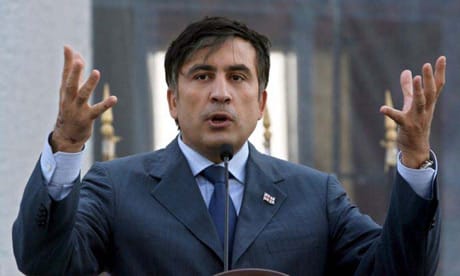
On October 1st, parliamentary elections will take place in the former Soviet satellite of Georgia. The National Movement party of Georgian President Mikheil Saakashvili is facing public pressure from protests after a video was released showing prison guards beating and sexually assaulting inmates with blunt objects. Interior Minister Bacho Akhalaia and several top prison officials resigned.
Saakashvili, who came to power in the bloodless "Rose Revolution" in 2003 and is term-limited out of office next year, has been a leader favored by Washington and particularly the GOP. However, Saakashvili's tenure has included jailing political opponents and closing opposition television stations. Parliamentary elections since the revolution have produced results so skewed toward the National Movement party that some commentators call Georgia a "one-party state."
New constitutional reforms about to take effect are designed to divide power among the president, a prime minister, and the parliament. According to these reforms, Saakashvili will still leave the presidency, but is eligible to become prime minister or speaker of the parliament. If prime minister, he would still be able to continue determining foreign and domestic policy. At this point, Saakashvili has given no indication of who might succeed him as president from the National Movement party.
Leading the opposition to Saakashvili's party is billionaire Bidzina Ivanishvili and the Georgian Dream coalition, an alliance of several smaller parties. A reclusive billionaire, Ivanishvili's campaign began with calls for Saakashvili to resign. Ivanishvili garnered sympathy from masses when the state froze his assets and revoked his Georgian citizenship. Most media reports record the opposition trailing National Movement by about 20 points. Ivanishvili has not indicated whether he will run for the presidency in 2013.
Georgian elections may not necessarily register very high in the consciences of many American voters, but Washington's relationship with Georgia and Georgia's desire to join NATO is a cause of much tension between both countries and Georgia's neighbor, Russia. If Georgia succeeds in its quest to join NATO, then Georgia will become much more prominent to the US and American voters.
Born in 1949, NATO was a military treaty between the United States and Western Europe for protection against a Soviet Union that controlled half of Europe. Two decades after the capitulation of the USSR, certain US Senators are urging the acceptance of Georgia, a former Soviet possession, into NATO, an organization whose founding purpose was opposition to Russia. In addition to stretching the geographical definition of the North Atlantic Treaty Organization, the NATO charter's fifth article would compel the United States to fight for Georgia in any war with Russia.
Despite many claims that Georgia is a liberal democratic country, the Saakashvili regime has been marred with signs of authoritarianism. The demonstrations over the prison abuse scandal and the enthusiasm for Ivanishvili suggest that the Georgian population may be tiring of the Saakashvili regime, but the reigning power is likely to remain entrenched. That Saakashvili-- who has not given indication for a successor to the presidency from the National Movement party-- might become prime minister after his presidency ends, invites comparisons to Vladimir Putin.
Georgia has given every indication that it still wishes to join NATO, which even presumed challenger Ivanishvili supports. Chances of Georgian entry may have evaporated with the 2008 war because it revealed Saakashvili is either unstable or trigger-happy. While even his friend George W. Bush would not militarily support him, President Obama has held Saakashvili at arm's length, suggesting that Washington only desires a stable partner in Tbilisi.
If President Mikheil Saakashvili decides to remain a player in Georgian politics, as the constitutional reforms seem designed to allow, it complicates how Washington handles Russia. Moscow is on record saying that it will not deal with a Georgia led by Saakashvili and Georgia is without any significant allies besides America.
The United States is currently ending eleven years in Afghanistan and nine in Iraq. Regardless of his next role, Saakashvili is still a polarizing figure whose past behavior will hamper any efforts to cooperate with Russia. Whoever succeeds him is likely to continue the fight for Georgian entry into NATO while Washington faces its own choices about the commitments it takes on.