

Credit: http://www.wvik.org
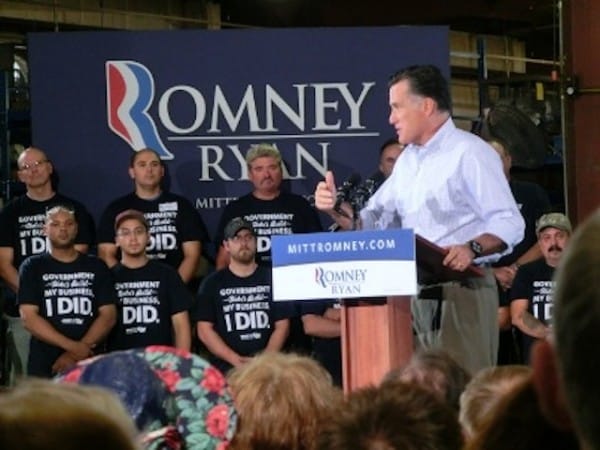
When it comes to deciding who to vote for, the independent voter has a daunting task ahead of them. The funds raised by the two mainstream campaigns, which have totaled over half a billion dollars each, are mostly appropriated towards getting the parties' messages out to the public, but how are those messages conveyed, and what are independent voters suppose to think?
The answer to this question may seem simple at first, but in actuality, it isn't. It has been widely acknowledged that both parties have been caught, and reported by the press, of blatantly manipulating the truth in order to achieve an end game. With Paul Ryan's attack on Obama at the RNC about a plant in Janesville, Wisconsin going under during his presidency, or Cecile Richard's claim during the DNC that Romney will get rid of Planned Parenthood and “turn the clock back on a century of progress,” we can see why.
The reality of both claims, after examination, is that the plant in Janesville closed under Bush’s last term and Romney has simply proposed to eliminate federal money for the program, but he didn't say he'd get rid of it.
Brian Adams, a Professor of Political Science at San Diego State University, says that the messages during political campaigns are formed from a process of “opinion polling, and focused groups that are used to find out what personal characteristics voters want in a candidate, and then the candidates try to appeal to that." This tactic can be seen all the way back from Eisenhower to Bush Jr., who when vying for the top seat on 1600 Pennsylvania Avenue, diligently told the voters who they were and who their opponent was not.
Likability is the term it has been deemed among organizations like Pew Research Center and Gallup, and among campaign managers, making it one of the most focused strategies in this years Presidential campaign.
In a recent Gallup poll, Obama is viewed as more likable than his GOP opponent, favored by 53% of voters. This is comparatively higher to his approval rating, which is just below the 50 percent mark. The concept is simple, people vote on who they like, but for independent voters on the fence, or those who crave more policy, this type of politicking translates to continued lack of policies on the campaign trail and more distorted truths.
Lauren Signorino, an independent voter and Writer's Assistant at TNT, says, “I think that the way a President is perceived socially takes precedent over the policies he will enact while in office. It's hard to trust any information you get, because everything is biased toward one side or the other.”
What Signorino feels, is what many independent voters struggles with when receiving the message of presidential hopefuls, or any politician running for office. It is clear the parties do not consider what independent voters need in order to get the right information to sway their vote, and that is the facts.
Adams believes that the distortions independent voters like Mrs. Signorino face, have always been around and “if you look back at the last few elections there are all sorts of distortions, and all sorts of misleading statements. I am not necessarily willing to say it has gotten worse, it definitely hasn’t gotten better. The focus on character, as opposed to policy is one thing, and the dishonesty of politicians is another. And I don’t think that this election is distorting the truth more than those in the past. I think we know it more with all the fact checking organizations.”
Organizations like Politifact or Politico, who stringently cover the issues and news pertaining to the political climate, are what Adams means by knowing more. We have more outlets to tell us what is what when it comes to claims on the campaign trail.
So what can independent voters do to make the most informed decision, separate from campaign rhetoric?
“There are resources out there you just have to dig through them a little bit. It won’t be on the first or second page of Google. It’s about finding a credible source of information on various policies. Certainly candidates are not credible sources of information, campaign sources are not credible, political pundits are not credible sources of information, you have to go out and find them.”
According to a recent study by Pew Research, independent voters now make up roughly 38% of the electorate; the largest it has been in 75 years, leaving 32% affiliated with the Democratic Party and 24% affiliated with the GOP. That means that independent voters makes up the largest demographic of voters in the coming election and gives them the potential to change the outcome in swing states, and ultimately the election itself. This factor, and this factor alone, makes it crucial for independent voters to absorb all the credible information they can through what ever sources possible.
The information voters need, must be void of partisan rhetoric, and must be credible and separate from the campaign landscape.
In order to obtain this knowledge the independent voter must seek out sources in news, talk radio and online sites to get the best information possible. This will help them to differentiate between grandstanding on the campaign trail and facts on the campaign trail.
Informing yourself is what any conscious voter should do, but unfortunately it is not. There are voters on both sides who vote based on likability, which should never be the case when voting someone into office. So, the burden falls on independent voters to seek out information separate from partisan rhetoric, bias and mudslinging.