The Week in Syria

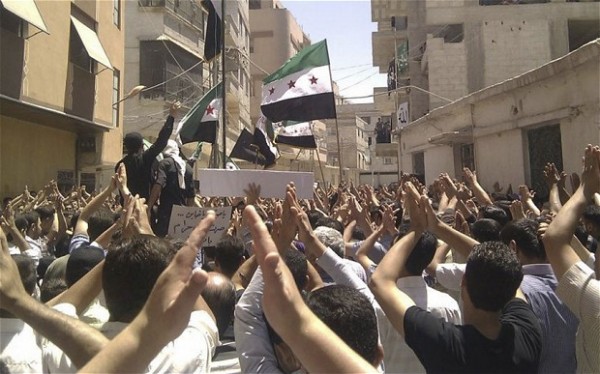
Fighting between the army of Syrian President Bashar al-Assad and the Free Syrian Army raged in the northern Syrian city of Aleppo, the largest in the country, with rebels taking land near the airport.
Professor Robert Rabil of Florida Atlantic University noted how the Turkish arming of the rebels is leading to, among other things, the withering of the territorial integrity of Syria:
"Strategically, however, the battle is about reconnecting Aleppo and its environs to its historic hinterland in Turkey, much as Homs and Hama had been historically connected to Northern Lebanon. This reconnection enhances the influence of Turkey over the opposition, represented mainly by the Syrian National Council, and provides the Free Syrian Army with a strategic route for receiving armaments from Ankara. Heavy weaponry from Turkey reportedly has already begun to be transported to the rebels in Aleppo, signifying that the attack on the city was no less a Turkish than a rebel decision."
But as Rabil readily admits, the restive Kurdish population straddling the border between Turkey and Syria may pose a problem. Decapitating northern Syria may open a can of worms:
"Ankara is jittery about the Kurds' ambivalent political position and allegiance . . . Not only have the Kurds refused to join the Syrian National Council; reportedly a significant number of them belong to the Kurdish Democratic Union Party. The party has a close relationship with the Kurdish Workers Party (PKK), which has resumed its militant campaign against Turkish authorities."
Former Syrian prime minister Riyad Farid Hijab, who defected one week ago, was reported in the New York Times saying, "Based on my experience and my position, the regime is falling apart morally, materially, economically . . . Its military is rusting, and it only controls 30 percent of Syria's territory," and that other leaders were themselves waiting to defect.
In addition to the fighting in Aleppo, there were reports of a massacre in a suburb of the capital city of Damascus. Rebels claimed that government troops committed the atrocity, describing it as an "execution." However, there have been several such "massacres" reported by activists, such as ones in Houla and Tremseh, which turned out to have been committed by rebel factions themselves, so it remains to be seen whether this report is reliable or rebel propaganda.
Meanwhile, the situation for Syria's ancient Christian population remains bleak.
As a Carmelite nun quoted in the Catholic Register described the Christians' situation:
"We know now that those people are not fighting for freedom, they are fighting for their values, and those values are not even those of moderate Islam, they are fundamentalist. . . . What has really scandalized us and leaves us in distress is that the Western world seems to be encouraging this rise of sectarian violence just to topple the (Assad) regime."
There are similar tales of the vengeance unleashed in other Arab Spring countries like Egypt and Libya where Christians have been the targets of violence because of their faith and their privileged, protected positions under the former regimes. Some groups, such as the US-based Syrian Christians for Democracy have denounced the nun, Mother Agnes Mariam, for spreading "regime lies," but the fates of brethren in nearby countries is good reason to suggest that religious tolerance is not an Arab Spring objective.

Foreign policy has played a marginal role in the 2012 presidential election, which is still more than two months away, but it is the aspect in which presidents exert the most influence. With the continued reporting and newspaper op-eds urging something, one gets the suspicion that the US election is all that's saving Assad from either Western intervention or more clandestine actions, such as those taken in Afghanistan circa 1979.
The news from Syria is, as usual, rather grim. The situation portends the potential break-up of Syria's territorial integrity and more defections from a sinking ship highlight not only the fractured nature of the regime, but are greasing the skids for a Western intervention.
But the situation still begs the question: As repulsive as the Assad dictatorship is by Western standards, what is America's interest in seeing who prevails in the de facto Syrian civil war?
Latest articles