Disturbing Trend: "Green on Blue" Attacks in Afghanistan

 Bianca Ciotti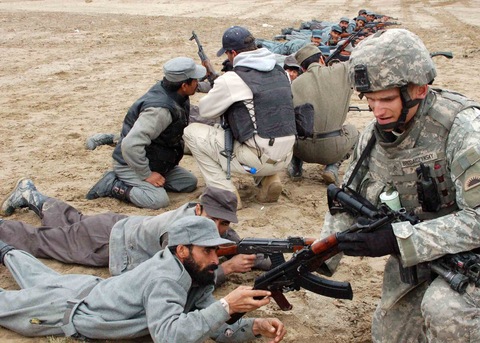
July was a bleak month for the U.S. military. In Afghanistan, July set a grim record as the most deadly month of 2012 for U.S. soldier casualties. Military higher ups are scrambling to make sense of this spike in violence.
War related casualties skyrocketed last month in Afghanistan when 40 military service personnel were killed in action. 1,961 troops have died in Afghanistan since U.S. deployment in 2001. Trends indicate that casualty rates spike in the summer months, which officials attribute to increased mobility of insurgent operations within the mountainous Afghan wild.
However, a new and disturbing trend may have contributed to this unusually high KIA rate. In a PBS interview, veteran Pentagon reporter Mark Thompson explains that American trained Afghan police recruits are turning their guns on U.S. soldiers. Two incidents of these so-called "green on blue" attacks occurred on August 17th in the Kandahar province of Afghanistan.
According to Thompson, the Pentagon believes that 50% of the attacks can be attributed to Taliban infiltrators, and the other half consist of personal attacks as a result of the high tension between U.S. and Afghan troops. In a separate segment, PBS interviewed the Washington Post bureau chief in Kabul, Kevin Sieff, about the insurgent attacks and their effect on morale.
He explained:
"...Some of them, particularly some of the recent attacks, are executed by Taliban or insurgent plants who manage to infiltrate the security forces. And they go through training, they put on Afghan uniforms, and they wait for the right moment... When the relationship is challenged by something like this, it's a really devastating blow at a really important time in the drawdown."
Beyond the negative effects on morale, these attacks may affect the withdrawal of troops from Afghanistan by 2014. When questioned about how these attacks and the counter measures taken to prevent them affect the withdrawal of troops from the region, Thompson responded:
"Number one, for the U.S. to leave...they have got to train up the Afghan national security forces... There are a lot more Afghans now being trained. And NATO will quickly point out that's one of the problems. We have got a lot more Afghans that we're interfacing with than was the case a year or two ago and that can account for some of the increase.But plainly it does hamper the handoff, and that is a big concern in the military."
"Green on blue" attacks are up 11% in the second quarter of 2012, a significant increase from 2011. Beyond contributing to the already high casualty rate in July, these attacks significantly hinder the removal of U.S. troops from Afghanistan. An eight step vetting process has been in place for six months since these attacks began increasing in frequency, but the new procedure seems to have no effect.
July may have closed as the most deadly month of 2012 for U.S. military personnel abroad, but August has already seen seven new "green on blue" attacks in the past two weeks.

You Might Also Like