
Source: bloomberg.com
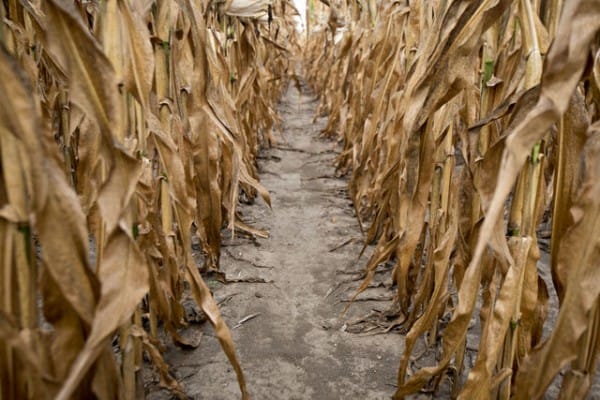
On Monday, President Obama visited farmers in Iowa affected by this summer’s severe drought. In a speech he talked about how Congress has, so far, failed to provide emergency relief to farmers or pass a new farm bill.
The president blamed House Republicans, like Vice Presidential candidate Paul Ryan, for Congresses failure to act. President Obama said of the congressman, “He's one of those leaders of Congress standing in the way." He went on to say, "If you happen to see Congressman Ryan, tell him how important this farm bill is to Iowa and our rural communities.”
Because of the stagnant reaction in Congress, the President has begun to take matters into his own hands, presenting his own version of a relief plan for the nation’s farmers. To provide some assistance to livestock producers, he has ordered the Department of Agriculture to purchase up to $170 million worth of meat, poultry, and fish from struggling farmers.
The food will go to federal food nutrition assistance programs, including food banks. The Obama Administration is making some necessary adjustments in order to aid farmers but maintains that this is not enough. On the White House drought response fact sheet states, “Congress still needs to act to ensure that the needed disaster assistance is available to these communities.”
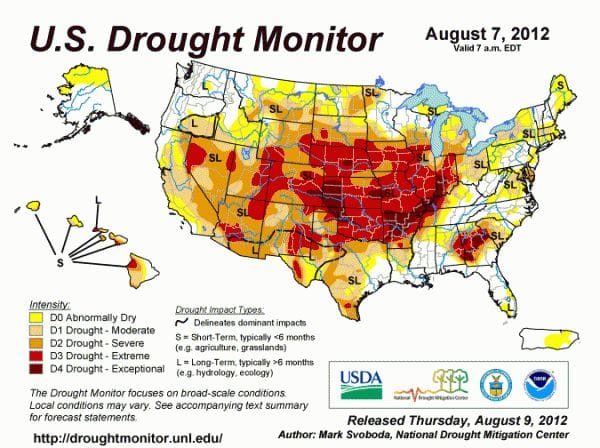
One industry that is not seeing a timely response from the president is corn. Corn growers have seen some of the worse effects of the drought. They expect 13 percent less corn yield than in 2011, marking this year’s yield the lowest in nearly two decades. As one of the nation’s most in demand products for food and fuel, this puts a major strain on livestock producers who use corn as a primary feed source. They are now forced to contend over each bushel of corn with ethanol producers. Credit: droughtmonitor.unl.edu
The biofuel industry generally purchases around 40% of nation’s corn crop, for the production of ethanol each year. This practice supported by the federal government which has, for the past five years, mandated that gasoline in the United States contain 9% ethanol. Livestock producers have asked the federal government to wave this requirement, in order to ease some of the competition over the diminishing crop.
The U.N Food and Agriculture Organization is siding with livestock producers in urging the United States to ease biofuel policies for the time being. The UN’s July food price index, indicating a 6 percent surge in food prices has prompted the organization to increase pressure on the United States.
Ethanol producers have begun to fight back to attracts to their industry, claiming that their drain on corn crops are not as great as have been claimed. According to producers, over a third of corn that is processed to make ethanol is then converted back into animal feed.
The federal government and the president are being pulled in multiple directions about how to respond to the drought. Any response is sure to receive backlash. With corn at the center of the drought crisis it will be a matter of time until we see whether livestock or biofuel will win a greater claim on the crop.