

Reuters / Kevin Bartram
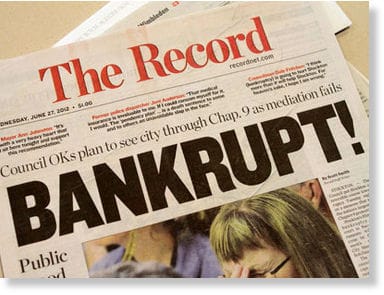
Now approaching 16 trillion, Washington DC's debt casts a shadow over federal elections and politics. Perhaps more concerning is the debt facing cities and states across the nation. States and cities cannot print money, and it is not as easy for them to obtain loans. Nations do not go bankrupt easily. Even Greece has found a way to avoid total fiscal collapse for now.
Cities and states have traditionally found it more difficult to run up massive debt. If there is one state that has become the face of America's debt problem, it is California. While the budget problems of cities in California surely include the cost of providing services and decreases in property tax revenue, extravagant pensions symbolize the fiscal problems of the municipalities.
The numbers are shocking. While not all retirees are earning huge pensions, some retirees are a tremendous burden to cities, even as they have moved on to other jobs. Russia Today records some of the examples:
"Former Stockton Police Chief Tom Morris retired with a $204,000 pension after just eight months on the job. While his California city became the largest in the US to file for bankruptcy, he moved to another city and makes an additional $76,066 salary at a new job.
Two former police chiefs in San Bernardino receive similarly high pensions. Keith Kilmer receives $216,581 annually, while working another job. His predecessor, Michael Billdt, who has no college degree and was accused of trying to bribe an officer to withdraw a union grievance in exchange for a dropped investigation, receives $205,014."
Most Americans would react to this information with shock and outrage, even disbelief. While not all cities and former employees are part of the problem, fiscal difficulties are pervasive. Reuters explains:
"The city is not alone in struggling to meet pension obligations, particularly for police and firefighters. In other California cities and in municipalities nationwide, retirement costs promised to city employees in good times are wreaking havoc with budgets in the wake of the housing market crash and high unemployment."
Why is this problem occurring? The problem has to do with city policies, often made in times of plenty. While there are surely examples of out of control private sector pensions, there are few policies that can compare to some of the perks offered by these municipalities. It all has to do with the numbers. The policies themselves allow employees to earn huge percentages of their salaries long after leaving their jobs. Russia Today says:
"Morris’ unusually high pension is not an isolated incident. City councils across California have allowed public safety employees to retire after working for 30 years and collect 90 per cent of their top salaries. But while raking in a sizable pension, they often take jobs elsewhere, while still in their early 50’s."
A pension that allows someone to earn 90 percent of their salary strikes at the very concept of wage. A wage is given in exchange for labor. The incentive for an employee to do a job and do it well is the knowledge that their work will be rewarded. When pensions reach high percentages, the incentive to continue to work and work well disappears.
These pension earners can retire early and get a job somewhere else. The concept of a pension is to provide a living for a worker after they retire. Allowing retirement early, or after a short amount of time, allows a person to live off taxpayers while earning money at another job.
This is government. These are "public servants" (a term which seems to have lost any meaning it may have had). They are to serve the people. Many of our country's first leaders served with little or no pay. Even US presidents had to worry about earning a living after leaving office. Now some city employees can live off the taxpayers, while providing no benefit to them.
This problem is made worse by the conditions of California cities like San Bernardino and Stockton. These cities are cutting services and facing bankruptcies, while still paying these massive pensions. These cities are facing fiscal collapse:
"In the past two months, the cities of Stockton and Mammoth Lakes have also filed for Chapter 9 bankruptcy protection, a special bankruptcy provision for municipalities. Stockton, which like San Bernardino has suffered from the housing crash that was particularly acute in southern California, filed for bankruptcy in June, becoming the largest U.S. city to do so."
While the checks are being sent, libraries and other government services that are used by citizens are suffering cuts:
"While local California governments continue to pay six-figure lifetime benefits for some retirees, they are slashing local police and fire services to make up for the costs. They are also cutting library hours and other public services to keep up with the payments."
It is time cities got their priorities straight. While it is true that these pensions are obligations cities can't get out of, these stories should send a message to the rest of the nation. Even when things are going well, city leaders can't lose sight of reality. Government employees are not fundamentally superior to private sector workers. They should not continue to earn nearly their full salary for years after their work is over.
The fact that the fiscal forecast is sunny for a time does not mean that extravagant pensions are possible in the long run. These are problems that really hit home. A few employees are walking away with the hard-earned money of citizens, who are deprived of the services for which their tax money was intended. Today it is a few cities in California. If the lesson is not learned, local communities are in for a long fiscal battle.