
Ron Paul, Ben Bernanke Spar on Fed Audit One Last Time

 Wes Messamore
Photo: Gage Skidmore
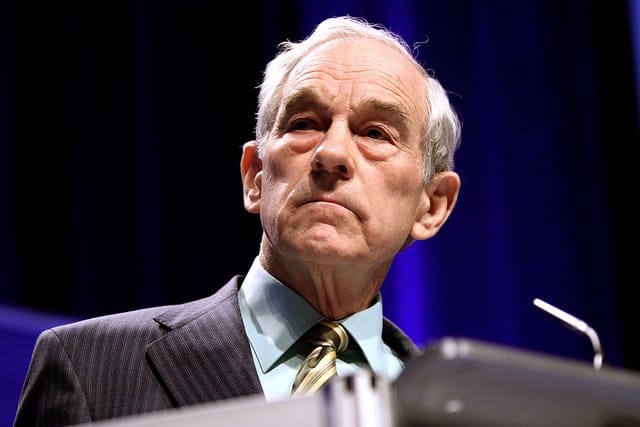
Congressman Ron Paul, who is serving his last term in the US House, had one final chance to cross examine Federal Reserve Chairman Ben Bernanke Wednesday during the chairman's testimony to the House Financial Services Committee.
In his opening remarks, Paul wanted to dispel any notion that his now notorious criticisms of the Federal Reserve System are confined to Ben Bernanke or any individual person at the helm of monetary policy, stating:
"I have, over the years obviously been critical of what goes on on monetary policy, but it hasn't been the chairman of the Federal Reserve... it's always been the system. I think they have a job that they can't do because it's an unmanageable job, and it's a fallacy. It's a flawed system, and therefore we shouldn't expect good results, and generally we are not getting results."
Ron Paul-- a 12 term congressman from Texas, a member of the Republican Party, and a one-time Libertarian Party member during his 1988 bid for president as its nominee-- left his medical practice and entered politics during the 1970s when Richard Nixon removed the last of the US dollar's ties to gold, fearing that it would have unintended economic consequences.
Since then, his political career has been defined by his focus on monetary policy, his opposition to the central banking of the Federal Reserve System, and his belief that the centrally-planned expansion of a money supply by its central bank is what leads to the booms and busts that have wrought economic havoc throughout US history, an economic theory referred to as the Austrian Business Cycle. Paul said:
"I have hoped in the past to try to contribute to the discussion on monetary policy, the business cycle, and why it benefits the rich over the poor, and so far my views have not prevailed, but I've appreciated the opportunity, and I appreciate this opportunity to have served on the banking committee."
Though it has not yet passed into acceptance by mainstream economists, the proponents of the Austrian Business Cycle theory have demonstrated an uncanny ability to predict cyclical economic activity where more mainstream economic models could not, including the stagflation of the 1970s, which more mainstream Keynesian theory had considered impossible, and the 2008 housing and credit crunch, which took most analysts by surprise.
The main focus of Ron Paul's efforts to reform the current monetary system has been fighting for the passage of legislation requiring a full, public audit of the Federal Reserve's activities. In response to the Texas congressman's calls for greater Fed transparency via public audit, Bernanke said:
"We fully accept the need for transparency and accountability, but it is a well established fact that an independent central bank will provide better outcomes... There's no constitutional reason why Congress couldn't take over monetary policy... but I'm advising you that it wouldn't be very good from an economic policy point of view."
Ron Paul rebutted:
"When the Fed talks about independence, what they're really talking about is secrecy, not transparency. What the GAO cannot audit... is that it cannot audit monetary policy... it would not be able to look at agreements and operations with foreign central banks, and governments, and other banks, or transactions made under direction of the FOMC, or discussions or communications between the board and the Federal Reserve System related to all those items. So it really, it's really not an audit without this."
He continued by referencing the $15 trillion that the Federal Reserve secretly created on its books and lent out to big Wall Street financials and foreign central banks from 2007 - 2010 during the height of the financial crisis, which the public would only later discover as a result of the limited, one-time audit provided for in the Dodd-Frank financial reform bill. Paul asked: "How did we ever get into this situation where Congress has nothing to say about trillions and trillions of dollars of bailing out certain banks and governments through these currency swaps?"

Later this month, the full US House will vote on Ron Paul's Fed Audit bill, HR 459, which has 273 co-sponsors. Paul says he expects it to fail in the Senate, but that he is confident that the prospect of a full Fed audit will not end with his political career, leaving it to one of the bill's cosponsors to reintroduce it in future sessions of Congress.
You Might Also Like


