City-State Interests Collide Concerning California Pension Reform

As the California budget continues to face major deficits, and state legislatures frantically look for ways to avoid further state economic downturn, public employees pensions have been placed on the chopping block. In June, California’s second and third largest cities passed pension reform measures with an overwhelming amount of support from voters.
The California legislature is expected to pass some type of pension reform bill in August. However, charter cities such as San Diego and San Jose have shown apprehension toward statewide pension reform. Voters in San Diego and San Jose worry that statewide pension reform could impede the recently approved pension reform policies unique to San Diego and San Jose.
Under the defined-benefit plan, public employees rely on three contributors to fund their pension plans: employees themselves, government contributions, and investment earnings. However, the three sources do not equally contribute to pension funding. Investment earnings typically have funded 60-75%.
Governor Jerry Brown, believes the root of the pension problem revolves around declining Wall Street returns:
“As Wall Street profits soared to unrealistic levels, state pension earnings grew abnormally and many California jurisdictions took advantage of what turned out to be a temporary windfall and adopted pension programs that could not be sustained.”
While previously sustainable, given the current circumstances, proponents of pension reform believe California is unable to maintain the same system given current fiscal realities. Additionally, many voters are unhappy with the percentage of city budgets that fund pensions.
A June Reuters report estimated California’s budget gap to be nearly $16 billion. This figure fails to account for California’s pension shortfall which estimated to be as high as a half trillion dollars.
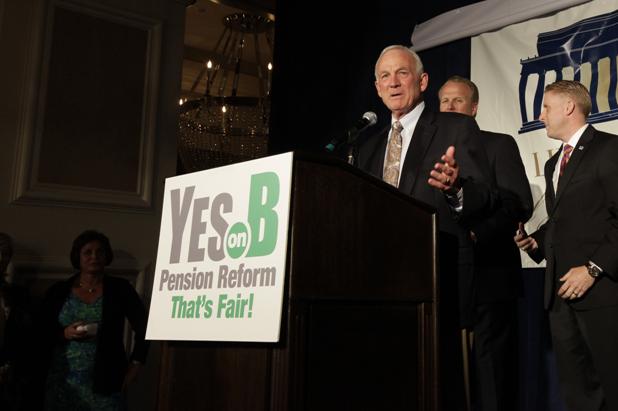
San Diego passed its pension reform plan, Prop B, during the June open primaries. The measure needed over 50% of the voters vote, and ended up garnering 66% support. San Jose also passed a pension reform plan by 70%.

In passing Prop B, San Diego will move forward in switching new city hires from a pension system to a 401(k) style retirement plan, except police officers. The city also will implement five-year pay freeze to current employees' pensionable income.
The legislation asserts, “the City's pension costs are projected to increase by more than $100 million over the next 10 years if we don't take action now. Proposition B is expected to save nearly $1 billion, which means more City money for priorities such as public works, etc.”
Critics of Proposition B claim the measure detrimentally increases retirement costs by $54 million over the first three years of its enactment. Critics also cite that Proposition B excludes city workers from the Social Security option, as well as eliminates the pension that serves as a substitute. Opponents of the bill fear Prop B will detract potential public safety workers as well as increase the difficulty of retaining such workers.
San Jose Mayor Chuck Reed responded to Gov. Jerry Brown and Senate President pro Tem Darrell Steinberg's statements regarding potential statewide pension reform:
"The California constitution gives charter cities complete authority over employee compensation, so I don't think they can undo what the voters have done," Reed toldMercury News, adding, “only a constitutional amendment could alter that.”
Jerry Sanders also displayed disapproval of a potential statewide pension reform by sending a letter to Senator Darrell Steinberg in which he wrote:
“As a charter city, it is our right and our duty to ensure that our fiscal house is in order,” Sanders wrote in the letter, obtained by U-T San Diego. “Any statewide effort to undo the reform passed by an overwhelming majority of San Diegans violates the tenet of charter cities and usurps the will of the people of our city.”
Jerry Sanders continued along the same lines in a statement included in the Los Angeles Times, that he believed voters "understand that these pension systems are simply unsustainable. They were created during a different era when people did not live as long."
“Senator Steinberg respects the will of the voters, and has made it crystal clear that as the Legislature and the Governor work toward compromise on pension reform that he has no intention of overriding the decision made by voters in San Jose and San Diego,” Senate leader Steinberg’s press secretary, Mark Hedlund said.
Despite Senator Steinberg and Gov. Jerry Brown’s efforts to indicate that the state government will not impede on the voter passed measures, pension reform in San Diego faces two legal setbacks.
According to a recent KPBS report, a Superior Court judge “issued a temporary restraining order preventing the city from implanting Prop B until July 27th.”
Secondly, the state Supreme Court “denied the city’s request to avoid going through an administrative law process with California’s Public Employment Relations Board (PERB).”
Meaning, the complaint the Municipal Employees Association filed, will be upheld. MEA filed the complaint citing that city leaders showed misconduct by supporting Prop B pension reform.
In November, candidates Bob Filner (D) and Carl DeMaio (R) will run for Mayor of San Diego. City councilmember DeMaio played an integral part in creating Prop B to reform San Diego’s pension problems, while Filner strongly opposed the pension reform plan.
Congressman Bob Filner was the only candidate prior to the primaries that openly disapproved of Prop B. Rep. Filner told KPBS, “Proposition B is not fair to employees because it gives them 401(k)'s, which are subject to the stock market, but city employees do not receive social security benefits.”
Rep. Filner plainly stated the city is "stuck with a mess, but that it needs to find a solution that's fair to taxpayers and employees.”
In response to the recent legal setbacks challenging Prop B, DeMaio released a statement addressing the court rulings:
"Prob B is now the law in the City of San Diego - and today's court decision is a procedural requirement that will ultimately have no impact on our timeline to implement pension reform. We cannot prevent frivolous lawsuits from the labor unions, but once their procedural efforts are exhausted, San Diego taxpayers will prevail and receive the pension reform they have long waited for."
Whether the measure will survive the legal setbacks and state legislation is unknown.
Latest articles