Debate Over Restrictive Voting Laws Intensifies
As the 2012 election nears, a new wave of restrictive voting laws takes center stage, drawing into question the power of these laws in suppressing voter turnout among minority groups.
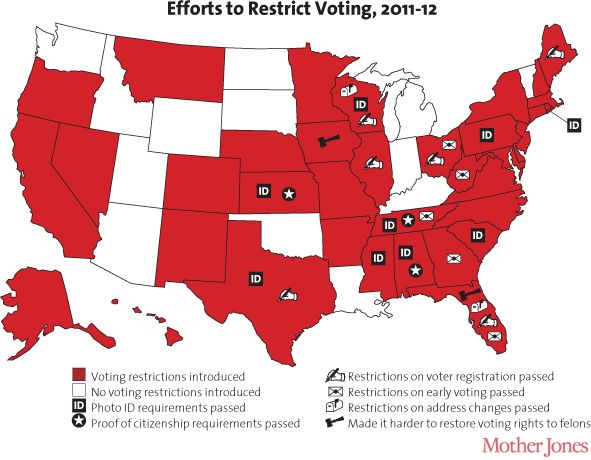
This year alone, 24 laws and 2 executive actions have been passed making it harder to vote, 47 bills are pending, and 180 bills have been introduced in 41 states. These laws would require voters to show government-issued photo identification or proof of citizenship, restrict voter registration drives, reduce early and absentee days, and make it harder to restore voting rights.
Suppressing Voter Turnout, One Law At A Time
What started out as a partisan talking point, has now escalated into a nationwide debate, with opponents arguing that these laws were put into place by Republican lawmakers in an attempt to restrict young, minority, and low-income voters.
As made evident in 2008, minority voters have an increasingly pivotal role in deciding elections. In 2008, voter turnout increased by five million from 2004, with a significant increase in voter turnout among young people, blacks and Hispanics.
Minority groups and young voters will be key in this year's election, and both Democrats and Republicans are shifting their strategies in order to target these demographics. What remains unclear, however, is Republican presidential candidate Mitt Romney's ability to appeal to these voters. Recent polls show Romney trailing Obama in support among these groups, prompting Democrats to categorize the recent wave of restrictive voting laws as a direct effort to block these groups from participation.
Voter ID Laws to Influence Outcome of the 2012 Election
Disguised as voter fraud prevention laws, the Brennan Center for Justice argues these restrictions are expected to affect more than five millions voters in states that represent over half the total number of electoral votes needed to win presidency. That's 179 electoral votes, out of the 270 total votes needed to secure the presidency.

Republicans have repeatedly argued these laws are a necessary protection against the threat of voter fraud in the 2012 election.
But Republican House Majority Leader Mike Turzai's admission that Pennsylvania's voter ID law "is going to allow Governor Romney to win the state of Pennsylvania," raises serious questions about the partisan feud over the law.
Signed into law by Republican Governor Tom Corbett, Pennsylvania's voter identification law now threatens to affect 758,000 eligible voters who do not have a driver's license or a primary form of identification. Put into perspective by the Philadelphia Inquirer, that's 9.2 percent of the state's total number of voters.
Republicans haven't won Pennsylvania since 1988, and while Turzai lists three other achievements that may influence the election, his confidence that voter ID laws will benefit the GOP politically in the 2012 election is chilling.
The Case Against Voter Fraud
As for voter fraud, the numbers are stacked against it, with little to no evidence that voter fraud caused by in-person impersonation actually exists.
After a 5 year crackdown on voter fraud put in place by the Bush administration, the Justice Department has found "virtually no evidence" of any fraud.
In Wisconsin, prosecutors have lost almost twice as many cases as they have won. And cases won involved felons who were unaware they were not allowed to vote.
Contrary to Republican National Committee Chairman Reince Priebus' claim that Wisconsin is "absolutely riddled with voter fraud," the state's voter fraud rate in 2004 was .0002 percent. That's 7 votes.
Out of the 250 claims of fraud made by the state of Indiana in the Supreme Court's photo ID case Crawford v. Marion County Election Board, not one was actualized to be caused by in-person impersonation fraud. And that's in the entire history of voting in the state.
Mother Jones reports: A 2005 report by the American Center for Voting Rights claimed there were more than 100 cases of voter fraud involving 300,000 votes in 2004. A review of the charges turned up only 185 votes that were even potentially fraudulent.
Furthermore, only 26 voters have been convicted for federal election-related crimes, i.e. voter fraud.
Political participation is the cornerstone on which our system of government was created and the defining characteristic of democracy. In a government created by the people, for the people, shouldn't we be celebrating civic engagement, not suppressing it?
Latest articles