Election in Libya Will Reveal Consequences of Intervention
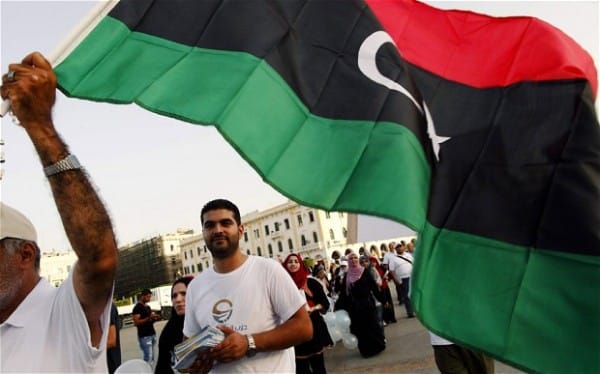
By Carl Wicklander | 07/08/2012 | Headline, War and Foreign Policy | 2 CommentsOn July 7 Libyans began voting for the first time in decades.
The reason for the vote is to elect a General National Council to succeed the National Transitional Council that ruled in the wake of the deposal of Moammar Gaddafi last year and subsequently write a constitution.
As of this writing, the expected winners will be the Muslim Brotherhood’s Justice and Construction Party, the secular Alliance of National Forces, National Front Party, and the al-Watan party founded by veteran Afghan fighter Abdel-Hakim Belhaj. Interpretations of the elections will surely abound, but it is the Islamist parties which are expected to do best.
It will likely take some time before it is clear what kind of government will emerge in Libya, but one of the common threads throughout most reporting on the Libyan elections has been the perpetuation of regional rivalries with an emphasis on personalities.
Like Iraq, Libya is an artificial construction whose borders were drawn by imperial powers. Therefore, there isn’t a clear definition of Libyan national identity in the modern Western sense. The three ancient regions of Tripolitania, Fezzan, and Cyrenaica that comprise modern Libya are rivals and their history is evident in this election. As Alison Pargeter writes at Foreign Policy:
“The intense localism that has emerged is also symptomatic of Qaddafi’s failure to stamp a sense of ‘Libyanness’ on the country. His long rule only served to intensify, rather than reduce, regional divisions. Always wary of the east given its links to the former monarchy, the colonel clamped down heavily on the region after it became the focus of an Islamist rebellion in the mid-1990s. . . . The east, it seems, has been unable to shake off a perceived sense of marginalization. In its most extreme form, this resentment has manifested itself in a movement for semiautonomy and a refusal to participate in the election.”
The possibility of another broadly Islamist-dominated regime coming to power is indeed likely, especially in a country that has been repressed for decades. As Mohamed Yusuf al-Magariaf, president of the National Front Party said in the Washington Post, “It’s a personality contest. . . . Libyans tend to play solo. Collective teamwork is not in our culture or our history.” Likewise, Ali Tarhouni, a Libyan-born professor at the University of Washington said of his people, “We are not educated, and we do not know about political parties.”
It remains to be seen whether Washington will have sufficient overview of the new regime. Rebels have a tendency to turn on their patrons and make a wash of the whole operation. But statements like those above do not create much hope that a liberal democracy is about to sprout in the northern Sahara. The much more likely scenario is that a regime will emerge that resembles the last one, but with more compliance to Washington’s wishes. Otherwise it will be one marked by continued militia violence and potential break-up.
The Western-led intervention that made these elections possible has produced some troubling results that are not confined to Libya. The most far-reaching thus far has been the turmoil unleashed in nearby Mali.
The power vacuum created by Gaddafi’s demise allowed caches of weapons to flow into Mali and into the hands of ethnic Tuareg rebels aligned with al Qaeda in the Maghreb. The result has been an attempted coup d’etat in the north and the destruction of rivals’ religious shrines in what has been one of the more tolerant countries in Africa.
Veiling a policy of regime change under the rubric of the Responsibility to Protect doctrine has already produced embarrassing results outside of Libya. An electoral outcome in Libya that exacerbates ethnic and religious tensions or alienates the West would be icing on the cake of a Western world that has no concept of national interests.


Leave Your Comment →
2 Comments
Faith Eischen
07.09.2012
@faitheischen
Consociationalism poses a huge threat to the livelihoods of states. With consociationalism, communal ethnics accept the fact that the “melting pot,” doesn’t work and we have therefore critical problems may come up in the future…states are going to be confronted with citizens who have multiple identities and competing loyalties.
Nikos Retsos
07.11.2012
Why should Washington have “an overview of the new regime?” Elections mean self-determination, don’t they? We know what the U.S. overview did with its CIA death squads in Central and Latin America, don’t we?
The Libyan elections were surely a step towards stability. But the Libyans must look over their shoulders, and be suspicious on how Libyan expatriates were imported by the Western powers early in Benghazi, and how they ascended to the top posts. At the same time, the U.S. was pushing hard to have the Libyan militias disarmed – to make easier for its stooges to take over Libya. The Libyan Rebel Commanders suspected the rush by the West to take over Libya and refused to disarm. They are still on guard of all the foreign imported stooges amongst them!
Mr. Jibril was one among other confidantes Westerners grabbed by the CIA, the British, and the French intelligence that landed in Benghazi with a mission to take over post-Gaddafi Libya. That team promised help to the TNC to overthrow Gaddafi on the condition that Libya won’t become an Islamic state. As proof, the TNC was required by the terms to appoint to top post of its leadership people recommended by the West. The TNC complied, and the West pushed the U.S. Security Council Resolution that allowed its air forces to bomb the Gaddafi regime, which helped the Libyan Rebels to topple him.
Mahmud Jibril was then pushed by the U.S. into the Prime Minister’s job! Then Jibril appointed Khalifa Hiftar -another Libyan U.S. expatriate- as Supreme Commander of the New Libyan Army, even though he was a suspect in the assassination of General Fatah Yunis, the first TNC appointed commander of the New Libyan Army! Both were U.S.citizens living in the states who suddenly rose to the top of TNC without having offered anything to the Libyan Revolution – as I have written in my blog at: (my.telegraph.co.uk/retsos_nikos/)
Shortly after his appointment, Jibril and Khalifa Hiftar tried to take over Libya’s Tripoli Int’l Airport from the Commander who liberated Tripoli from Gaddafi’s forces, Abdelhakim Belhadj. (Belhadj was arrested by the CIA in Thailand as an Al Qaeda recruit, and he claims to have been tortured; he is certainly not one the U.S. would like to see in any future Libyan leadership position) Belhadj’s militia defended the airport, and then Belhadj and other powerful militia commanders demanded from the TNC the dismissal of Jibril and Hiftar. The TNC was forced to oust them. Now Jibril surfaced again at the top in Libya -without firing a shot during the Revolution, but with heavy U.S. backing of his campaign! And it seems to me that those who fought the Libyan Revolution may end up being the losers, and those who could buy the elections with foreign support may end up as the winners!
I don’t have any doubt that the U.S. spent $$$ millions clandestinely to boost Jibril’s campaign. Nor I have any doubt that Jibril will re-appoint Khalifa Hiftar if he has a chance, and then they will try to build a Libyan army that will take its orders from Washington – as the Egyptian Army does today! I believe Jibril is designed and heavily backed by the U.S. to be the future Mubarak of Libya! That is certainly not the kind of stability that the Libyans want for the next 30 years!
Nikos Retsos, retired professor, USA